

Tag: gay

  • From Protests to Profits: Is Pride Back at Square One?

    From Protests to Profits: Is Pride Back at Square One?

    Illustration: Harjyot Khalsa, www.harjyotkhalsa.com

    As Pride celebrations grow and proliferate, they often become sites of controversy: What is being celebrated-the diversity of the community or just the visibility of a select few? Who gets to take part in this celebration, and who is left out or sidelined? From corporate sponsorships to grassroots protests, author Ahmed Awadalla examines the ever-evolving landscape of LGBTIQ+ Pride in Germany.

    Berlin stands apart. If you ask someone in the city about attending a Pride event, they'll likely respond with another question: "Which one?" This is the essence of Berlin-a metropolis that hosts a multitude of queer marches and initiatives, each with its own distinct priorities and vision of the LGBTIQ+ experience. In a city this vast, with its diverse communities and subcultures, there's always a space where one can feel seen-or at least, it seems that way.

    Having lived in Berlin for years, I've witnessed the Pride landscape shift and evolve, with each event embodying a different interpretation of queerness. What first stood out to me during my early summers in the city was the name "Christopher Street Day" (CSD)-a direct reference to the American Stonewall Riots. These riots erupted in response to persistent police harassment following a raid on a New York bar. Although a pivotal moment in queer history, the choice felt curious, if not a little dissonant, considering Germany's deep history of advocacy for queer rights.

    Naturally, when I first arrived in Berlin, I was eager to join a queer march in the hope of finding community and connection. My first march wasn't a typical Pride event but a protest organised by Nasser Al-Ahmad, a young Lebanese man who faced brutal violence from his family after coming out. The march began outside a mosque in Neukölln to challenge the role of religious institutions in promoting homophobia. Despite Nasser's efforts to emphasise that homophobia wasn't just "a Muslim problem," media coverage framed the issue as a clash between queer and migrant communities, pitting them against each other.

    As I marched, I quickly noticed how out of place I felt in the predominantly white crowd. At one point, a woman asked me to move aside, assuming I wasn't part of the protest, likely because of my appearance. This made me question my own belonging in a space that was supposed to be about solidarity and plurality. It highlighted the uncomfortable reality that even within queer spaces, not everyone feels welcomed or understood. Different people I spoke to had their own take on what Pride means to them. For some, it feels like home, while for others, it remains a space where their struggles are made invisible.

    Between Celebration and Commercialisation

    The first German CSD took place in Berlin in 1979, inspired by American Pride events but soon adapted to local politics. What began as passionate protests for LGBTQ+ rights has, over time, turned into something much more mainstream and commercialised. Big companies and political parties now play a more significant role. This trend is part of a larger pattern called "rainbow capitalism," where businesses use LGBTQ+ symbols and slogans for profit, while urgent issues facing the community, especially those on its margins, are pushed aside.

    "Honestly, I couldn't stand it," said Mahdi, a community member who left CSD Berlin this year after just 10 minutes. "Pharma companies, banks, and internet giants-what do they have to do with our struggle?" Mahdi's frustration is palpable. For him, the sight of straight people occupying corporate floats felt like another layer of erasure. "I get that allies are important, but they need to be mindful of the space they take up," Mahdi added, reflecting a common sentiment among those who feel mainstream Pride has lost its way.

    But not everyone shares this sense of alienation. "For me, my reasons for going to CSD are two-fold," said Cameron, a regular CSD attendee. "The principles of Pride are still very worthy. It's a day where we can celebrate our LGBTQ+ identities and reflect on how we're not just tolerated but accepted and even celebrated by wider society." Cameron acknowledges the criticisms about corporate influence but admits that, for him, it doesn't overshadow the event's value. "Yes, the parade has been hijacked by corporate interests, but the party atmosphere-dancing in the rain to Spice Girls with queer folks from all over the world-is still magical. It's just fun!"

    Cameron recognises his own privilege within these spaces. "I haven't felt excluded because I fit the classic stereotype of a white gay male. I can see why others might feel less represented," he admitted. Hassan, a gay man of colour, shares Cameron's sentiment: "My birthday aligns with CSD Berlin, so my friends visit me from other cities, and we get to experience this collective joy, dressing however we want. It's a time to truly celebrate together."

    Tensions Under the Rainbow

    While some are disillusioned by Pride's shift away from its radical roots, others appreciate it as a space for self-acceptance. But this raises a fundamental question: Should Pride be about identity or action? Is it enough to reclaim our identities as a response to the shame society imposes, or should Pride be about taking meaningful steps towards change? And if so, what kind of action?

    These debates aren't new. In the 1990s, the group Gay Shame emerged in the U.S. to challenge the focus on identity and visibility over activism. They argued that simply transforming shame into pride wasn't enough without confronting systemic oppression through tangible actions like supporting trans rights and fighting against economic inequality. Their stance echoed the message: "None of us is free until all of us are free."

    In Berlin, I found a similar spirit at Alternative CSD (Kreuzberg Pride), which rejected corporate sponsorship and focused on grassroots activism, taking on issues like poverty and gentrification. But internal conflicts eventually led to its end, showing that even in activist spaces, disagreements can break down solidarity. After a hiatus, Internationalist Queer Pride emerged in 2021 with a bold political stance that demands revolutionary action to dismantle all forms of oppression. They advocate for environmental justice, decriminalising sex work, supporting indigenous and migrant rights, and abolishing border regimes

    "It's empowering to see so many diverse groups coming together for a bigger cause," says Andreas, a cis white queer man who attended this year's Internationalist Queer Pride (IQP). However, he adds, "This year's event was traumatic for many participants due to the police's excessive use of violence." For Andreas, this repression is reminiscent of the early days of queer activism, like the Stonewall riots, when police were viewed as a threat, not allies. This controversy around the police's role is also present on a global scale. For example, Pride Toronto banned police participation following concerns about police brutality and racial profiling raised by the Black Lives Matter movement.

    Dozens of arrests were reported during Internationalist Queer Pride (IQP) this year, directly linked to one of the most contentious issues in Germany: the ongoing atrocities in Palestine. Demonstrations in solidarity with Palestinian communities have frequently faced severe police crackdowns, viewed as an unprecedented restriction of free speech. Germany's stance is often framed through the concept of Reason of statewhich reflects the country's commitment to protecting Israel's security due to historical responsibility for the Holocaust. Critics argue that this has translated into unconditional support for Israeli violations of international law.

    The Dyke* March and The Persistence of Patriarchy

    The Dyke* March, which began in the 1990s to promote lesbian visibility, has since expanded to include women, trans, and non-binary individuals. Cisgender men are asked not to participate, creating a space where these voices and experiences are centered without being overshadowed. Like Kreuzberg Pride, the Dyke* March remains focused on activism and intersectionality, resisting the trend towards commercialisation. However, police violence was also reported at this year's Dyke* March, on the backdrop of Palestinian solidarity.

    Two people I talked to have been regularly attending the Dyke* March. Sarah thinks that patriarchy is still a problem within the queer community and that it manifests in how many queer spaces cater primarily to the male experience. "Yes, there are more FLINTA* spaces and events now, but it's still not enough," she said. "We need to keep pushing for real change, not just more visibility." Mar, who identifies as non-binary, also finds it important to attend: "I can be read as a cis male because of my appearance, but I think building a shared understanding shouldn't be based solely on appearance. The experiences of not feeling safe in our bodies and in public spaces are significant things we should come together based on."

    Right-Wing Return and the Full Circle

    While the tensions between police and demonstrators in Berlin may seem like a historical throwback to the early days of activism, another issue warrants serious attention. In 2024, right-wing groups in Germany have increasingly targeted Pride events, particularly in East Germany. These anti-CSD marches are part of a broader trend of rising nationalism and xenophobia in the country. Although images of neo-Nazis in places like Bautzen have generated significant concern on social media, a persistent narrative in German politics portrays homophobia, transphobia, and anti-Semitism as problems imported from elsewhere. This downplays the actual threat posed by right-wing groups that have demonstrated their presence both on the streets and within the German parliament.

    There is no better lesson than the one we are learning now: we must understand issues of xenophobia and injustices related to gender and sexuality as inseparable. With the current existential threats, Pride seems to have come full circle, and we must confront the question of what it means to gather collectively and for what purpose.

  • Intersectionality: What does that mean?

    Intersectionality: What does that mean?

    The history of the term "intersectionality" begins in the 1980s. At the end of this decade, the African-American legal scholar Kimberlé Crenshaw looked at legal rulings following discrimination claims in court. She noticed that the legal system had a number of gaps. The case of DeGraffenreid v. General Motors. At the end of the 1970s, the car manufacturer General Motors had almost all Black workers were dismissed. General Motors was then sued. The accusation: the company was acting in a racist and sexist manner.

    The court did not recognise the discrimination

    However, the court ruled that this could not be a case of racism: After all, there were still people working at the company Black Men. According to the court, this could not be sexism either. After all, many women still worked in the company: white Women. The court considered racism and sexism to be separate phenomena.

    Kimberlé Crenshaw criticised the fact that racism and sexism cannot be viewed separately. Rather, the two forms of discrimination are intertwined here. She called this entanglement "intersectionality". The term comes from the English word "intersections", which means "intersections". And this shows how intersectionality is often misunderstood: It is precisely not is a mere addition of sexism and racism. Rather, this intersection creates a completely new form of discrimination. This means that this Black women have had experiences that neither Black Men, still white Women experience.

    Intersectionality is not an addition of discrimination

    Of course, the same applies to the diversity of gay, bisexual and other men who have sex with men. A Black gay man has experiences that white gay men don't have. He also has experiences that Black heterosexual men do not have. In the same way, a gay trans* man has experiences that neither heterosexual trans* men nor gay cis men have. And similarly, a gay man who uses a wheelchair experiences discrimination that neither non-disabled gay men nor disabled heterosexual men do.

    This is what is meant by the concept of intersectionality. It calls for a sharper focus on mechanisms of discrimination and more attention to detail. Otherwise, we run the risk of not recognising discrimination as such. As was the case in court at General Motors. Kimberlé Crenshaw himself commented on this:

    "Intersectionality is a lens through which you can see where power arises and collides, where it intertwines and intersects. It's not simply a question of there being a race problem here, a gender problem here and a class or LBGTQ problem there. This framework often ignores what happens to the people who are affected by all of these things."

    Kimberlé Crenshaw
  • Mpox containment: success of the community?

    Mpox containment: success of the community?

    They were headlines that nobody wanted to read: In May 2022, in the midst of the coronavirus pandemic, the media reported a "monkeypox outbreak" in Europe. The virus soon spread across the continent at a speed that worried experts.

    However, the majority of the population soon seemed to breathe a sigh of relief. It is true that "monkeypox" is not a sexually transmitted disease in the strictest sense; the virus can be passed on through close skin contact. However, the vast majority of those infected were, and still are, men who have sex with men. According to the Robert Koch Institute, out of a total of 3,670 cases nationwide (as of 6 December), only 19 female cases, four cases in male adolescents and two cases in children under 14 years of age have been reported to date.

    In international reporting, this led to "monkeypox" soon being incorrectly labelled as a "gay disease" by some media outlets. For some, this brought back dark memories of the media's discriminatory and erroneous handling of the AIDS crisis in the 1980s. Back then, HIV and AIDS were also dismissed as something that only affected gay men. 

    Stigmatisation of the communities

    "Because the group of gay and bisexual men made up the majority of cases, some of the reporting made it sound as if it was a disease that only affects gay men," says Timo. The 27-year-old student lives in Berlin and actually goes by a different name. However, because the topic is still associated with stigma, he prefers to remain anonymous. "The name 'monkey pox' felt very discriminatory," he continued. 

    The World Health Organisation (WHO) has also recognised that the name "monkeypox" has a stigmatising effect on those affected. "Following consultations with global experts, the WHO will begin to use the new preferred name Mpox as a synonym for monkeypox." These are the words of a statement from the organisation.

    "In clubs, women have said to me that they don't want to drink from my bottle because we gays are dealing with monkeypox"

    Timo

    But it wasn't just the reporting that Timo found problematic. It was also difficult for him how people outside the community dealt with the outbreak: "In clubs, women said to me that they didn't want to drink from my bottle because we gays have to deal with monkeypox," reports the Berliner-by-choice. 

    However, the most inglorious role during the Mpox outbreak was probably played by the state. Its actions or inaction during the peak phase left many perplexed and angry. This is because the vaccination campaign against the virus was delayed in many places - even when the vaccine was already available in some cases. It almost seemed as if nothing had been learnt from the coronavirus pandemic.

    Failed vaccination management and its far-reaching consequences

    Berlin, of all places, attracted negative attention with its consistently unsuccessful vaccination management. Yet the city was Germany's Mpox hotspot, and nowhere else were as many people infected with the virus as in Berlin. According to the Daily Mirror the metropolis was storing around 8,000 vaccine doses that could not be administered due to bureaucratic obstacles.

    Holger Wicht, press spokesman for Deutsche Aidshilfe, told the rbb"Those responsible have to ask themselves whether they really take the protection of those affected, especially men who have sex with men, seriously."

    "Those responsible have to ask themselves whether they really take the protection of those affected, especially men who have sex with men, seriously."

    Holger Wicht, press spokesman for Deutsche Aidshilfe

    The failed vaccination management not only meant that those willing to be vaccinated did not get the vaccine and the risk of infection remained high - but also had much more far-reaching consequences, according to Dirk Sander, also from Deutsche Aidshilfe: "There was also anger and sadness in the communities because people had been looking forward to a relatively corona-free summer. The psyche of some was not the best. I also heard from the scene that the consumption of alcohol and other drugs during this time was 'partly suicidal'."

    According to Sander, many gay and bisexual men simply felt left in the lurch: "Statements such as: 'They should keep their feet still, then they won't need a vaccination' have contributed to this feeling," he explains. 

    Timo also knows how difficult it was to get a vaccination at the beginning: "I tried to get a vaccination appointment with my GP." But he was told to try again in four to six weeks. The student was also put off calling the specially set up vaccination hotline. He quickly felt disillusioned - and the feeling that he was on his own. 

    Containing the virus thanks to the communities

    He therefore decided to proactively limit his sexual behaviour. "Friends told me how painful an infection can be. It just worried me too much," he explains. He was also afraid of the three-week isolation. "Having to spend three weeks alone in my flat in the middle of summer - I was just too scared of that." 

    Maurice, who actually has a different name, and his partner, with whom the 29-year-old lives in an open relationship, also decided to take action themselves: "We radically renounced any sexual adventures," he reports. And he also had to wait a long time for a vaccination: "I wrote to 25 practices until I got an appointment after about three weeks," says Maurice. 

    "It has already been proven that gay and bisexual men adapted their behaviour after the first media reports. Otherwise, the course of the epidemic would be inexplicable."

    Dirk Sander, German AIDS Service Organisation

    Like Timo and Maurice, many other men who have sex with men have also restricted their sexual behaviour. Sander says: "It has already been proven that gay and bisexual men adapted their behaviour after the first media reports. Otherwise, the course of the epidemic would be inexplicable. The vaccinations came quite late and then bit by bit." According to the RKI, the number of Mpox cases has been declining since August, with only single-digit case numbers reported since mid-October. During the peak phase, there were 420 cases per week.  

    A success that the communities, not the state, can take credit for. But does the Mpox outbreak have long-term consequences? Have gay and bisexual men possibly lost the fun and desire to have sex? Sander says: "Based on internal statistics from the leisure sector of gay men, you could clearly see that the mood was changing again: after more and more people were vaccinated and the numbers fell, behaviour returned to normal. Fortunately!"

    According to the Standing Committee on Vaccination (STIKO), the vaccine is now available throughout Germany. Anyone who has only received one dose or none at all should now be able to get an appointment quickly and easily. The expert group advises anyone who has only received the vaccine once to get a second dose. Anyone who has not yet been vaccinated should do so, according to the STIKO. "The outbreak is not over yet..." 

    More info about Mpox
    Fortunately, Mpox usually heals on its own, but can have very unpleasant and painful symptoms. The best protection is vaccination. It is free of charge and also possible for people without an insurance card.

    You can find all the information in German, English, Ukrainian and Russian at www.iwwit.de/mpox.
  • 5 questions for the Gay Health Chat

    5 questions for the Gay Health Chat

    Hello Klaus! Congratulations on five years Gay Health Chat! What exactly is the Gay Health Chat and who is it aimed at?

    Thank you very much!

    The Gay Health Chat is an internet counselling service. It works without registration and is free of charge. It is aimed at gay men and all men who have sex with men. This also includes trans* men, as well as non-binary and gender non-conforming people who feel they belong to the gay community.

    Why was the Gay Health Chat created?

    Small counselling centres and AIDS service organisations simply don't always have the money or resources to set up an online chat. With Gay Health Chat, Deutsche Aidshilfe provides the technology and ensures good quality. The counsellors then join in from 46 counselling centres: from Austria, Germany and Switzerland.

    Who advises at the Gay Health Chat and how are the counsellors trained?

    Everyone who works for us has been trained as an HIV/STI counsellor by Deutsche Aidshilfe. And we regularly train everyone in online communication, because it is much more difficult to assess how the other person is doing when typing and without visual contact. This year, we are also adding additional training to become first aiders for mental health problems. Our counsellors are all gay or queer themselves and work, for example, at gay checkpoints, in the IWWIT team or at AIDS service organisations - a very colourful mix.

    What kind of questions do people come to the Gay Health Chat with?

    Most of the questions have to do with sex. We're the AIDS service organisation and we know our way around that particularly well. But since corona, more and more people have been chatting to us because they feel like shit, are lonely and can't cope. We can help them too.

    Which topics are people perhaps not yet so aware of, but which you can still advise on?

    We talk a lot and have learnt a lot about drugs during sex in recent years: why is it particularly hot and what steps are necessary when it's no longer fun - we can now offer good help. In addition, every counsellor has experienced coming out as a gay man and can therefore understand everyone else who is currently dealing with this issue. How can I become a self-confident, courageous person in this world? That is our goal.

    Klaus, thank you very much for the interview!

    You can reach the Gay Health Chat at gayhealthchat.com.
    You can find everything about gay life at iwwit.de/gay-life!
  • The last 175 prisoner of the Federal Republic of Germany

    The last 175 prisoner of the Federal Republic of Germany

    Prison for consensual gay sex: the last 175 prisoner was only released from prison in 2004 after serving a ten-year sentence. Manuel Izdebski on an unbelievable story and the insanity of the Criminalisation.

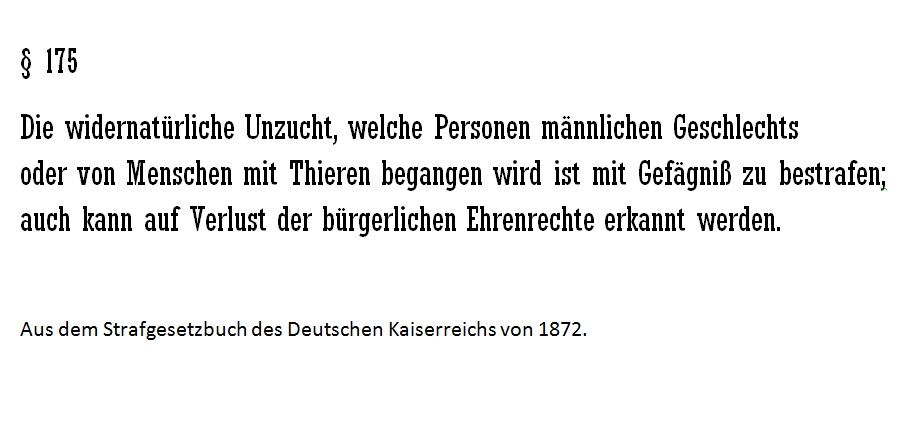
    The Federal Republic sentenced around 50,000 gays after Section 175 of the German Criminal Code because of their homosexuality. It was not until 1969 that consensual sex between adult men was no longer punishable - at that time, adult still meant at least 21 years old.

    Historical overview of paragraph 175

    1871

    Section 175 was introduced under the German Reich Penal Code. It criminalised sexual acts between men and shaped the state’s persecution of homosexual men for decades.

    1935-1945

    Under National Socialism, Section 175 was made considerably more stringent. The broadening of the scope of criminal liability led to systematic persecution, convictions and deportations.

    After 1945

    Even after the end of the Nazi regime, Section 175 remained in force for the time being. It was only through gradual reforms and social change that it was completely abolished in 1994.

    The detailed history of Paragraph 175

    However, the paragraph remained in a youth protection version until 1994 and provided for a different age of consent for heterosexual and homosexual contact: While homosexual acts with minors were generally prohibited, an absolute age of consent of 14 years applied to heterosexual contact.

    An additional 4,500 convictions were handed down between 1969 and 1994. One of the victims of this criminalisation was Frank Schneider*, who was sentenced to ten years in prison in a spectacular appeal trial in 1994. His offence: He had consensual sex with a 17-year-old teenager on several occasions when he was in his early 30s.

    Paragraph 175 of the German Criminal Code (Paragraf 175 StGB) existed from 1 January 1872 (entry into force of the Reich Criminal Code) until 11 June 1994.

    Imprisonment until the end - despite the abolition of Paragraph 175

    Schneider is regarded as the last 175 prisoner in the Federal Republic of Germany. He was only released from prison in 2004 after serving his entire sentence. Three petitions for clemency and several applications for early release after serving two thirds of his sentence were rejected by the judiciary. The fact that his offence was no longer a criminal offence only a few months after the trial due to the abolition of Paragraph 175 was of no consequence, as Schneider had a relevant previous conviction: he had already been convicted once for having sex with a 16-year-old teenager - not a criminal offence for heterosexuals.

    "While we were already dancing at a CSD, others of us were still in prison," comments historian Alexander Wäldner on the case. He has been researching the persecution of homosexuals for 15 years. He became aware of Frank Schneider's fate by chance: "We didn't even think that someone could still be in prison," he says.

    The consequences of the conviction - a ruined life

    Schneider now lives a secluded life far from home in a foreign city. He is an early retiree and has to supplement his small pension with basic income support. The conviction has destroyed his middle-class existence. All his possessions were liquidated during his imprisonment. As a convicted sex offender, he was never able to regain his footing and find a job. He declined an interview request despite assurances of anonymity. Schneider does not want to remember this dark chapter of his life story. Alexander Wäldner kept in touch with him via a third party. He describes him as a man from a humble background who earned his living as a labourer before his prison sentence and had never developed a gay identity. His simple education also proved to be a disadvantage during the trial. "Others would have been able to present themselves better in court," explains Wäldner.

    The insanity of criminalisation

    Schneider's fate bears witness to the insanity of criminalisation. The German judiciary once again used him to harshly persecute homosexuals, just a few months before the final end of the notorious paragraph.

    Schneider is one of the groups of cases that can claim compensation as a victim of Paragraph 175, according to the key points paper by Federal Minister of Justice Heiko Maas. The Bundestag must now pass a corresponding law that also rehabilitates the convicted men.

    "You can't make amends," says historian Wäldner, "but you can set an example!"

    *Name changed by the editors


    Frequently asked questions about the term „175“

    The term „175“ often appears in connection with the persecution of homosexual men in Germany.
    Here we answer key questions about the meaning of the term and its historical context.

    What does the term „175“ mean?

    Men who were convicted under Paragraph 175 were referred to as „175ers“. The term was not an official legal term, but an informal designation for those affected by state prosecution.

    Why was Paragraph 175 so momentous?

    Paragraph 175 criminalised sexual acts between men. This meant that homosexual men could be persecuted, imprisoned and socially marginalised for decades - often with lifelong consequences.

    Why were „175ers“ still in prison after 1945?

    Paragraph 175 was not immediately repealed after the end of National Socialism. In the Federal Republic of Germany, even the stricter Nazi version continued to apply for a long time, which is why convictions were still possible after 1945.

    Why did the abolition of Paragraph 175 have no effect on some of those affected?

    In many cases, previous convictions continued to be regarded as aggravating offences. Even if the paragraph was later abolished, this often had no legal consequences for men who had already been convicted.

    Why is the term „175“ still relevant today?

    The term symbolises state injustice and the long persecution of homosexual men. It is a reminder that legal discrimination can destroy real lives.

    Blog posts about queer history and enlightenment

    Exciting articles on queer history, social debates and political developments.

    Need someone to talk to?

    Whether acute or simply for orientation - sometimes it helps to talk to someone in confidence.
    Use the Gay Health Chat - the button at the bottom right will accompany you on the page. There you can chat anonymously and free of charge:

    - Personal live advice in the chat
    - Help by e-mail or telephone
    - Information on health, law, everyday life and more

  • Interview: Lutz has MPX ("monkeypox")

    Interview: Lutz has MPX ("monkeypox")

    Lutz, how are you?

    At the moment, eleven days after the early symptoms, I'm doing well again and have almost recovered. I already felt better on the third day, luckily it passed quickly for me.

    You are the first MPX, or "monkeypox" case in the Rhein-Erft district. How did you realise that something was wrong?

    On the night of 25 May, five days after my return from my holiday in Maspalomas, the symptoms appeared: Lymph node swelling in the groin area, a fever of 39 degrees and a smallpox in the genital area. In my case, it took about two weeks from the suspected infection in Gran Canaria for the first symptoms to appear. I realised that it was MPX, or "monkey pox", because an acquaintance of mine - who I met by chance on holiday - had tested positive three days before me. He told me about the symptoms and advised me to look out for something similar. So when I had the same symptoms, I went straight to the emergency department at Cologne University Hospital, where they carried out a smallpox smear and PCR. On Friday 27 May, I got the call that I had tested positive.

    Would you like to tell us how you got infected?

    Probably at the Maspalomas Pride. I met my German friend by chance at a party there. We both had close physical contact there, but also afterwards with others at private sex parties. There were lots of people from different European countries there. Among them was a Berliner who also got infected in Maspalomas.

    How did your infection progress?

    The fever went away quickly in two days, but the swelling of the lymph nodes persisted for a week. Now they are only slightly swollen, not as much as before. I had four smallpox, one on my genital area, one on my right upper arm, one on my bum and the fourth on my head under my hair. At first they looked like normal pimples, then they had a whitish crust with fluid inside, about a centimetre in size. Three of them are now barely visible. The one in the genital area will take some time to disappear. I didn't have to take any medication, they heal on their own.

    "21 days of isolation is very hard for me."

    It sounds hard, being alone in isolation with a virus that only a few people in Germany have.

    But I'm not afraid of the disease, because fortunately I have a very mild course. However, 21 days of isolation is very hard for me. I feel very lonely and alone during this time: I write and phone a lot with friends, family and acquaintances. That helps me.

    And how was the communication with the health authority?

    Immediately after my positive test result on 27 May, the public health department called me and told me that I had to go into quarantine for at least 21 days. They also asked who I had been in contact with. They also call me regularly and ask about the development of my symptoms. In my case, the quarantine ends automatically when everything has healed without me having to be examined by a doctor again, but the health authorities take different approaches here.

    "I believe that there could always be individual cases due to the contacts, but that a pandemic will not occur."

    Do you think there could be an outbreak in Germany?

    The virus is not at all easy to transmit, you have to make an effort: We had very close physical contact. I believe that there could always be individual cases as a result of contact, but that there won't be a pandemic.

    "It's true that we are severely affected, but I don't like the idea of talking about a risk group."

    Some expressions are used in the media that could promote stigmatisation and discrimination against gay and bisexual men. How do you perceive this discussion now?

    It is partly stigmatising. It's clear that more gays are affected by MPX, but it can affect anyone. The information that we are severely affected is correct, but I don't like talking about a risk group. The use of language is very reminiscent of the 1980s, when HIV broke out and there were very stigmatising media reports. Words such as risk group should be reformulated and replaced by, for example, "frequently affected people".

    How do the people around you react? Are they happy to help you or do you have the feeling that there are prejudices or fears?

    The people around me reacted really cool and immediately offered me help with shopping, for example. I didn't notice any fears or prejudices.

    "There's no point in being afraid during sex. Fear takes the fun out of sex. I really enjoy having fun!"

    With what you know and experience now: Would you have wanted to do your Maspalomas holiday differently?

    I wouldn't have spent my holiday any differently and would have done exactly the same. There's no point in being afraid during sex. It can always happen that you catch something. Fear takes the fun out of sex. I really enjoy having fun! 

    What should be done now?

    Watch out for the spread, educate people! I, for example, got the symptoms all at once. But my friend's symptoms came on gradually. So the symptoms can vary from person to person. You should always look out for symptoms and get tested if you suspect something. It is also important to build up your testing capacity.

    More info on MPX ("monkeypox")
    MPX information at IWWIT: https://www.iwwit.de/affenpocken

    MPX ("monkeypox"): Number of cases on the rise, vaccination is coming

    MPX information from Deutsche Aidshilfe: https://www.aidshilfe.de/affenpocken

    STIKO puts recommendation for vaccination against MPX ("monkeypox") to the vote
  • Federal Government Commissioner for Queer Issues: "I take a clear stance on incitement to violence!"

    Federal Government Commissioner for Queer Issues: "I take a clear stance on incitement to violence!"

    Mr Lehmann, in 2021 you were directly elected to the Bundestag by more than 70,000 Cologne residents. Since November, you have been Parliamentary State Secretary in the Ministry of Family Affairs and since January, you have also been the Federal Government's Queer Commissioner. With all these successes: Do you personally still experience disadvantages or discrimination because you are gay?

    In the 20 years that I have been gay, I have of course also been discriminated against from time to time. For example, my husband and I have been verbally abused on the street because we were walking hand in hand or attacked on the internet. Nevertheless, I have certainly experienced less everyday discrimination than other people because I am in a privileged role as a politician. My party has always fought for the rights of LGBTIQ* and other minorities. I am naturally surrounded by a very safe and open environment.

    You recently reported a hate preacher from Görlitz who agitated against queer people in a video and wished them dead. How do you generally deal with homophobic attacks? When do you defend yourself - and when do you ignore them so as not to attract additional attention to extremists?

    When it comes to calls for violence or a call for murder, as in the case of this hate preacher, I take a clear stance. I call in the state security services and press charges. In my political work, I unfortunately have to live with hate comments online, which have increased massively now that I am even more in the public eye due to my new position as Queer Representative. I ignore a lot of it, but here too I report comments and block the authors when boundaries are crossed.

    Discrimination within the LGBTIQ* community: Even within the queer community, trans* people and non-binary people often encounter reservations. How inclusive do you find the queer scene?

    The LGBTIQ* community is very diverse - and just as diverse are the demands that the different groups place on politics. As queer commissioner, I am the point of contact for everyone. I try to listen and incorporate the needs of the community into government work. Despite all the differences within the community, I also see a lot of potential for alliances. And I am convinced that if we want to achieve something in terms of queer politics in this legislature, we need mutual solidarity. We need to stand up together for the rights of the LGBTIQ* community - for example, currently with the planned self-determination law, which is intended to replace the so-called "Transsexuals Act". There is a lot of headwind at the moment and we will still have to have many a discussion and do a lot of persuasive work until the law is finalised. Support from within the community is therefore important.

    As a queer representative, do you also feel responsible for more tolerance within the community - and how could we promote it?

    In any case, I see this as one of my tasks. I think the most important thing is to stay in dialogue with each other and to realise that we can only achieve the ambitious goals that we have set out in the coalition agreement if the community gets involved and acts in solidarity. Then we can make a real start for diversity, self-determination and equal rights for LGBTIQ* people in this legislative period. This summer, for example, I want to give the go-ahead for the first nationwide action plan for diversity and against queer hostility.

    The associations and initiatives of the queer community are making a very important contribution to this action plan - we are starting a dialogue process about what is important to them and where further support is needed. Family law should also finally be updated and adapted to social realities. After all, families are diverse and do not always consist of just a mother, father and child. We therefore want to reform parentage law and provide legal protection for multiple parenthoods. There are various interests within the community on all of these topics, which are expressed and also heard.

    "Medically, HIV is now well manageable. Discrimination, on the other hand, makes people ill."

    Today, people with HIV can live with the virus almost without any problems - and HIV is not transmissible under therapy. A major problem for them, however, is the Stigmatisation of HIV. Almost 80 per cent find it risky to talk about their infection because they are often confronted with prejudices - on a date, for example. In your role, how do you want to contribute to further reducing the stigmatisation of people with HIV?

    HIV is now well manageable medically. Discrimination, on the other hand, makes people ill. For many people with HIV, the fear of rejection and marginalisation outweighs the health consequences. I am therefore in favour of ensuring that the action plan for diversity and against queer hostility also includes measures such as strengthening educational work on HIV. I will ask the Federal Ministry of Health and the Federal Centre for Health Education to play an active role here in order to make doctors more aware of current treatment and prevention options and to prevent stigmatisation. Because nobody with HIV should have to hide.

    According to surveys only one fifth of Germans know that HIV therapy reliably prevents the transmission of HIV. What is it like in your circle of friends? Do they all already know about protection through therapy?

    In my queer circle of acquaintances, largely yes. But I recently explained at length to a heterosexual friend who has a lot of fears about HIV and Aids what PrEP is and that HIV treatment can prevent the transmission of the virus. She didn't know any of this and was relieved and grateful for the information afterwards.

    "PrEP has proven to be highly effective protection in recent years (...). Now it's a matter of ensuring supply in rural areas too."

    For more than two years, the PrEP as a health insurance benefit, including for gay men. What is your assessment after two years of PrEP on prescription?

    Nowadays there are three good and effective methods of prevention: condoms, PrEP and therapy. PrEP has proven to be highly effective protection in recent years - as shown by research conducted by the RKI to accompany and evaluate the introduction of PrEP. According to this, it is estimated that up to 21,600 people in Germany were already using PrEP in 2020, almost predominantly men. We also know that there are very large regional differences in PrEP use - use is particularly widespread in large cities such as Berlin. Now it's all about that, to ensure supply in rural areas as well and in regions where there are fewer doctors who prescribe PrEP - and at the same time to disseminate information about PrEP even further into the community.

    How much has PrEP changed gay (sex) life?

    I think almost every gay man knows the feeling of waiting for the results of an HIV test at regular intervals and hoping that the test is negative. This constant fear of infection can be demoralising and has often been a burden at the back of your mind - even though sexuality should actually be liberating and free of fear. PrEP has given gay men additional security - for many, PrEP is a liberation, even if it does not protect against other STIs.

    "This constant fear of infection can be demoralising and was often a burden in the back of our minds - even though sexuality should actually be liberating and free of fear."

    Your partner Arndt Klocke has already been outed as a PrEP user in an interview and also showed his face on social media with ICH WEISS WAS ICH TU in favour of PrEP. Now, of course, we are very interested: Which of the three safer sex methods to protect against HIV do you use and why?

    I've stuck with the good old condom so far. (laughs)

    Arndt Klocke and you have been a couple for 20 years. So to finish, please give us a relationship tip: how do you manage to have a happy relationship - despite a career and a lot of commuting between NRW and Berlin?

    My husband and I make sure that we have time together - our private lives are sacred to both of us. We spend the weekends together as often as possible, either in Cologne or Berlin. We go to the cinema a lot, we're interested in culture, sport and travelling. And somehow the commute is exhausting, but it's also good for the relationship because we always look forward to seeing each other again.

    You and Mr Klocke were recently on the podcast Queer stuff as a guest. There you also talked about sex outside of a relationship. You said that you would "grant and wish for open relationships for straight people too." Why would you recommend an open relationship?

    I would not like to recommend any particular Relationship model. Because how relationships are lived, what makes you happy and what fulfilling sexuality means is something that everyone has to decide for themselves and negotiate with other people. What I would definitely recommend, however, is openness - both within partnerships and externally. Because that frees you up and also creates new spaces for other people to dare to do the same. Self-determined sexuality with changing partners, committed monogamous partnerships and all variations in between: Being able to decide for yourself without stigma is at the heart of a liberal society. And this also includes a sex-positive policy.

  • Even today, people with HIV are still marginalised in the scene

    Even today, people with HIV are still marginalised in the scene

    The "positive voices 2.0" study was published in September 2021. It shows: As a rule, people with HIV can live very well with their infection. This was confirmed by almost 90% of respondents. However, the problem with living with HIV is discrimination and stigmatisation - even in the gay community.

    This was reason enough for us to make the results of the study one of our main topics this year! People living with HIV were involved in this survey from the very beginning. People with HIV interviewed other people with HIV. This created an important situation of trust so that the interviewees could share their authentic experiences.

    Some people with HIV also have their say in our new video! Watch it here:

    At ICH WEISS WAS ICH TU (IWWIT), people with HIV have been an important part of our campaign from the very beginning. Just like authentic images of life with HIV. They prevent stigmatisation and discrimination.

    If you would like to support us in our work, then share this video! And tell people about a very special piece of good news: HIV is not transmissible under therapy. Because that's what the study also showed: This news has greatly relieved those affected.

    Show solidarity wherever people with HIV are marginalised or discriminated against! And find out more at iwwit.de! Here you will find lots more information about living with HIV. And you will find information on how you or others can defend yourself against discrimination and marginalisation.

  • Prejudices make you ill. HIV under therapy does not.

    Prejudices make you ill. HIV under therapy does not.

    The "positive voices 2.0" study has shown: The majority of people with HIV surveyed can now live well with the infection. But at the same time, many experience discrimination and marginalisation on a daily basis!

    All of this has a significant negative impact on health, well-being and sexual satisfaction. Added to this are feelings of shame and guilt.

    The study also shows that more than 50% of respondents have been rejected at least once during sex in the past 12 months. And this despite the fact that there is protection through therapy.

    Watch our video now:

    The good news is that since Protection through therapy 40 per cent of those surveyed experience less discrimination. The HIV medication suppresses the multiplication of HIV in the body. HIV can then no longer be transmitted during sex.

    So if you have already asked yourself what you can do to combat discrimination against people with HIV, then this would be the first step. Pass it on: HIV is not transmissible under therapy. Tell your friends, family or work colleagues.

    And there's more you can do. Show solidarity wherever people with HIV are marginalised or discriminated against! And find out more at iwwit.de! Here you will find lots more information about living with HIV. And you will find information on how you or others can defend yourself against discrimination and marginalisation.

    We also show in our Campaign authentic images of people with HIV, because they are an indispensable part of our community.

    You want more? Then get in touch with IWWIT - and tell us what you think! Or tell us about your ideas or wishes on the topic of living with HIV: On Facebook, Instagram or classically by e-mail. We look forward to seeing you!