

Tag: gay

  • Proud voice of queerness: LEOPOLD in an interview

    Proud voice of queerness: LEOPOLD in an interview

    A vocal powerhouse with strong messages: "Pink Rebell" LEOPOLD has been conquering more and more stages, podcasts and TV shows with political and militant music for some time now. Next big dream: the Eurovision Song Contest! Our author Michael G. Meyer spoke to LEOPOLD.

    Your music is unusual, especially your voice stands out from the usual pop music. How did you get your unusual voice, was it a lot of training and lessons?

    I think the fact that my voice is considered unusual shows how strongly we still think in terms of gender roles. It's not expected that a man can have a higher voice or a woman a lower voice. In my case, I've always had a high speaking and singing voice, even as a child. I've always sung a lot and experimented with my voice and thus, consciously and unconsciously, trained my voice. I also had singing lessons during my studies, which allowed me to develop my voice further.

    "The fact that my voice is seen as unusual shows how strongly we still think in terms of gender roles."

    You are compared to Dua Lipa, Lady Gaga and some other stars, what role models do you have yourself?

    Musically, artistically and as a person, I find Prince, Janelle Monáe, Lady Gaga, David Bowie and Beyoncé incredibly exciting and inspiring. Aretha Franklin had a huge influence on me vocally.

    Where does the name LEOPOLD come from?

    My great-uncle and great-grandfather on my father's side were both called Leopold. My parents gave me Leopold, along with two other names, as my first name in memory of both of them.
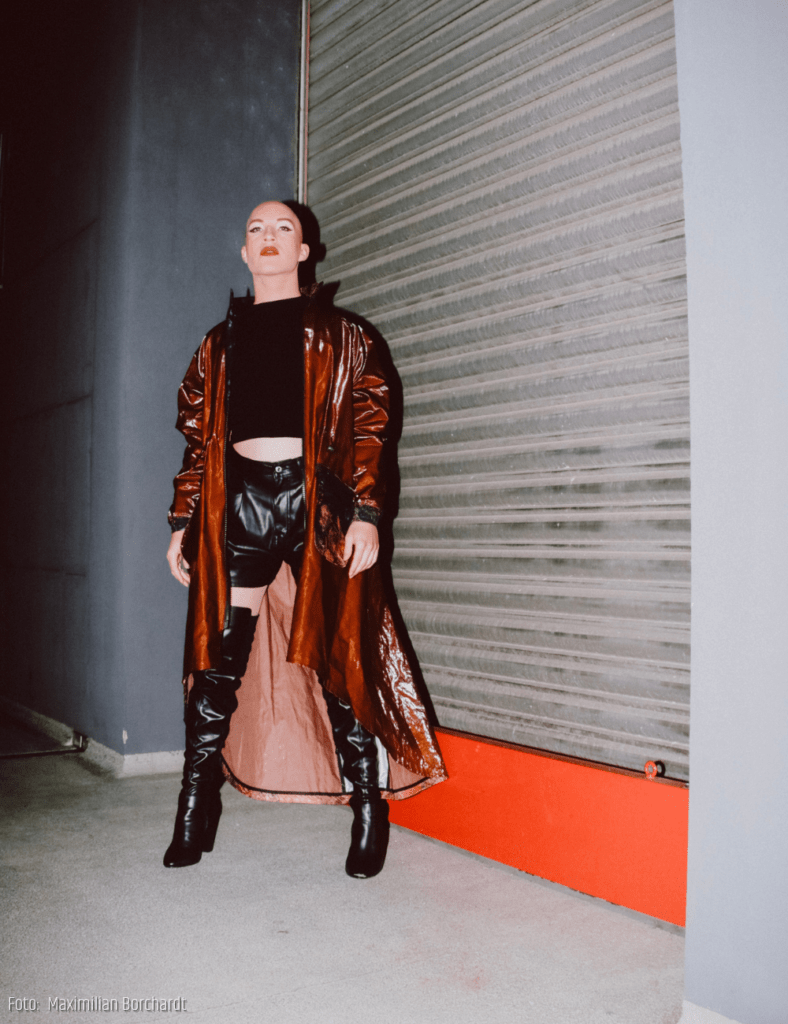
    LEOPOLD stands confidently in front of a garage door and looks down into the camera.

    Bayerischer Rundfunk once called you a "queerness glitter bag" - what does "queerness" mean to you?

    For me, queerness means being colourful, loud and proud, celebrating your own differences and standing up for them.

    You're from Würzburg, no offence, but that's not exactly the queerest place in Germany. How did you grow up there and how did you get into music?

    I grew up in a small village near Würzburg. Of course, queerness wasn't as present there as it would have been in a larger city. I have a great family and had a very nice, carefree childhood. Our parents did a lot for my siblings and me. We always listened to a lot of different music at home. When I was about 8 years old, my parents enrolled me in a children's and youth choir in the neighbouring village. That's how I got into music at an early age.

    How is your private life Leopold, how do you separate your professional and private lives?

    My name alone separates my professional from my private life, because Leopold is not my first name and I only use it on stage. As far as my appearance is concerned, I tend to walk around casually in my private life and don't wear high heels, flashy outfits or make-up. In my private life I tend to be inconspicuous and sometimes reserved and shy.

    Have you experienced discrimination yourself, such as hate comments online?

    Yes, I regularly receive hate messages on social media as comments or private messages. Even in real life, I'm often looked at funny or publicly insulted.

    I'm very sorry about that. How do you see the debates in Germany regarding queerness at the moment? For example, where do you think we stand on the issue of "trans*"?

    A lot has happened in Germany in recent years, including with regard to the gender and pronoun debate. Nevertheless, as LGBTQIA+ we still do not enjoy the same rights as cis and heterosexual people. We also regularly experience discrimination and marginalisation. The right to self-determination, the opportunity to donate blood and much more are all things that have already been initiated in some cases, but have not yet been implemented.

    LEOPOLD stands lasciviously leaning against a graffiti wall wearing sunglasses and a tiger-patterned top.

    Queerness in pop music is more present than it used to be. How do you see that and where do you fit in?

    That's true, but for my taste there could still be more queer acts in the international and German pop landscape. I try to use my music to bring queer topics out of the niche and into the mainstream, making them more accessible to people. My music itself is catchy and poppy - but with certain rough edges.

    How do you deal with your look and sex appeal in public? What would be too daring for you? What is important to you to convey?

    First and foremost, it's about feeling good. If something doesn't feel good for me or isn't flattering, I don't do it or don't wear it. I pursue a certain aesthetic with my outfits and performances and don't want to appear vulgar. It can be offensive, but at the same time it should be stylish and glamorous.

    Your outfits are certainly very carefully chosen, do you have a particular style?

    First and foremost, I look for outfits that appeal to me and that I think might look good on me. I want to look stylish and elegant in my outfits. I also like them to be more unusual and extravagant. I regularly work with different, mostly queer designers.

    "The ESC is every year. And I will definitely apply again."

    You were in the selection for the ESC, which unfortunately didn't work out. Are you disappointed or have you already got over it?

    At first, of course, I was disappointed - also because my team and I have been working towards this for a long time. But I think maybe it just wasn't meant to be this year. The good thing is that the ESC is every year. And I will definitely apply again.

    What are your next projects?

    There are lots of concerts coming up again in 2022 and I will also be releasing new music. There will also be some innovations, so you'll be in for a surprise 😉

    Where can we see you live next? Concerts are finally taking place again!

    I will be performing again at festivals and of course at some CSD and Pride events, more information will be announced soon. If you want to stay up to date and don't want to miss anything, you can contact me at InstagramFacebookTwitterTikTok and YouTube follow.

  • How the compensation for §175 and §151 judgements works

    How the compensation for §175 and §151 judgements works

    Who was criminalised by Paragraphs 175 and 151?
    §Section 175 came into force in 1872, one year after the founding of the German Empire, and criminalised "unnatural fornication between persons of the male sex". In 1935, the Nazis tightened the paragraph. All acts with "voluptuous intent" were now considered a criminal offence. Mere touching could already be prosecuted.

    After the war, §175 remained unchanged in the Federal Republic in the Nazi version for more than two decades. In 1969, it was then defused for the first time and a second time in 1973. Now men over the age of 18 could be punished if they had sex with boys under the age of 18, while the age of consent for girls was 14 (although the court could refrain from punishing the man for girls aged between 14 and 16 if he was under 21). The reason for this unequal treatment was the homophobic so-called "seduction theory", i.e. the idea that young people could be "seduced" into homosexuality.

    In 1950, the GDR returned to the original version of §175 (before National Socialism), although from the end of the 1950s onwards hardly anyone was sentenced under this paragraph. In 1968, the GDR then introduced its own penal code. Section 151 was introduced in it. This criminalised sexual acts by all people under the age of 18 with young people of the same sex. This meant that lesbian and bisexual women were also criminalised. Section 151 was cancelled without replacement in 1988.

    After a brief phase of legalisation, male homosexuality was criminalised again in East Germany after reunification, as §175 was only abolished in 1994 (also due to pressure from the East).

    In the legal sense of the time, the two paragraphs criminalised same-sex sexual acts. From today's perspective, however, it can be assumed that not only gay and bisexual cis men (or in the GDR also cis women) were criminalised. In fact, all people who were assigned to the male sex at birth and had sex with people who were also assigned to the male sex were criminalised in the Federal Republic of Germany. Paragraph 175 therefore also criminalised trans* women, for example, who had sex with people who were assigned to the male sex. In the GDR, Section 151 criminalised all people who had sex with other people if both were assigned the same sex at birth. This also affected trans* men, for example.

    It is important to know: The right to compensation applies regardless of your current and former gender or sexual identity.

    Jan, who is entitled to compensation?

    All people who were convicted on the basis of § 175 StGB after 8 May 1945 or on the basis of § 151, which was valid in the former GDR. However, it should be noted that you are only entitled to compensation if the partner with whom you were arrested was over 16 years old. There is no entitlement to compensation for sex with minors. A directive was added to the Compensation Act in 2019. Men who have not been convicted but have suffered extraordinary negative effects as a result of the law are now also entitled to compensation.

    What does this mean?

    Let me give you an example: the police or the public prosecutor's office were not discreet in their investigations. For example, those affected were involuntarily outed at work and lost their job or were given notice to leave their home. However, the criminal prosecution or the pre-trial detention suffered must be based on suspicion in connection with an allegation of an offence under Section 175. These men are also entitled to compensation.

    Now men who have not been convicted but have suffered extraordinary negative effects as a result of the law are also entitled to compensation.
    Jan Bockemühl advises on BISS e.v. Men who wish to apply for compensation for convictions under § 175 (FRG) and § 151 (GDR).

    Where and by when can the application be submitted?

    There is a rush here. Applications can only be submitted to the Federal Office of Justice in Bonn until 21 July 2022.

    Which documents must be submitted?

    In the best case scenario, a copy of the judgement or documents relating to the periods of imprisonment suffered are available and can be attached to the informal application. Otherwise, a certificate of rehabilitation must first be applied for from the public prosecutor's office. An application form for compensation under the Directive is available on the website of the Federal Office of Justice. We are happy to support those affected with the application process via our free hotline 0800 175 2017.

    How high is the expected compensation?

    This also varies from case to case. The law stipulates 3,000 euros for each conviction, 1,500 euros for each year or part thereof of deprivation of liberty and 500 euros for any preliminary proceedings initiated. In addition, a one-off payment of 1,500 euros is possible for exceptionally negative effects.

    Do you know a person who was also convicted under §175 (FRG) or §151 (GDR)? Then encourage them to apply for compensation. You can find all information at Federal Office of Justiceand under www.schwuleundalter.de/entschaedigung-und-rehabilitierung/
    You can find everything about gay life in old age at www.iwwit.de/schwules-leben/alter.
    Addendum: After this article was finalised, it became known that the The current government is planning to maintain claims for compensation possibly beyond 22 July after all. Nevertheless, it may be advisable to submit an application quickly. You can also get expert advice here at BISS e. V..
  • "Syphilis can also be contracted through kissing or oral sex." - In conversation with a general practitioner

    "Syphilis can also be contracted through kissing or oral sex." - In conversation with a general practitioner

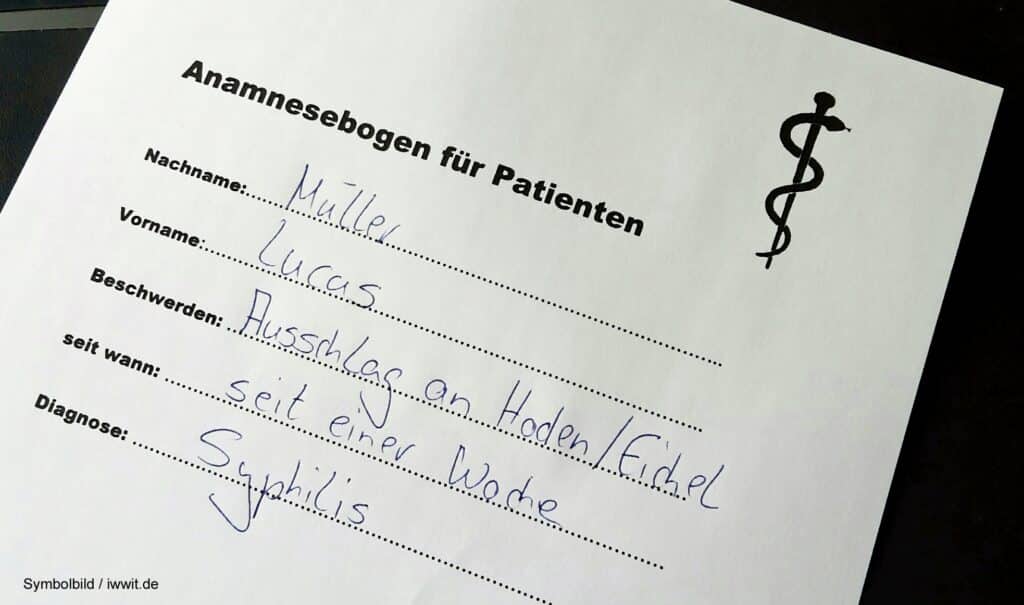
    The Robert Koch Institute has recorded a continuous increase in syphilis cases in Germany since 2010. More than 80 per cent of these cases can be traced back to sexual contact between men. To what extent are these figures also reflected in everyday medical practice? An interview with the Berlin general practitioner and infectiologist Dr Christoph Schuler

    Dr. Christoph Schuler – Experience report on syphilis in gay men
    „We see new cases of syphilis every week“ – Interview with Dr. Schuler from Berlin

    Syphilis in gay men: a persistent problem in practice

    Christoph Schuler, your patient base also includes a large percentage of gay men. To what extent does syphilis play a role in your everyday practice?
    We certainly have a new case in our practice every week on average, and have had one for several years. The number of cases has not necessarily increased in recent months, but it has remained very constant at a high level over a long period of time.

    From your practical experience, can you identify certain patient groups that are particularly affected?
    We discover a lot of syphilis infections in our HIV patients, if only because they are regularly screened for sexually transmitted infections (STIs).

    How gay men can become infected with syphilis

    This means that new infections are detected automatically and at a very early stage.
    Correct. On the other hand, there are many non-positive patients who come to us because of suspicious symptoms or who have had a routine STI test done on their own initiative.

    Some have also been tested elsewhere, for example at testing facilities in gay counselling centres, and then visited us after being diagnosed. And last but not least, there are also men who have learnt from their sexual partner that they have been diagnosed with syphilis and have therefore had themselves tested.

    Does it also happen that the same patient gets infected again and again?
    This is indeed the case, but with syphilis in particular it is very difficult to distinguish whether it is a new infection or a flare-up of an inadequately treated infection.

    Could the fact that the number of infections is so consistently high or even rising possibly be due to a change in sexual behaviour? Namely that gay men are having more sex without condoms again?
    I don't see a direct connection. Of course, condoms are dispensed with more often because HIV treatment is effective.

    ... and therefore the virus can no longer be transmitted.
    Secondly, safe sex with a condom is not a practice that can completely rule out syphilis infection. You can also become infected through kissing or oral sex.

    In our practical experience, however, there are certainly scenes in which syphilis infections are more likely to occur, for example in men who are sexually active or go to sex parties. If new infections occur here, they are also passed on quickly. This makes it all the more important to inform your sexual partners if you have been diagnosed with an infection so that your partner can be treated.

    Stigmatisation of syphilis among homosexual patients

    Syphilis appears to be more morally burdensome than other sexually transmitted diseases. Is it really easier for patients to go to the doctor for gonorrhoea, for example?
    That is indeed the case. Patients in particular who have never had to deal with an STI before and only have occasional sexual contact feel quite offended and are sometimes a little shocked. This is clearly due to the stigmatising character that syphilis still has. Even if syphilis is treated: a scar remains visible in the blood for life. But the treatment also differs from that of many other STIs: The injections can be quite painful and - depending on how late the infection was discovered - may need to be repeated at weekly intervals. If you have allergies, daily infusions or several weeks of tablets may also be necessary. The treatment of gonorrhoea or chlamydia, on the other hand, is much simpler and less complicated.

    The alt text describes the image content in a factual and accessible manner, including a focus phrase.
    Diagnosis and progression: How syphilis is documented in practice

    Why syphilis is particularly common among gay men

    Unlike with hepatitis A, for example, once you have recovered from syphilis you are not automatically protected from a new infection. How do people deal with it if they catch it more than once?
    Recently, I have seen more and more patients who are very frustrated and say: "I'm not going to do anything anymore". Not only has the number of syphilis cases increased, but gonorrhoea and chlamydia are also more widespread. Some people have obviously lost their desire to have sex, at least when it comes to sex in public places.

    Thank you very much for the interview!

    More about syphilis with transmission, treatment and protection you can find out here in the clip

  • Mr Gay Germany: "Proud to be alive!"

    Mr Gay Germany: "Proud to be alive!"

    For the first time, Max Appenroth, an openly trans* person, was elected Mr Gay Germany. We spoke to Max about the contest, trans* hostility in the gay community and Max's campaign #ProudToBeAlive.

    Trigger warning: This interview is about trans* hostility, mental well-being and suicide, among other things.


    Max, you've had several coming-outs, would you like to tell us about them?

    When I was 13, I came out as a lesbian. It was my first coming out. At the time, it felt wrong for me as a "woman" with men. At some point I realised that I wasn't a woman and had another coming out as trans*. I also more or less came out as a gay person because my identity and my changed appearance gave me access to other spaces such as gay bars and saunas and allowed me to live my sexuality differently. Then two years ago I had a different kind of coming out as a non-binary trans* person. So I feel comfortable in the male spectrum, but I am clearly more than "just" a man.

    What does the term "non-binary people" mean?
    Non-binary people can see themselves as "both male and female" or as "neither male nor female" or reject the dual-gender construct altogether.

    When did you feel most comfortable in your body during this time?

    Now I feel very comfortable in my body. I don't like the narrative that trans* people are born in the wrong body. I was born in the perfect body! There was only one time when I didn't feel comfortable with certain parts of my body and wanted to modify them to feel 100% comfortable in this body. That was ten years ago when I had an operation to have my breasts removed. Since then, my body is just perfect the way it is.

    What does the term "transition" mean?
    Transition describes the (medical, legal, social, physical) process of people who do not identify with the gender assigned to them at birth to express and approximate their gender identity and physical experience.

    What was the route to the operation like?

    Difficult! Finding expert information on the subject of transition is not easy. You have to find out everything for yourself: What do I want? What options do I have? In addition, in Germany it usually takes one to two years from the application to the health insurance company to the operation. And the applications are often rejected. Then you have to appeal and then wait again for processing until you finally get the OK. I wouldn't have been able to stand it any longer, both mentally and physically, because I had my breasts tied off and everything pressed flat. That means your chest is permanently compressed, you can't breathe, you can't really walk upright, you have back pain. So I had my breast operation in the USA. I had to pay a lot myself, but it meant I could avoid a really bad process with the health insurance company and get to my destination faster.

    What does the term "cis men" mean?
    Cis men were assigned the gender "male" at birth and they still identify with it today.

    Does the infrastructure of Germany's queer scene lack prevention messages and organisations for trans* people?

    Absolutely! Even though Germany is generally a great country when it comes to healthcare, this doesn't apply to trans* people because there is far too little knowledge about our bodies and needs. Even in queer initiatives that are committed to healthcare, much more simply needs to be done so that we are seen and can really participate. In other words, not that something is done for us by someone, but that we as a community are allowed to do it for ourselves.

    For example, prevention campaigns: If no trans* people are involved, how do you know how best to address the community? If only gay cis men can be seen on all the posters, but no trans* people, I don't feel addressed. You simply have to look at how you represent the communities and how you work with them in order to really do the best possible work that also reflects the needs of the community. I work primarily in the field of HIV prevention, especially for trans* people, and I can see how much work still needs to be done.

    Gay. Trans*. Part of the scene!
    Our brochure "Gay. Trans*. Part of the scene!" offers gay trans* and cis men, gender-nonconforming and non-binary people who feel part of the gay community all the information they need on respectful behaviour within our diverse scene, gay sex and protection against HIV (safer sex). Brief information on trans* history and important activists as well as links to more information round off the brochure. You can find it at iwwit.de/trans!
    Max smiles into the camera.
    Max wants to focus more on the high suicide rate among queer teenagers and young adults.

    How can your work and the community benefit from your victory as Mr Gay Germany?

    Thanks to the increased visibility I now have, more people follow me on social media or I am invited to various events. This gives me more reach and of course also has an impact on my work because more people are aware of the problems and the difficult situation and are listening.

    What was your motivation to take part in the competition?

    I stumbled across it by chance on social media and realised that it's not just a beauty contest, but that content takes centre stage. Each person has to stand up for a specific issue and launch a campaign for it. I thought that was pretty cool and got to grips with it. As a trans* person, I always get hostility from the gay community, so I also thought that I would like to show people in a contest like this that we trans* people are very much part of the community.

    "Just because they can't imagine having sex with a trans* person doesn't mean that has to apply to everyone in the gay community."

    So you experience discrimination from the gay community?

    The gay community is one of my communities and I feel at home there. But sometimes I hear things like "You have no place here" or "That's not a "real" man, so you can't be in the gay community". Maybe there's a lack of education here: not everyone has to find me attractive or imagine going to bed with me. I don't want to go to bed with everyone either. But just because I personally can't imagine something, or don't like something, doesn't mean that others can't like it. Just because they can't imagine having sex with a trans* person doesn't mean that everyone in the gay community has to.

    "You don't have to be able to understand my identity to accept me."

    What would you say to these people?

    As trans* people, we are not taking anything away from anyone. I don't want to abolish any gender. I just want to be able to live with respect and dignity, just like everyone else. People don't have to be able to understand my identity to accept me. I can't understand a lot of things either. But that doesn't mean it can't exist just because I don't understand it. Nevertheless, this is the best proof that my work for more trans* visibility is still needed, and in fact, comments like this act like petrol in my engine. That's exactly why I'm doing more.

    "For me, comments like that are like petrol in my engine."

    Back to the competition: how did it go?

    Everything went relatively quickly. I applied online at the end of October and had my first telephone interview a week later. Then I had to develop a community campaign in the next three days. I thought about a campaign and presented it. Shortly afterwards, I found out that I was in the semi-finals. Between the semi-final and the final, you have to continue building the campaign to show the jury in the final how you are working on it. The final came exactly six weeks after the first phone call.
    The other competitors were of different ages and backgrounds. Not all of them were totally slim and muscular either, but simply had different body shapes. I thought it was nice to see that it wasn't just about muscle-bound cis men. It was a short, intense time, but when I heard my name in the final, it was an indescribable moment. It was a huge load off my mind.

    What is your campaign about?

    It is called #ProudToBeAlive (proud to be alive) and deals with the high suicide rate among queer teenagers and young adults. Unfortunately, this is a topic that we rarely talk about. I would like to improve this situation in two ways: Firstly, by creating a professional crisis support structure for young LGBTQIA+ in the form of online counselling parallel to telephone counselling, through which help is offered in acute situations.

    And in the long term, I want to increase the visibility of queer people in children's and young adult literature. When queer children and young people see in children's books that there are other people who are just like them - in other words, when they always find themselves - they get the feeling that they are not alone. And that you are okay just the way you are. I believe that if they realise this from an early age, they could lead a completely different life than if they had to cope with it alone. My first trans*-empowering children's book will be published in German and English at the beginning of April, it's called "No matter what changes, the heart remains exactly the same".

    Max, good luck with it and thank you very much for the interview!

    Trans* men, non-binary and gender non-conforming people are part of the gay scene! Find out more about our campaign "Gay. Trans*. Part of the scene!" Click on www.iwwit.de/trans!

    Gay Health Chat
    Are you looking for someone to talk to? Someone who will listen to you and possibly give you advice? Then chat with counsellors from the community at www.gayhealthchat.de!
    Hint
    There are situations that are anything but easy. There is help here:
    - Telephone counselling: 0800-1110111 and 0800-1110222
    - German Depression Relief Foundation

  • "Can I just be human? / Can I just be me?"

    "Can I just be human? / Can I just be me?"

    On his new album "Boyology", Danish pop singer Asbjørn pleads for a different understanding of masculinity - and encourages gay men in particular to embrace their vulnerability.

    Back in 1984, Herbert Grönemeyer asked "When is a man a man?". Almost four decades have passed since then, and the question still lingers. The Danish pop singer Asbjørn is also preoccupied with it. Ultimately, this question is also about his own identity as a queer man and a new self-image of masculinity.

    Emancipation from the traditional male ideal

    This debate runs like a red thread through his new, now third album. It is, as the 29-year-old says, his "emancipation from the traditional male ideal and the invisible expectations in society and of ourselves as to what a man should or should not be". Asbjørn expresses this most clearly in his melancholy, reflective song "Be Human" in succinct verses: "I don't wanna be a man/ If man means power, to not empower others". And "I don't wanna be a man/ If man means violence instead of showing kindness."

    The album cover of "Boyology" by Asbjørn. (Artwork by Max Binski)

    With a wistful falsetto, Asbjørn sings about mendacious, outdated and toxic notions of masculinity. In the end, he asks: "Can I just be human? / Can I just be me?" Simply being yourself, allowing yourself to be vulnerable, is one of the messages that Asbjørn has packaged in clever yet danceable pop. Just like the message: above all, believe in yourself and don't pretend, even when it comes to matters of love.

    A sung "Fuck you..." to his old record company

    The singer, musician and producer, who grew up near Aarhus, seems to be speaking from his own experience. Several songs tell of broken relationships and at the same time of the fear of firm commitments. "Remember my Name" is one of them, another very emotional track driven by electronic beats. The verse lines "Rember my name, the boy that got away" can be understood as a message to an ex who was caught cold by the break-up. For Asbjørn, however, the song also has a completely different, very personal interpretation. Strictly speaking, it is a "I can do it without you" greeting to his old record company. However, the material he had worked on for his third album in his adopted home of Berlin was not commercial enough for them.

    "I was deeply hurt by the cynicism of the industry," admits Asbjørn. That's why he retreated to a summer house in Denmark, "where I could shout at the sea to ignite the last remnants of my resilience and prove them wrong."

    Inspired by Lyykie Li, Robyn and other great artists

    In the eleven songs on "Boylogica", Asbjørn shows what he has learnt from his musical role models such as Lyykie Li, Timbaland, Robyn and Missy Elliott. Above all, however, he shows that an intimate and intense confrontation is also possible in dancefloor and radio-friendly songs - with one's own and with society's expectations of interpersonal relationships and supposedly typical gender behaviour.

    "like a queer coming-of-age short film"

    Asbjørn about his "The Boyology Series" on YouTube

    Asbjørn thought he had long since overcome these expectations, but then realised to his own surprise that he was "suppressing his love pain in this super stereotypical way". For him, this realisation was the catalyst for this album. And there is no doubt in his mind that he is drawn to men when it comes to love. His videos, like those for his first two albums, are unambiguous and open-hearted. Asbjørn has selected three songs from the new album and produced videos for them that, as he says himself, are intended to feel "like a queer coming-of-age short film". This "The Boyology Series" can be seen on YouTube.

    https://www.youtube.com/playlist?list=PLP46yV9_YdrQtSI7tny9JGfJVi0Lrwrie


    The new album by Asbjørn: "Boyology" has been released by Embassy of Music.

    Official website of Asbjørn:

    https://www.asbjornmusic.com/


    Asbjørn live on 8 April 2022 at Lido Berlin

  • Sex in old age - information and 4 testimonials

    Sex in old age - information and 4 testimonials

    Sex in old age: between change, closeness and new lust

    Sex doesn't stop just because we get older - on the contrary. Many people experience a new quality of intimacy and pleasure as they get older. But „sex in old age“ is still a taboo subject in our society, especially when it comes to gay men.

    A lot changes as you get older: your body reacts differently, your libido can fluctuate and sometimes health issues take centre stage. At the same time, emotional closeness becomes more important. Instead of the pressure to perform, mindfulness, trust and new experiences take centre stage.

    Society also has some catching up to do: the sexuality of older people - especially gay men - is often overlooked. This makes it all the more important to talk about it openly.

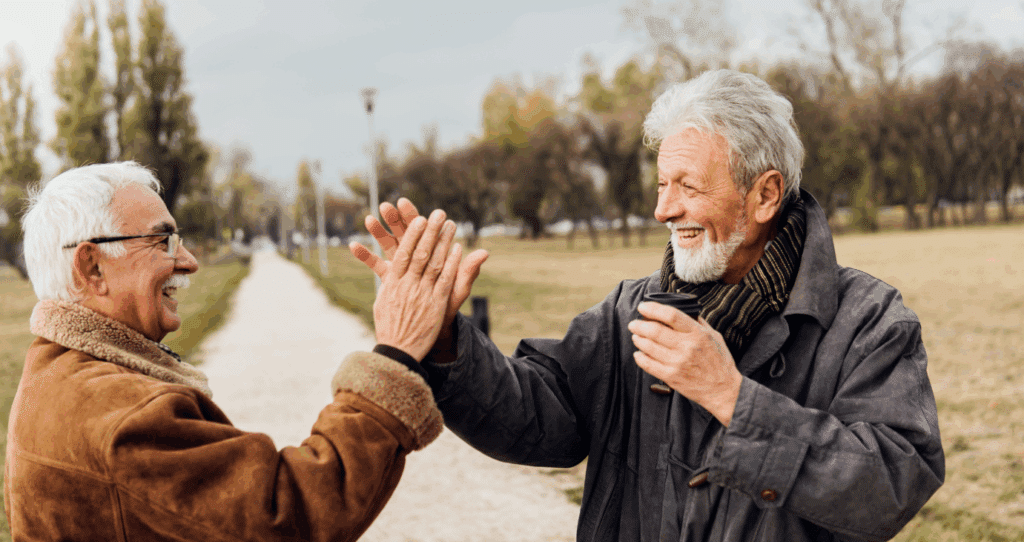
    Two elderly men greet each other warmly during a walk in the park.
    Openness and joie de vivre even beyond the age of 60

    Physical changes

    The hormonal balance changes with increasing age - testosterone levels in particular fall. This can have an impact on libido, erectile function and sexual performance. These physical changes are completely normal and are part of natural ageing.

    Nevertheless, sex remains fulfilling for many men in old age - often even more intense, because the focus shifts: less on performance and more on closeness, mindfulness and conscious enjoyment. If you recognise and accept your body's signals, you can live your sexuality healthily and confidently in old age. If necessary, medical counselling or supportive aids can also help to reduce insecurities.

    Sexual health in old age

    Sex in old age is not only possible, but can also be beneficial to your health. Studies show that regular sexual activity can have positive effects on the circulatory system, immune system and mental well-being. The prostate also benefits - according to some studies, regular ejaculation can reduce the risk of prostate problems.

    At the same time, hormonal changes or chronic illnesses can bring challenges. It is therefore important to be aware of your own body and be willing to talk about problems. Sexually transmitted diseases are also often underestimated in old age - regular testing and protection are just as relevant as in younger years.

    Psychological aspects of sex in old age

    Sex in old age is not only a physical but also an emotional challenge and opportunity at the same time. Many men struggle with insecurities, for example due to physical changes, diminishing potency or societal ideas about how „masculine“ or „powerful“ sexuality should be.

    Self-image plays a central role here. If you accept yourself and treat your own body with love, you can also experience intimacy in a new way - free from pressure or expectations. Especially in old age, deeper, more honest relationships often develop because many men know their needs better and are more open about them. Sexuality in old age does not mean withdrawal, but often a new approach to closeness, pleasure and self-confidence.

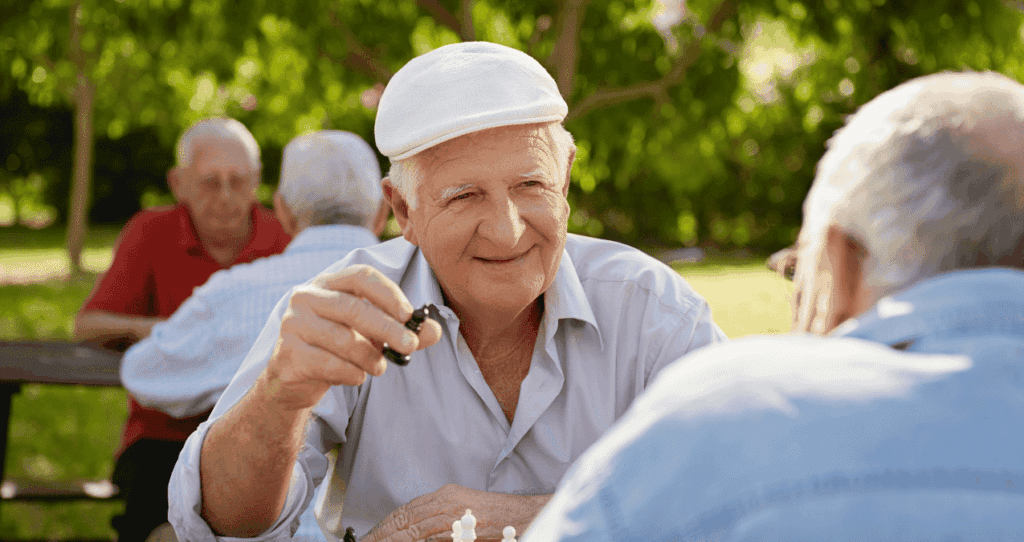
    Older men play chess in the park and enjoy their time together.
    Open dialogue, closeness and community in old age

    Partnership and relationship

    With increasing age, the dynamics in partnerships often change and with them sexuality. Many couples experience less sexual activity, but a deeper form of intimacy. Conversations about desires, boundaries and new needs become more important.

    Sex in old age doesn't have to look like it used to. For some couples, this means more tenderness, more attentiveness and less pressure to perform. For others, it can mean allowing new impulses or getting over longstanding taboos. Long-standing relationships in particular benefit from honest communication and the courage to rediscover things.

    Social perspectives

    In our society, sex in old age is still a taboo subject - especially when it comes to gay men. Older bodies are often seen as asexual, invisible or no longer desirable. These prejudices can become deeply engrained in their self-image and lead to men feeling ashamed of their sexual desires or suppressing them. Yet the need for closeness, lust and intimacy is not a question of age. On the contrary: many men discover new facets of their sexuality later in life. This makes it all the more important that these experiences are seen and recognised. Sex in old age deserves visibility, respect and a natural place in the public eye.

    Practical tips for fulfilling sex in old age

    Sex in old age can change and can also be rediscovered. If you keep an open mind and embrace your own needs, you can experience a lot. Small aids such as lubricants, sexual enhancers or sex toys can help when the body changes. A relaxed atmosphere, time and trust also play an important role. Communication is just as important: talking openly about desires, fears or boundaries creates closeness, especially in new relationships. Anyone who feels insecure can also seek medical or therapeutic support.


    Sex in old age - 4 testimonials

    The prejudice persists that old people don't have sex. Not at all! Perhaps priorities are shifting and cuddling is becoming more important than a hot fuck, but sex still plays a role in the 60-plus generation, as these four gay men report by way of example.

    Sex in old age - 4 testimonials
    Sex with your partner
    K

    Kurt (62)

    from Zeitz

    I've been living with my partner for eight years. We got married four years ago. Many couples just sleep in the same bed after such a long time, but nothing happens. With us, however, it does.

    We regularly have sex with each other, but also with other men - sometimes together, sometimes individually. That gives our sex life the necessary spice.

    „But when we invite someone over, we expect more than just lying down and holding out our hole. For us, sex includes kissing, tenderness, licking and rimming as well as a hot blowjob.“
    Sex as a single
    J

    Julio (66)

    from Cologne

    Why so many gay men have a problem with getting older is a mystery to me. I still have sex and find it much more intense than when I was younger.

    But sometimes I'm also looking for a kick: I regularly fly to Gran Canaria to go naturist. I feel free in the dunes of Maspalomas and enjoy the fact that others feel the same way.

    „I stopped going to bars a long time ago. They're all giraffes: first they stick their necks out and then you look at them and they bury their heads in the sand.“
    Sex for money
    JC

    Jean-Claude (66)

    from Karlsruhe

    When I was as young as the men I find beautiful and attractive, homosexuality was still considered sick and disgusting. I find it wonderful when a young man lies next to me and I can give him the love that I lacked back then.

    It goes without saying that I give them something for their tenderness and the time they spend with me.

    „But I've never ordered a professional callboy. That would be far too business-like for me. I need the feeling of being liked.“
    Hardly any sex
    K

    Karl (60)

    from Dillenburg

    Everyone has certain ideas about a potential sex partner. I myself like the look of younger, sporty men. But there has to be a good interpersonal fit too. That makes it almost impossible for me to stay sexually active.

    Because for my target group, I'm an old bag and I live in a real backwater. Sex for sale is out of the question for me.

    „But not having sex doesn't mean that I'm frustrated. I mainly have younger friends. I've also retained a bit of eroticism: I'm a passionate wrestler.“

    FAQ: Frequently asked questions about sex in old age

    Is sex still healthy in old age?

    Yes, studies show that regular sex in old age can have a positive effect on the cardiovascular system, hormones and mental well-being. The prostate also benefits from sexual activity.

    How often do men have sex in old age?

    That is very individual. Some have more desire than before, others less. The important thing is not the frequency, but that sexuality in old age meets your own needs.

    Are there aids for fulfilling sex in old age?

    Yes, sexual enhancers, lubricants or sex toys can help when the body is changing. Counselling from doctors or sex therapy can also help.

    What to do about erectile dysfunction in old age?

    Erection problems are common in old age. Open dialogue with your partner and medical help can provide relief. Medication and other aids are well tolerated today.

    How does sexuality change in long-term relationships?

    Many couples experience less sex, but deeper intimacy. Communication about desires and openness to new things are crucial for experiencing closeness in old age.

    Why is there so little talk about sex in old age?

    Sexuality in old age is often a taboo in society. Gay men in particular experience invisibility or prejudice in old age. Testimonials help to change this.

    How does pleasure change with age?

    Pleasure can become more intense, slower or even more conscious with age. Physical changes influence the sensation - but not the ability to feel pleasure.

    Similar blog posts

    Need someone to talk to?

    Whether acute or simply for orientation - sometimes it helps to talk to someone in confidence.
    Use the Gay Health Chat - the button at the bottom right will accompany you on the page. There you can chat anonymously and free of charge:

    - Personal live advice in the chat
    - Help by e-mail or telephone
    - Information on health, law, everyday life and more

  • Age difference in a relationship: When love knows no age

    Age difference in a relationship: When love knows no age

    The "gay generation" is getting on in years. The over-60s are confidently taking advantage of what the gay scene has to offer - as long as their health plays along. A mood report from Hamburg.

    Age difference relationship: Growing older in the gay scene

    "I'm not going to do that scene to myself when I'm 70," Karl-Heinz realises. He no longer wants to wait in a bar for his prince charming. "You just have to realise that: For the scene is You feel old, even if you have a completely different impression," explains the retired vocational school teacher. "If you look at yourself in the mirror every day, you don't realise how you're ageing."

    Avoiding bars is easy for the single man. He prefers to look for sex outdoors, for example in the city park. "I enjoy the chase," says Karl-Heinz and laughs. "The guys I get there wouldn't look at my arse in a bar."

    New ways of meeting in old age

    Cruising can also be very sociable. Almost 20 years ago, Karl-Heinz met a man almost 20 years his junior while cruising the dunes of Ibiza. They didn't have sex, but when they met again in the beach supermarket, they arranged to meet for dinner. This is how Karl-Heinz met a gay trekking group. Since then, he has hiked with them at least once a year through the low mountain ranges and knows the Harz Mountains almost by heart.

    Karl-Heinz no longer goes to gay bars - but is still well connected with other gays. Together with a fellow volunteer from the gay information shop, he is currently organising Hein & Fiete a "Gay History Tour" through St Pauli. Like Karl-Heinz, many older men are present in the community - they are used to it. "There is a lot of interest in specific counselling and leisure activities for gay and bisexual men over 50," says Heiko Gerlach. Together with Christian Szillat, the qualified nurse surveyed gay men in Hamburg and analysed the answers on behalf of the AIDS-Hilfe Hamburg analysed. "Männerliebende Männer 50 plus in Hamburg" is the name of her study, which she published on Radio Pink Channel have introduced themselves. A special generation, according to the two experts: they were the first to live their homosexuality relatively openly. It is not surprising that they are now openly demanding that their circumstances be taken into account in old age.

    When health determines everyday life

    So as long as the body keeps up, gay life continues happily beyond the age of fifty. Eckhard also used to go to the sauna regularly a few years ago. He still knows what's on offer: Partner discount on Fridays, wellness on Sundays and "40up" on Wednesdays with a discount for over-40s. "She could do a '70up' day for me," says Eckhard and smiles. In recent years, the trained electrician has spent more time in hospital than in the sauna. Following a heart operation, Eckhard moved into a retirement home in St. Georg in 2013, in the "Regenbogen" ward. "That doesn't mean anything," says Eckhard, "I'm the only gay person here for miles around."

    For a long time, Eckhard could not imagine that he would ever need help. He even put his HIV infection behind him. Eckhard was diagnosed in 1990 and persevered until the first combination therapies were available. "Now I've been below the detection limit for over twelve years," he says proudly. "HIV doesn't cause me any problems - they only came as I got older." In the meantime, a few have come together. Eckhard's table in the 20 square metre room is neatly lined up: a wristband for measuring blood pressure, a device for measuring blood sugar, an insulin syringe. There is also an asthma spray and a cardboard box of cough sweets. "This variety of complaints is driving me crazy," says Karl-Heinz. "It's always in the back of my mind: what's next?"

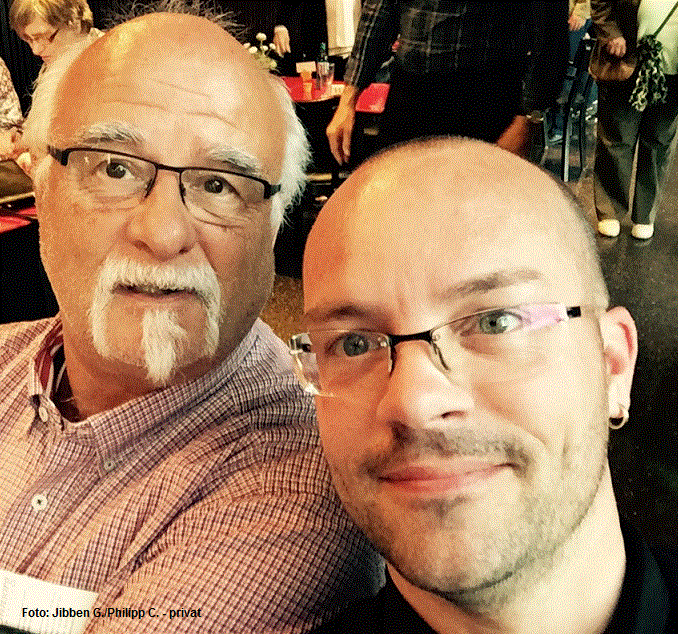
    Gay couple with an age difference: Jibben (68) and Philipp (41) in Hamburg
    Jibben (68) has been together with Philipp (41) for 15 years and they got married in 2006. "Philipp is of course also a reason why I stay fit," says Jibben.

    Age difference relationship: Two generations, one everyday life

    Jibben also sometimes worries "that his bones aren't cooperating as well". But he doesn't let that get him down. His antidote: do a lot. The 68-year-old manages three websites, including the gay and lesbian portal hamburg.gay-web.info. „I hope that's one reason why I'm still fit upstairs,“ says the broad-shouldered man with the white goatee, tapping his head. „Philipp is also a reason, of course,“ adds Jibben gently, „as a young husband, that sometimes keeps you on your toes.“

    Partnership across age boundaries

    Jibben has been together with Philipp (41; seen together in the photo) for 15 years and they got married in 2006. Every year at the Hamburg Pride street festival, the two of them sit in the organisation container, take in lost property and use radios to ensure that every stand has electricity and water. Jibben hasn't had enough of the scene yet. „That's also because I went to a gay bar for the first time when I was 50,“ Jibben surmises. „In hindsight, I wish I'd started earlier,“ says Jibben, „because I definitely missed out on a lot.“

    FAQ: Age difference relationship in the gay community

    Relationships with an age difference raise many questions - especially in the gay community. In this FAQ, we answer key questions about partnership, acceptance, challenges and social perception.

    What does a big age difference mean in a relationship?

    A large age difference in the relationship describes partnerships in which there are several decades between the partners. In the gay community, this constellation is comparatively common and often more socially visible than in heterosexual relationships.

    Are relationships with an age difference stable in the long term?

    Yes, many relationships with an age difference are stable and long-term. It is not the years of life that are decisive, but shared values, mutual respect and similar ideas about living together. The article shows that such partnerships can work for many years.

    Why are age differences more visible in the gay scene?

    For historical reasons, many gay men were only able to live their sexuality openly later. As a result, encounters between generations occur more frequently - for example in the scene, in voluntary work or through shared interests. The age difference in the relationship is often consciously accepted.

    What challenges does a relationship with an age difference entail?

    Different life phases, health issues or social expectations can present challenges. At the same time, many couples report that openness and communication help to constructively bridge these differences.

    Does age still play a big role in the gay community today?

    Age continues to play a role, for example in access to the scene or physical expectations. However, it is becoming increasingly apparent that rigid age limits are becoming less important - especially in relationships where closeness and trust are more important than numbers.

    How is the age difference in the relationship perceived from the outside?

    The perception is different. While some couples are confronted with prejudice, others experience a great deal of acceptance. Social discourse has opened up and relationships with an age difference are now viewed in a more differentiated way than in the past.

    Voices from the community

    Reports, experiences and perspectives on love, ageing, health and cohesion in the community.

    Need someone to talk to?

    Whether acute or simply for orientation - sometimes it helps to talk to someone in confidence.
    Use the Gay Health Chat - the button at the bottom right will accompany you on the page. There you can chat anonymously and free of charge:

    - Personal live advice in the chat
    - Help by e-mail or telephone
    - Information on health, law, everyday life and more

  • Max (21): "I'm no different to other gay boys"

    Max (21) about his life with HIV infection
    Photo: Private

    Max is 21 years old, studies in Jena and came out as HIV-positive more than a year ago. He is happy about this decision and would like more positive guys to say that they have HIV. A conversation about unfounded worries, the point at which internet dating becomes unsexy and what a report about the "Testhelden" campaign by ICH WEISS WAS ICH TU triggered in him

    How openly do you live with HIV in the gay scene?
    Quite openly. This isn't the first interview I've given about it and the vast majority of people in my immediate environment know about it. If dating portals offer the option of declaring your HIV status, then I do that too. Or I bring it up when it becomes necessary. But it's also not the first thing I tell people about myself. Although it's strange now when people don't know.

    What do you mean by that?
    Being open about the fact that I am positive simply makes things, conversations and general dealings with others less complicated. The hurdle is removed, everyone knows and that's good. If someone comes along who doesn't know, there is often a need for explanation. This complicates the situation again and the issue comes to the fore. And that triggers unease, which is not really necessary.

    "If I can help others to protect themselves, that's great."

    Was it easy for you to come out publicly?
    My public outing came about like this: I read a report on a website about this "Testhelden" campaign that impressed me. I then contacted the author to tell him about it. He then said: "Could you imagine talking publicly about your infection yourself?" And I could. I wasn't that scared of it. There are far too few people who do that. And that's why many other people don't realise that the lives of most positive people are not much different from those of negative people. And I'm still glad I did it. If I can help others to protect themselves, that's great.

    "I then have to explain that protection through therapy works and that I am not infectious."

    How do other people react when you tell them that you are positive?
    Especially today, when my HIV status has become quite normal for me, I am always surprised by how much some people worry. Not about being infected by me. Most people are well aware of that. But many people still think that I'll get ill at some point and then die far too early or something. And it's not always easy to make them realise that I'm doing really well and that I'm not actually affected by HIV at all. It's annoying from time to time. When dating on the Internet, the matter also comes up at some point and many people react with great naturalness. But some don't either. I then have to explain that protection through therapy works and that I'm not infectious. Unfortunately, that quickly makes things unsexy.

    Fear of stigmatisation among young positives

    Do you know other young positives? How do they deal with their infection?
    I study in a smaller town, the scene here isn't huge. After I came out publicly, some of my friends came out to me. And what I generally notice is that there are now some young positives who are very open. But many others don't want it to be publicised and only talk about it with a few other people.

    "After coming out, you definitely become a topic of conversation."

    Why do you think that is?
    Well, they're afraid of being stigmatised. And that's not entirely unjustified. After coming out, you definitely become a topic of conversation. The general level of information about the lives of HIV-positive people is not great and prejudices and rumours can easily arise that make life more difficult. Many people are also afraid of jeopardising their professional future if it becomes known that they are positive.


    Max (21), student in Jena, Thuringia
    Photo: Private

    "And some negative people could relax when dealing with positive people."

    And what can we all do about it together?
    Good question. If positives are open about their infection, negatives have a chance to learn first-hand that living with HIV in 2017 no longer means being ill. We live completely normal lives and there are no longer any visible differences between positives and negatives. And some negatives could relax when dealing with positives. (laughs) And inform themselves better so that stigma is prevented before it happens.

    How does HIV affect your life today?
    I take two tablets every day, that's it. But that's now also automated, like brushing my teeth, and nothing I think about anymore. Apart from that, I'm probably no different to many 21-year-old gay boys all over the world.


    You can find out more about living with HIV at iwwit.de!

  • Reference person and confidant

    Reference person and confidant

    Volunteering: reference person and confidant
    © SP-PIC - Fotolia.com

    Theo (name changed) is 42 years old. He has been a volunteer at the Berlin AIDS service organisation Aids-Hilfe for nine years, providing emotional support for people with HIV. A portrait of Moritz Krehl

    In 1998, Theo was diagnosed as HIV-positive - a shock.

    Five years later, he voluntarily resigned from the church and moved to Berlin to find happiness. However, the separation from his former boyfriend, professional turbulence and few social contacts initially lead him into loneliness. Theo had not imagined the start would be so difficult. But instead of resigning himself and sitting at home until he becomes depressed, he joins the Berlin AIDS service organisation, BAH for short, to do voluntary work - a way out of isolation for him.

    BAH has ten to fifteen areas in which voluntary work is possible.

    Theo decides in favour of the "escort". There are three groups there: The volunteers from "Freunde im Krankenhaus" (Friends in Hospital), or FRIKS for short, accompany Aids patients who have to stay in hospital long-term. Those involved in "emotional support in prison" meet regularly with prisoners infected with HIV or suffering from AIDS. Theo works in the third group, "emotional support". Here too, the aim is to accompany people with HIV on their way out of the crisis, to give them back some of their quality of life and to be a carer and confidant.

    The "accompaniment" was launched in the 1980s, during the worst times of the AIDS crisis.

    Even back then, the volunteers accompanied HIV-positive people, but above all AIDS patients - until they died. In those days, it was often end-of-life care; the end of the accompanied path was predetermined from the outset.

    Even today, companions like Theo take HIV-positive and AIDS patients by the hand and give them a sense of security and familiarity. Unlike in the past, however, the end is no longer predetermined, thanks to modern medication. Today, intensive discussions between the counsellor, the person being accompanied and the AIDS service worker, as well as supervision, determine when it makes sense to end the support. In most cases, this is when the crisis has been overcome or when it becomes clear that the counselling cannot achieve the desired goals. The journey together can be short, but it can also extend over many years.

    What has not changed, however, is that AIDS often leads to social marginalisation.

    The disease isolates the patients, they become lonely. Resignation, depression and lethargy are frequent consequences, although Theo is convinced that an HIV diagnosis rarely creates new problems, but rather reinforces psychological predispositions - as can happen in critical life situations.

    To counteract isolation, the counsellors have contact with their clients at least once a week; preferably in person, but sometimes just on the phone. And although Theo, like most of the counsellors, works and has little time, he even spends the whole Saturday with his current client Benjamin (name changed) every fortnight to take him on an outing, go for a coffee or simply talk to him and listen to him.

    The man with Aids is about the same age as Theo himself - and only his second client in nine years. Theo has been accompanying Benjamin for four years now. You can tell that Theo cares about Benjamin's fate, but also that he doesn't care where he comes from or how he got into this situation. Theo doesn't pass judgement, he is concerned with the person and the path that lies ahead of him. "I want to help him experience his life."

    What did Theo gain from his involvement in the Berlin AIDS service organisation, and why is he still involved?

    He sought and found connections, he says. The supervision group gave him support. And he has found friends at BAH, a good network that he no longer wants to do without. The work also offers him "a social alternative to the cerebral desk life" and gives him the feeling that he is doing something good. And last but not least, he learns a lot about himself. In joint supervision sessions, Theo talks to the others about his personal problems and difficult moments during counselling. "I often get feedback that makes me think and helps me to develop personally."