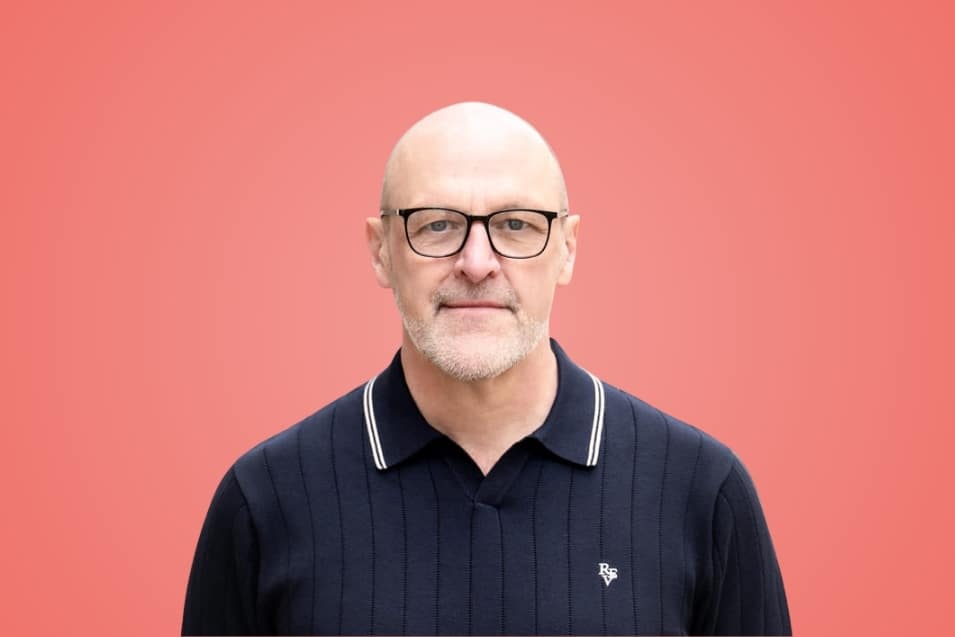
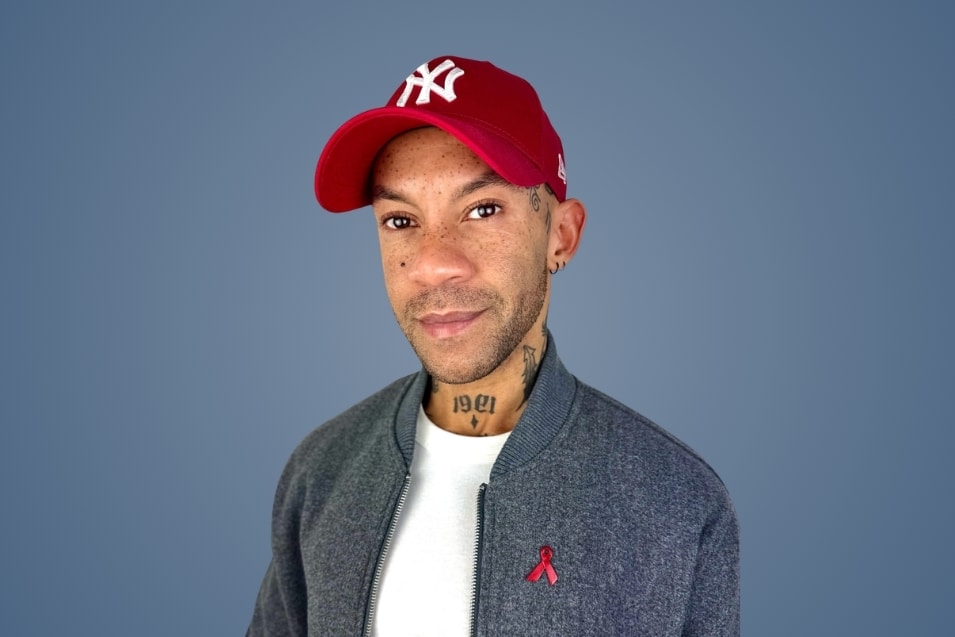
For World AIDS Day 2025, Torsten Poggenpohl, author of the book „einfach!ch schwul.bipolar.positiv.“, had a vision: a charity evening in his adopted home of Hamburg.
In 2013, the year of his diagnosis, this was one of the loneliest evenings he had ever experienced in Hamburg and in his life - he wanted to take this feeling away from others by spending an evening together.
Support from the community made the evening possible
During the planning of this event, however, he had to face the fact that he lost the funding for this evening several times.
On the contrary, he quickly asked his thousands of followers on Instagram and Facebook for support - true to the motto: „If everyone pays a euro„. - and so the money came together through smaller and larger donations.
Marcel Leo Guevara Kluxen opened the doors of his TOOM PEERSTALL exclusively on the day of rest - the „snacks“ were conjured up by Puk from the neighbouring Jolie.
Music, reading and donations for the Hamburg AIDS organisation
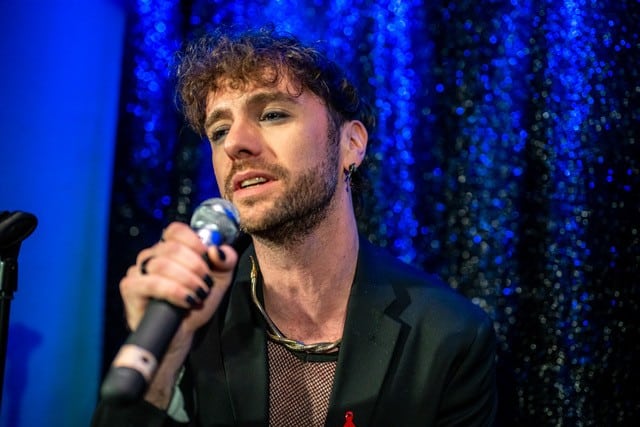
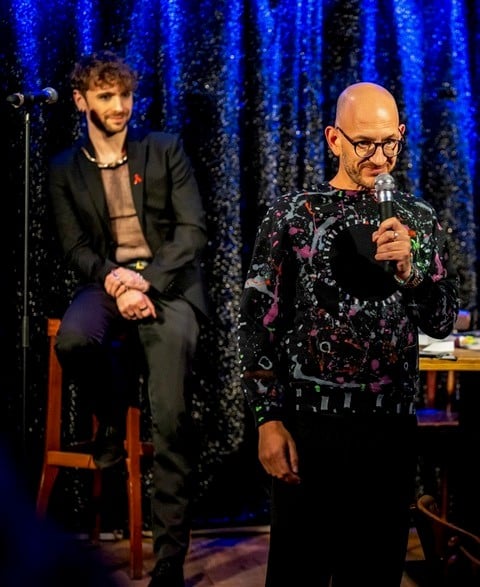
While Torsten read from his book, the musical singer Gerrit Hericks enchanted the audience with his voice. Hearts beat faster as the lyrics and music were perfectly harmonised.
During the interval, Torsten and Gerrit diligently sold raffle tickets to the audience - there were all sorts of prizes to be won, from charity bears from Aidshilfe to a luxury fragrance or a champagne breakfast for two in the legendary CafeGnosa.
A look into the eyes of the audience, who had come to show solidarity in the sign of the red ribbon, revealed that everyone felt they were in exactly the right place - that's as good as it gets.
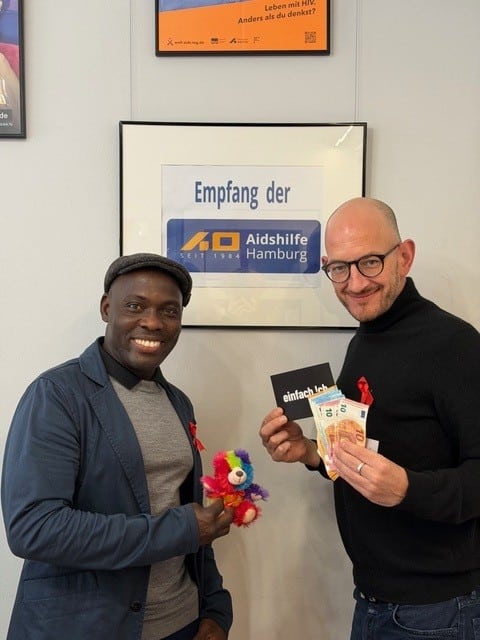
The following day, Torsten was able to hand over €550 - five hundred and fifty euros - to the managing director of Hamburger Aidshilfe.
Thank you Hamburg - Together for Hope - Together. Right now.
As the organising association of Christopher Street Day in Dresden, this year we are looking back on a situation characterised by commitment and new challenges. For us, CSD is not just a date in the calendar, but a central expression of our political work and our commitment to the rights of lesbian, gay, bisexual, trans*, inter* and queer people.
Our claim: political, visible and indispensable
For many years, the CSD in Dresden has stood for the demand for equal rights and social participation. This claim will remain in 2026. At a time when queer realities are becoming more visible, we are also experiencing that this very visibility is once again being called into question.
It is clear to us that visibility is political. It makes discrimination visible, creates spaces for dialogue and solidarity and demands change. This is exactly what CSD is for - on the streets, on stages, in conversations and by standing together.
What the new valuation means in concrete terms
Current challenges in implementation
This year, we are confronted with a change in the legal assessment of our event form. While the demonstration continues to be recognised as a political expression, this suddenly no longer applies to the rest of our programme - in particular the multi-day street festival.
The competent authority classifies this part as „predominantly entertaining“ and therefore not as an assembly. This decision not only surprised us - it also has a direct impact on our work. In concrete terms, it means that a large part of what we organise loses the legal protection that is intended for political gatherings.
What this decision means in concrete terms
What sounds technical at first has real consequences. If part of the CSD is no longer considered an assembly, it will be treated differently - legally, organisationally and financially. This means stricter regulations, additional security and infrastructure requirements and rising costs. At the same time, there is a new uncertainty in planning. For us as an association working on a voluntary basis, this is a considerable burden. Resources are limited and every additional requirement means more work for the people who make CSD possible in the first place.
At the heart of the matter is a fundamental question: What counts as political expression? Is it just the classic demonstration march - with banners, slogans and movement? Or does it also include the spaces in which people inform themselves, exchange ideas, listen, are visible and take a stand together? The CSD was never just a demonstration. It has always been a place of encounter and collective visibility. This is precisely where its political power lies. If these forms are suddenly categorised as „entertainment“, political reality is reduced.
What is at stake
A problematic separation
The current assessment follows a logic that we criticise: The march is recognised as political because it is classically demonstrative. The street party, on the other hand, is treated as something different - even though it conveys the same content. This separation seems contrived. It is based less on the actual function than on external forms. But political communication does not only take place in demonstrations. It also takes place where people come together, listen, discuss and visibly take a stand. At CSD in particular, these elements intertwine: people come for the demonstration, stay for the exchange and information and pass on the content.
The street festival is not a „supporting programme“, but a central component of the political statement. This is where conversations take place, demands are explained and people come into contact with each other.
Political impact is created through encounters
How the CSD has a concrete political impact
The CSD is not a rigid format, but a dynamic process. People come with different expectations: Some want to demonstrate, others want to inform themselves or simply be part of a community. This mixture is exactly what is wanted - and politically effective. Conversations take place on the site in which experiences of discrimination are shared, information is imparted and social issues are discussed. These conversations are a central component of political opinion-forming.
Many initiatives use the CSD to make their work visible, draw attention to grievances and mobilise support. For many visitors, this is their first contact with such issues. The stage programme also fulfils a political function. Contributions address social developments, categorise them and make them accessible to a broad audience.
Why this argument falls short
The official assessment reduces political communication to a narrow understanding of protest. However, political opinion is not only formed in clearly defined moments. It also arises where people enter into dialogue, content is communicated and perspectives become visible. Anyone who breaks down the CSD into individual elements loses sight of these connections.
Political impact is created through interaction
The various elements of the CSD interlock and reinforce each other. Political impact is not created selectively, but as a process. The CSD creates low-threshold access to political issues and reaches people who otherwise have little contact with such debates.
Diversity as a strength of political work
Political movements today are diverse. They use different forms of expression to reach people and make issues visible. This diversity is not a weakness - it is a prerequisite for successful political work. The CSD combines classic forms of protest with cultural and social elements. This creates a format that appeals to and involves different people. If this diversity is not recognised as political, political participation is restricted.
When publicity becomes a political effect
The role of the public
Another important aspect is the publicity. The CSD deliberately takes place in a public space. It is visible, accessible and open to everyone. This publicity is crucial. It ensures that issues do not remain in the private sphere, but become part of social discussion. When people attend the CSD - whether actively or as observers - they are confronted with topics that might not otherwise reach them. That is also a political effect.
The current evaluation therefore not only concerns organisational issues. It touches on the question of how political participation is organised - and which forms of it are recognised. If political forms of expression are defined too narrowly, there is a risk that important spaces will be lost. Spaces in which exchange is possible, in which people can network and in which social issues become visible. Such spaces are particularly important for marginalised groups.
Why we are taking this development seriously
We take this development seriously because it goes beyond the individual case. It affects not only CSD Dresden, but also the question of how civic engagement as a whole is evaluated. An open society needs diverse forms of political participation. It needs spaces in which people can get involved - regardless of whether they do so in traditional or new formats. This is exactly what the CSD stands for. And that is precisely why we are committed to ensuring that this form of political work is recognised as such.
Why the CSD must be protected as a political space.
Encounter as a political space
For many visitors, CSD is one of the few places where they can show themselves openly. This shared visibility is not apolitical - it is a collective expression that also has an outward effect. Encounters create community and political impact at the same time. It enables exchange, breaks down prejudices and strengthens solidarity.
Volunteering under pressure
The CSD Dresden is largely supported by voluntary work. Many people invest time and energy to make this project possible. More requirements, more costs and more uncertainty also mean more work. This commitment has its limits. If political work becomes structurally more difficult, this model comes under pressure.
Queer issues have become more visible, while at the same time hostility and counter-movements are on the rise. This is precisely why places like the CSD are important. They create visibility, connect people and make it clear that queer life is part of this society.
Why visibility is not neutral
Visibility is not neutral. For many queer people, it also means making themselves vulnerable and taking a public stance. This is a political act.
Our demands
Full legal equality for queer people
Consistent protection against discrimination and violence
Support for civil society initiatives
Recognising the entire CSD structure as a political expression
Why we continue
Why we continue
Despite all the challenges, one thing is certain for us: we will continue. CSD Dresden 2026 will take place - with a demonstration, programme and clear stance. Because visibility cannot be divided into „political“ and „non-political“.
A common mission
When these spaces become narrower, all the more attention and solidarity is needed. That is why we are inviting you: Inform yourselves, talk about it and support our work. Because in the end, it's not just about a legal judgement. It's about how visible queer life can be in the future. Right now, it is more important than ever that such spaces continue to exist and are strengthened.
CSD Dresden 2026
Dates, demo and programme
CSD Dresden 2026 invites you to take part in a demonstration, a political street festival and numerous
events promoting visibility, connection and dialogue. You can find details of many of the events and activities
directly from Christopher Street Day Dresden e.V.
CSD demo marchSaturday, 06 June 2026 - from 12:00 noonAltmarkt Dresden
Withdrawing from safe spaces: what right-wing populism means for queer people
AS
Axel Schock
Right-wing and right-wing populist views are not only becoming increasingly widespread in society and the public sphere, but parties that advocate such ideas are also gaining popularity. What political and social impact does this development have on the queer community?
JG
Jonathan Gregory
I am observing several reactions here. Due to the pressure that marginalised groups in particular, such as queer people, are increasingly experiencing, more and more are withdrawing from their safe spaces.
The IWWIT team travels a lot around the country, especially during the CSD season, and in the last year I have increasingly noticed through conversations on site that many queers are less and less confident about visiting community venues because they no longer seem safe to them. For example, because vandalism occurs there time and again or visitors are even afraid of being harassed or attacked.
We are also observing that queer projects are increasingly being affected by cost-cutting measures at both municipal and state level. As a result, such programmes are becoming fewer and far between and eventually disappearing altogether.
When community centres disappear: Loss of networking and participation
AS
Axel Schock
These places are not only important as meeting places and safe spaces for LGBTIQ*, but also as an anchor point for the work of IWWIT, for example.
JG
Jonathan Gregory
That's right. Queer people have long fought to no longer have to hide, but to be able to live openly and freely. But if we now lose these places, community work will also become more difficult. Of course, you can also network digitally and exchange ideas online. But it's simply different when you want to exchange ideas, get to know each other or organise in face-to-face conversations. If people withdraw again due to the political situation, they also lose access to community, such as cultural, leisure and health programmes.
AS
Axel Schock
This means that online services are becoming increasingly important. For example, to provide queer people with information on health issues.
JG
Jonathan Gregory
This brings us to another worrying socio-political development. Last year, for example, the IWWIT YouTube channel was blocked. As is well known, the owner is Google's parent company Alphabet. In Europe, too, we have become heavily dependent on US online platforms, which have their very own idea of censorship. If web content does not conform to what the US government deems to be right and important, the response is very quick with deletion and blocking. And that of course has a major impact on our prevention work, but also on the opportunities for networking.
Funding under pressure: IWWIT caught between proving its worth and political headwinds
AS
Axel Schock
How will the IWWIT campaign continue in the coming years under these changed conditions?
JG
Jonathan Gregory
Whether IWWIT will continue will be decided every five years. This is when the funding organisations, the Federal Ministry of Health and the Federal Institute of Public Health, evaluate our work and review our concept for the future.
AS
Axel Schock
And you managed to do this despite the significant change in the political climate?
JG
Jonathan Gregory
Yes, and we are very happy that we were able to convince those responsible of the necessity and importance of our work, but also of our concept for the coming years. However, we have also noticed that IWWIT as a project and what it stands for is increasingly being scrutinised by many different stakeholders - not in a critical and constructive way, but rather in a damning and derogatory manner.
This development can also be seen at a political level, for example through small or large questions from individual parties in the Bundestag. We were worried about whether our work would continue to be funded. Other important projects, especially in the areas of health promotion, anti-racism or LGBTIQ* rights, which are dependent on public funding, have to fear for their existence. When savings have to be made, such initiatives and projects are often the first to be cancelled because they are increasingly no longer considered important and are deemed dispensable.
Cuts affect queer projects: Individual cases or system failure?
AS
Axel Schock
In some cities, such as Potsdam and Halle (Saale), the local AIDS service organisations recently had to put their school prevention projects on hold because the funding for them was not extended.
JG
Jonathan Gregory
Unfortunately, these are not isolated cases. The actual sums with which such and other projects are funded by organisations, associations and initiatives with public subsidies are often not that large, but they represent an important part of the overall funding. If this money is missing, the programmes are often completely cancelled.
If, for example, a contact café or advice centre is run on a voluntary basis, but the room rent has so far been largely financed by subsidies, such places will be lost when these funds are withdrawn. This means that many people - whether queer or those with a history of migration - will lose an important opportunity to connect and participate in social life. This is another reason why it is important that Aidshilfe remains stable - so that we don't lose these networks and all the people who would otherwise fall through the cracks. We therefore need to strengthen not only our locations and services, but also our community.
AS
Axel Schock
What contribution can IWWIT make to this?
JG
Jonathan Gregory
AIDS service organisations and IWWIT have always regarded prevention work and sexual education as political. This is because we not only stand up for people with HIV, but also for a wide range of marginalised groups. For example, for people with HIV who may lose all access to healthcare systems if the political situation worsens. We are also committed to ensuring that people who have experienced flight have access to the healthcare system at all.
We will therefore combine our prevention work with political education more than ever before. Because we realise that one is not possible without the other. We naturally like to talk about sexuality and sex, and everything that goes with it. We all want love, we want spaces where we feel safe and comfortable, and we want to be recognised and respected by society for what we are: queer people. However, all of this can no longer be taken for granted.
We don't just want to educate the community, we also want to encourage them to talk about these issues and not become invisible: Go out, meet up, join forces!
Stay digitally present - and become active yourself
AS
Axel Schock
As we have already seen, there are fewer and fewer analogue offerings of this kind.
JG
Jonathan Gregory
We have set ourselves a clear conceptual focus for the new funding period. We will endeavour to be more present than ever on the various digital platforms that we already use. More than ever, we want to get in touch with people who we cannot or no longer reach in analogue life, for example at events during the CSD season. IWWIT has therefore also launched its own TikTok channel in order to reach another, very young target group in this way.
AS
Axel Schock
And do you have any tips on what each individual can do to ensure that not only AIDS service organisations remain stable, but also our community?
JG
Jonathan Gregory
That's a good question. Activism has many facets and there are numerous ways to make a difference. You can join many others at a CSD demonstration to demand your rights and ensure visibility. You can write a letter to a member of the Bundestag or to those responsible in your city council. But every single conversation can also make a difference in your own personal environment, simply by taking a clear stance.
The important thing is to look after yourself and stay informed. It's not just about what's happening in the Bundestag or with the parties, but also about what's happening at local level, right on your doorstep. IWWIT and Deutsche Aidshilfe will continue to be a trustworthy platform where you can obtain information on specific issues.
But what is also important for me to say is that we are living in turbulent times and all the bad news can put a mental strain on us. That's why anyone who is actively involved and takes a stand can only do so if they also look after themselves and their own health and allow themselves the necessary rest and time out.
Campaign #AidshilfeBleibtStabil: Information, material and visibility
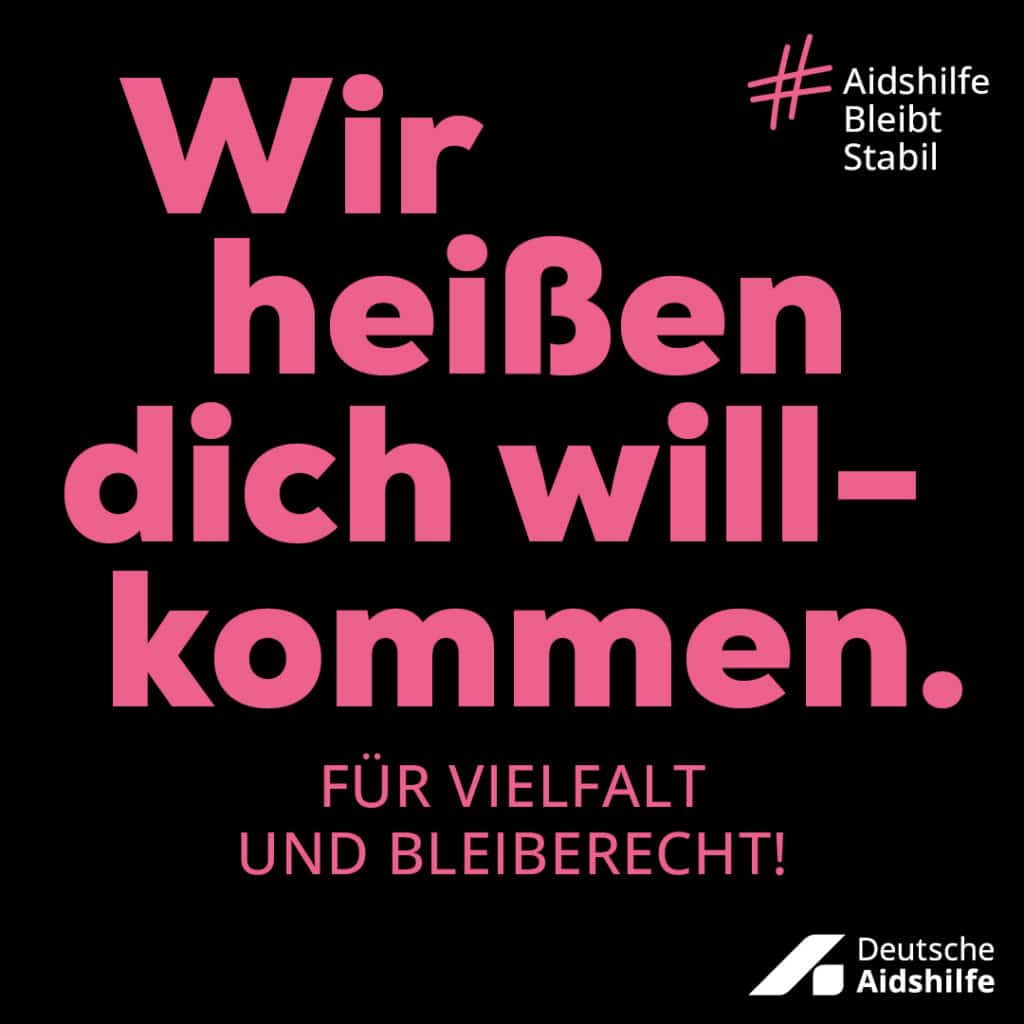
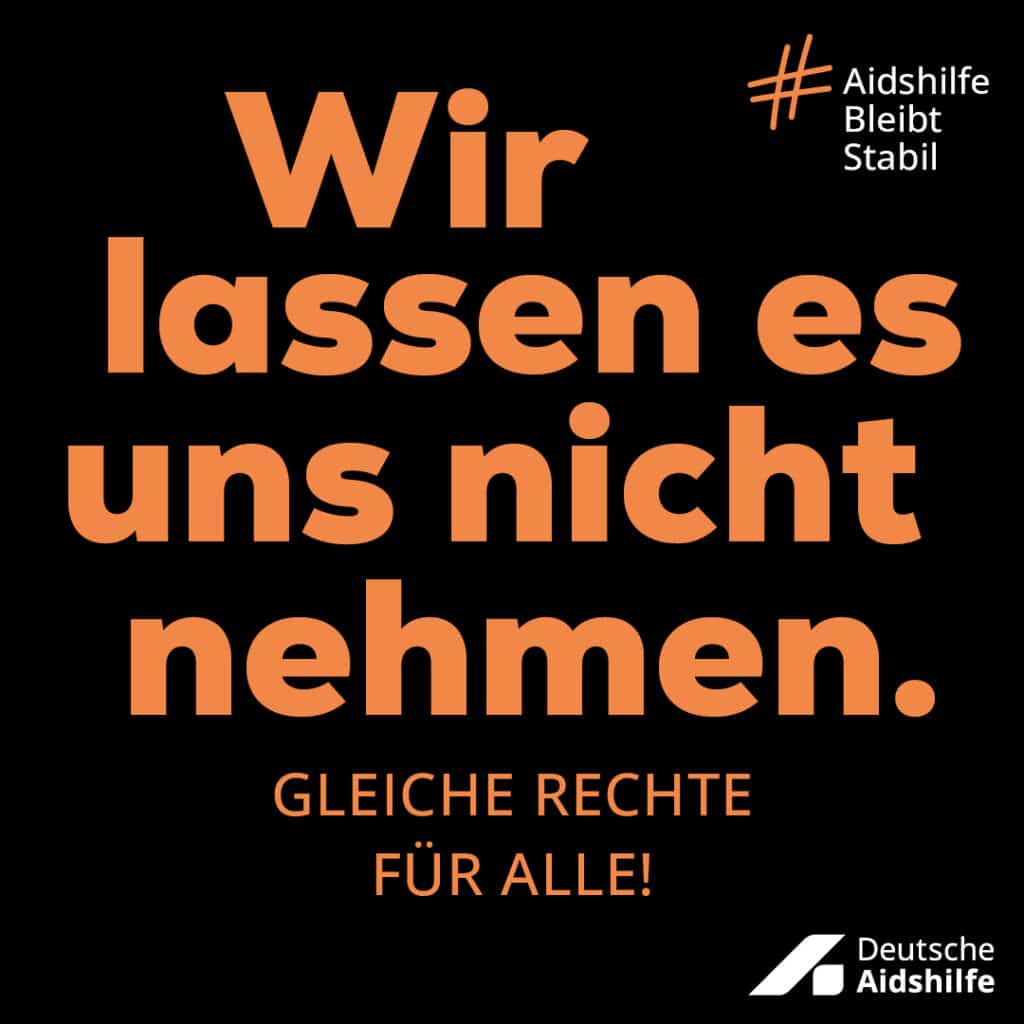
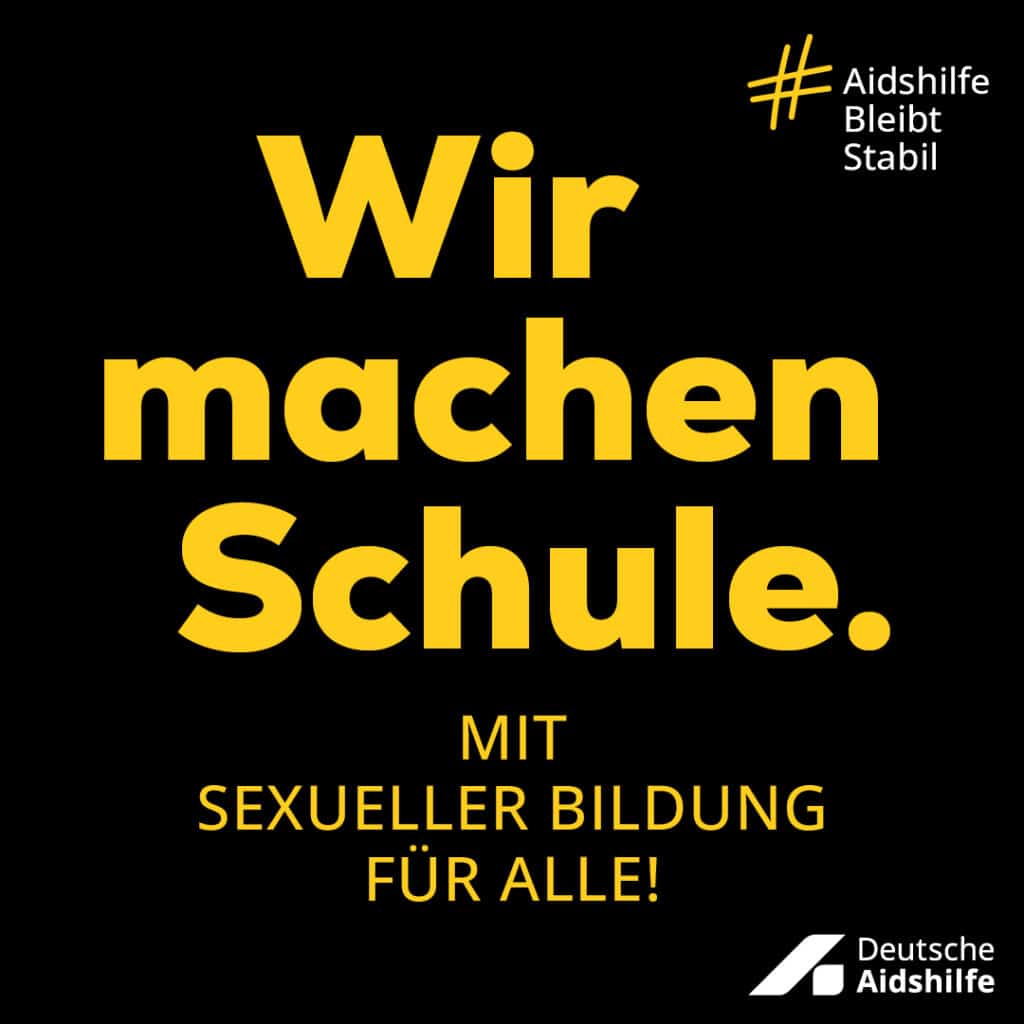
The campaign #AidshilfeStaysStable of Deutsche Aidshilfe sends a clear signal against right-wing populism, marginalisation and misanthropy. It highlights why AIDS service organisation work is important right now: for queer communities, for solidarity-based health work and for people affected by discrimination.
You can order the campaign stickers directly and use them wherever you want to make your stance visible - for example in advice centres, community spaces, at events or in everyday life. Simply click on a motif to access the respective order offer.
DAH campaign motif against exclusionDAH campaign motif for equal rightsDAH campaign motif on sexual educationDAH campaign motif on human rightsDAH campaign motif against right-wing populismDAH campaign motif for solidarity with sex workersEnglish campaign visual by Deutsche Aidshilfe
Need someone to talk to?
Whether acute or simply for orientation - sometimes it helps to talk to someone in confidence. Use the Gay Health Chat - the button at the bottom right will accompany you on the page. There you can chat anonymously and free of charge:
- Personal live advice in the chat - Help by e-mail or telephone - Information on health, law, everyday life and more
The § Section 175 of the German Criminal Code was over 123 years of law in Germany (from 1871/1872 to 10 June 1994). He represented Sexual acts between men are a criminal offence and thus enabled the state persecution of gay and bisexual men.
In the vernacular, men who were persecuted or sentenced under this law were often called „175s“ after the paragraph that criminalised their love.
Why was Paragraph 175 created?
When the German Reich came into being in 1871, it adopted a criminal provision from older legal systems that was known as the „unnatural fornication“ between men was defined. The state thus treated consensual homosexual relations as a crime.
Such regulations existed in many European countries at the time - they were an expression of the widespread idea that same-sex love was „unnatural“ or „immoral“.
Historical overview of paragraph 175
Timeline
Key milestones at a glance.
1949-1969
Federal Republic of Germany
The stricter Nazi version of the law remained in force. Consensual sex between men remained a criminal offence. Tens of thousands of investigations and convictions.
1969
First reform
Partial decriminalisation in the Federal Republic of Germany. Exemption from criminal liability only from the age of 21. Legal inequality continues.
1973
Further relaxation of paragraph 175
The age of consent was lowered to 18. This brought it into line with the age limits for heterosexual relationships. Section 175 nevertheless remained in force.
1994
Final abolition of paragraph 175
Repeal of Section 175 of the Criminal Code. The end of a special criminal provision that has been in force for over 120 years.
from 2002
Reappraisal and rehabilitation
The legal rehabilitation of those convicted began. Recognition of state injustice. The memory remains part of queer history.
1871
Introduction of paragraph 175
Introduction with the Criminal Code of the German Reich.
„Unnatural fornication“ between men became a punishable offence.
Homosexual men were officially regarded as offenders.
1871-1918
Empire
Section 175 remained unchanged.
Criminal prosecution was part of the state's moral and regulatory policy.
Demands for reform remained without effect.
1918-1933
Weimar Republic
Section 175 remained in place despite social liberalisation.
Several attempts at reform failed.
Activists demanded its abolition, without success.
1935-1945
National socialism and aggravation
Massive tightening of § 175 under the Nazi regime.
Criminal liability was extended to all „lewd“ acts between men.
Arrests, prison sentences and deportations to concentration camps.
Labelling those affected with the pink angle.
1945-1949
Post-war period
Section 175 remained in force.
The NS tightening was not cancelled.
Persecution of homosexual men continued.
1950s-1968
Development in the GDR
Section 175 was hardly ever applied in the 1950s.
1968 Extensive deletion from criminal law.
Only sexual acts with young people remained regulated.
1949-1969
Federal Republic of Germany
The tightened NS version remained in place.
Consensual sex between men remained a punishable offence.
Tens of thousands of investigations and convictions.
1969
First reform
Partial decriminalisation in the FRG.
Impunity only from the age of 21.
Continued unequal treatment under the law.
1973
Further relaxation of paragraph 175
Lowering the age of consent to 18.
Approaching heterosexual age limits.
§ Section 175 nevertheless remained in place.
1994
Final abolition of paragraph 175
Deletion of § 175 from the penal code.
End of a special criminal offence that has existed for over 120 years.
from 2002
Reappraisal and rehabilitation
Legal rehabilitation of the convicted began.
Recognition of state injustice.
Memory remains part of queer history.
Social and cultural significance
§ 175 was not only a legal law, but central expression of social homophobia in Germany over many generations.
It had a massive impact on the lives and freedom of gay men: from discrimination and stigmatisation to imprisonment and persecution.
The term „175“ and the long fight against this standard are therefore not only for legal oppression, but also for the protracted political and social struggle recognition, visibility and human rights of homosexual people in Germany.
Frequently asked questions about paragraph 175
Paragraph 175 is one of the darkest chapters in German legal history. Here we answer key questions about the law, its application and its significance to this day.
What was Paragraph 175?
Paragraph 175 was a section of the German penal code that criminalised sexual acts between men. It was in force from 1871 to 1994 and criminalised homosexual men for more than a century.
Why was Paragraph 175 introduced?
Paragraph 175 was introduced in the German Reich in 1871. It was based on the moral and social ideas of the time, which regarded same-sex love as „unnatural“ or „immoral“.
How was Paragraph 175 applied under National Socialism?
Under the Nazi regime, Paragraph 175 was massively tightened in 1935. Criminal liability was extended so that even the slightest offence could be prosecuted. Tens of thousands of men were arrested, sentenced or deported to concentration camps.
Did Paragraph 175 continue to apply after 1945?
Yes, after the end of National Socialism, Paragraph 175 initially remained in force in both German states. While it was later largely abolished in the GDR, even the stricter Nazi version continued to apply in the Federal Republic of Germany for a long time.
Were the victims rehabilitated?
The legal rehabilitation of men convicted under Paragraph 175 did not begin until 2002, meaning that the injustice they suffered was recognised very late.
Why is Paragraph 175 still relevant today?
Paragraph 175 symbolises state discrimination and persecution of queer people. Its history shows how laws can violate human rights - and why legal equality and remembrance are so important.
The latest empirical surveys show a downward trend in the acceptance of queer diversity. Trans people are particularly affected by this. The „Diversity Barometer 2025“ commissioned by the Robert Bosch Stiftung confirms the trend. Although acceptance is still positive, it is declining. As the study categorises trans as a sexual orientation, specific findings are largely ignored.
Figures and trends - why trans hostility is on the rise
However, two statements have a trans focus and the values here are particularly striking: „Transsexuals should keep to themselves“ and „Changing gender is against nature“. The first statement was rejected by 56 % of respondents, the second by only 34 %, while 23 % agreed with it unreservedly (in between were the gradations „not very true“ with 18 % and „fairly true“ with 12 %).
As far as the downward trend in acceptance is concerned, we are already familiar with corresponding findings from the USA. However, it is not clear from these empirical snapshots why this is the case. But that is precisely the interesting question. There is often talk of the majority of society being overwhelmed by certain issues, as well as of increasing political polarisation resulting in a split in society.
The constant bombardment of right-wing populists and right-wing extremists - flanked by supposedly feminist and religious fundamentalist groups - plays an important role. This is all the more true when anti-trans positions are elevated to a government programme, as has been the case with the renewed Trump presidency in the USA since the beginning of the year. On the one hand, this makes it easy to see how easily attitudes can be manipulated and the tendency to go along with general sentiments.
Symbolic image: Trans communities in the headwind - self-determination provides support.
What does trans hostility mean - and who does it affect?
Either way, we cannot ignore the fact that trans hostility is currently on the rise in society. Because this is the case, I would like to take a closer look at the question of what we mean by trans hostility. Because its forms are wide-ranging and not necessarily always recognisable at first glance. However, its overt forms are easily recognisable. Hate and violence are the most visible. Their increase is documented in police statistics, although it can be assumed that there is an unquantifiable dark field, i.e. discrimination that is not even reported and reported, and on the other hand, the increasing number of registered trans-hostile offences in recent times is likely to reflect a growing awareness of the issue.
To come back to the „diversity barometer“. This also expresses trans hostility in numerical terms. If 13 % of respondents agree that trans people should keep to themselves and 8 % largely share this view, then this means nothing other than that around one in five people are against the social visibility of trans people. Even without knowing the specific motives, social exclusion is most likely to stem from a hostile attitude, however it is characterised. In any case, such an attitude jeopardises both equal rights and the social participation of trans people.
For the second statement, the figures in the negative range also speak in favour of a tendency towards anti-trans attitudes. This is because those who consider trans to be unnatural ultimately locate it in the spectrum of illness and perversion. It should be noted here that biology is fundamentally instrumentalised as an objection to trans. However, this is based on an error of reasoning, namely that a narrow, culturally characterised concept of naturalness is invoked. I will go into this in more detail later. Just this much in advance: the biology argument in the context of trans proves to be one of the favourites in the range of anti-trans narratives.
Hidden trans hostility: internal dynamics in trans and queer communities
I want to focus here on the hidden, not always obvious trans hostility that appears through the back door, so to speak. The fact that we also find it in the queer community and even in the trans community may be surprising and alienating, but unfortunately it is part of everyday life. The motives for this are difficult to discern, because when a trans woman describes herself as sick and abnormal and vehemently speaks out against gender self-determination, which she has ultimately claimed through her transition, we may perceive this as a regressive attitude, but the actual motive cannot be recognised. We can only speculate whether this is due to self-hatred, for example, or whether it is an internalisation of negative external attributions.
SBGG in focus: Protection of self-determination vs. the debate on abuse in trans
A broad gateway for trans hostility is the misuse debate surrounding the Self-Determination Act (SBGG) and the fact that those who use it to change their name and civil status (change of gender entry) because they are trans, inter or non-binary and therefore have a comprehensible reason to do so can do so by submitting a low-threshold application to the relevant registry office and providing self-disclosure. This is precisely the essence of gender self-determination.
The SBGG has now been in force for just under a year and seems to be working on the whole. Currently, 22,000 people across Germany are said to have utilised the law to date, although it can be assumed that the number will be lower in the future, as the initial backlog should have been cleared by now. However, there was one obvious case of abuse by a right-wing extremist, an abuse that was announced and for political reasons, primarily to discredit the SBGG.
Categorise cases of abuse: Protect SBGG, strengthen self-determination - against trans-hostile regression
However, despite a heated media debate, it cannot really be claimed that this has caused the rule of law to falter or that the SBGG and thus gender self-determination has been called into question. It is obvious that such abuse ultimately follows an anti-trans impulse. However, the solution cannot be to cancel the principle of self-determination in order to return to, for example, the assessment as we know it from the so-called Transsexuals Act. In my opinion, the solution can only be to penalise obvious abuse. In other words, the SBGG needs to be criminalised.
The creation of the SBGG was already accompanied by an ongoing debate about abuse, which contained a highly trans-hostile potential. It was discussed, for example, that men could use the law to gain access to gender-specific spaces, i.e. access to women's saunas, women's prisons and all places reserved for women, such as toilets, changing rooms, etc. But also to hijack women's quotas or women's car parks. But also, for example, to hijack the women's quota or use women's car parks.
Even if men were always mentioned, trans women also came under the radar of suspicion of abuse, combined with the conclusion that the changed gender entry was on paper but did not apply in reality. Reservations and resentment against trans women took full effect here and ultimately left clear traces in the legal text.
Legal loopholes: Military paragraph, equality principle and de facto trans-hostile effects
This was also the case with the so-called military paragraph, which suspends the change of gender entry in the event of defence, as if trans women would then cease to be trans. Trans men are not affected by this, which violates the principle of equality with regard to trans women, according to which all people are equal before the law.
This is another example of poorly concealed and basically blatant trans hostility that attacks our integrity head-on. Incidentally, the legislator does not seem to be aware of the right to conscientious objection enshrined in the Basic Law. No change in civil status is required to exercise this right. Such scenarios show how deeply reservations about trans people are anchored in legal practice. The prime example is the so-called Transsexuals Act. Its restrictive nature led to several human rights violations, which the Federal Constitutional Court gradually eliminated.
Sketch: Queer teacher leads through a workshop - education, legal protection and lived self-determination as answers to trans hostility.
Recognising gender identity: Language, rights and self-determination for trans people
Let us turn to another area of discrimination that has already been briefly mentioned here: This is the talk of so-called biological gender, which is associated with two main statements. Firstly, it is intended to emphasise that there are only two genders. However, nobody in their right mind would deny the fact that there are women and men with distinct physical characteristics.
Where trans people find themselves in a gender binary defined by reproduction remains open, of course. After all, trans cannot be explained by gonads and genes. On the other hand, the existence of trans is also a fact that is supplemented by the findings of ethnology and cultural history research to the effect that there have always been people like me everywhere in the world, i.e. people who have changed gender roles.
The reference to the fact that nature is characterised by a wealth of variants, intended as a defence of sexual diversity, is true when it comes to sexual characteristics or hormonal and chromosomal issues, and is understandable as an objection to strict bisexuality, but is unfortunately not really helpful in answering the question of why trans exists. We cannot find a conclusive answer in it. The fact that this why cannot (yet) be answered makes us - unsurprisingly - easily vulnerable. The broad anti-trans front confirms this.
Ways out of trans hostility: education, legal protection and active self-determination
I had spoken of two different statements in connection with the talk of biological gender. The first statement claims that there are only two genders and leaves out trans people. The second denies gender identity, i.e. what characterises the reality of trans people's lives. It assumes that trans people always remain their birth gender regardless of body-altering measures. The statement is then: a trans woman remains a biological man and a trans man remains a biological woman. Such thinking has far-reaching consequences. Without going into detail here, its traces can be traced right through to current legislation, where a term such as gender identity is consistently avoided. The consequence: trans remains excluded, does not count wherever questions of gender are concerned.
I think it is obvious what is trans-hostile about it. It is a frontal attack on our integrity that casts doubt on our human ‚authenticity‘. The Self-Determination Act allows us gender self-determination on the one hand, but treats the confirmed gender identity as something second-class, not of full value.
Ways out of trans hostility: education and self-determination
There is no doubt that we are still at the beginning - despite all that has been achieved. The SBGG was made for trans, inter and non-binary people, but it looks like society as a whole still has to become gender-fluid.
FAQ on trans hostility
This FAQ section explains trans hostility and shows ways out - with a focus on trans perspectives, SBGG and self-determination. Use this FAQ section to quickly find definitions, figures, legal protection and practical tips.
What is trans hostility?
Trans hostility refers to derogatory attitudes, language or actions towards trans people - from mockery and misgendering to discrimination and violence. It has an individual, institutional and structural effect and reduces visibility and self-determination.
Why is trans hostility on the rise?
Polarised debates, disinformation and political tailwinds for anti-trans narratives reinforce prejudices. Where emotions dominate and facts are lacking, acceptance declines; influential actors accelerate this effect.
What forms of trans hostility are there?
Openly: Verbal abuse, threats, assaults. Covert: Gatekeeping, bureaucratic hurdles, ignoring gender identity and the „biology“ argument. Both restrict participation and self-determination.
What is the SBGG?
The SBGG is the Self-Determination Act. It makes it easier for trans, intersex and non-binary people to change their name and gender entry, thereby strengthening legal self-determination.
What role does the SBGG play in the context of trans hostility?
It removes barriers and protects dignity. At the same time, it is sometimes instrumentalised in anti-trans debates about abuse. The aim should be to take clear action against abuse without weakening the principle of self-determination.
What is the Self-Determination Act?
The Self-Determination Act (SBGG) regulates how people can change their first name and gender entry on their own responsibility. It replaces degrading assessments, simplifies procedures and strengthens legal protection and self-determination.
Our YouTube channel was blocked at the beginning of June. The reason? Alleged "nudity". This type of blocking often raises the question of queer censorship. One could discuss here what the depiction of nudity actually means. Is it simply bare skin, for example a video of cheerful men without tops, enjoying their company but not engaging in any sexual activity? Or is an image only categorised as pornographic when genitals are visible, regardless of the context? Is nudity always a bad thing or can it also serve good purposes?
The fact that such questions have to be asked in 2025 is the best illustration of how far society has fallen behind as a result of the shift to the right in recent years. Make no mistake: it is no coincidence that this move comes at a time when right-wing and far-right discourse is increasing dramatically and US corporations - our supposed "allies" - are unmasking themselves under the influence of Donald Trump's anti-"woke" policies. As soon as a different political wind blows and support is no longer worthwhile, the big players like Meta and Alphabet show their true colours. They have never been serious about the rights of LGBTIQ+ people, they just wanted to make money out of it. The fact that what is defined as a breach of policy primarily affects diversity endeavours - including queer education and prevention work - is symptomatic.
Apart from the fact that nudity is simply aesthetic - as the artists of antiquity already knew - it has often played an activist and political role in modern history. The fight against nudity (both real and perceived) in any form is just as old. In the following article, parallels will be drawn between today's queer movement and the first German queer movement (ca. 1897-1933). The context may be different, but the challenges are anything but new.
The beginnings of a struggle for self-determination
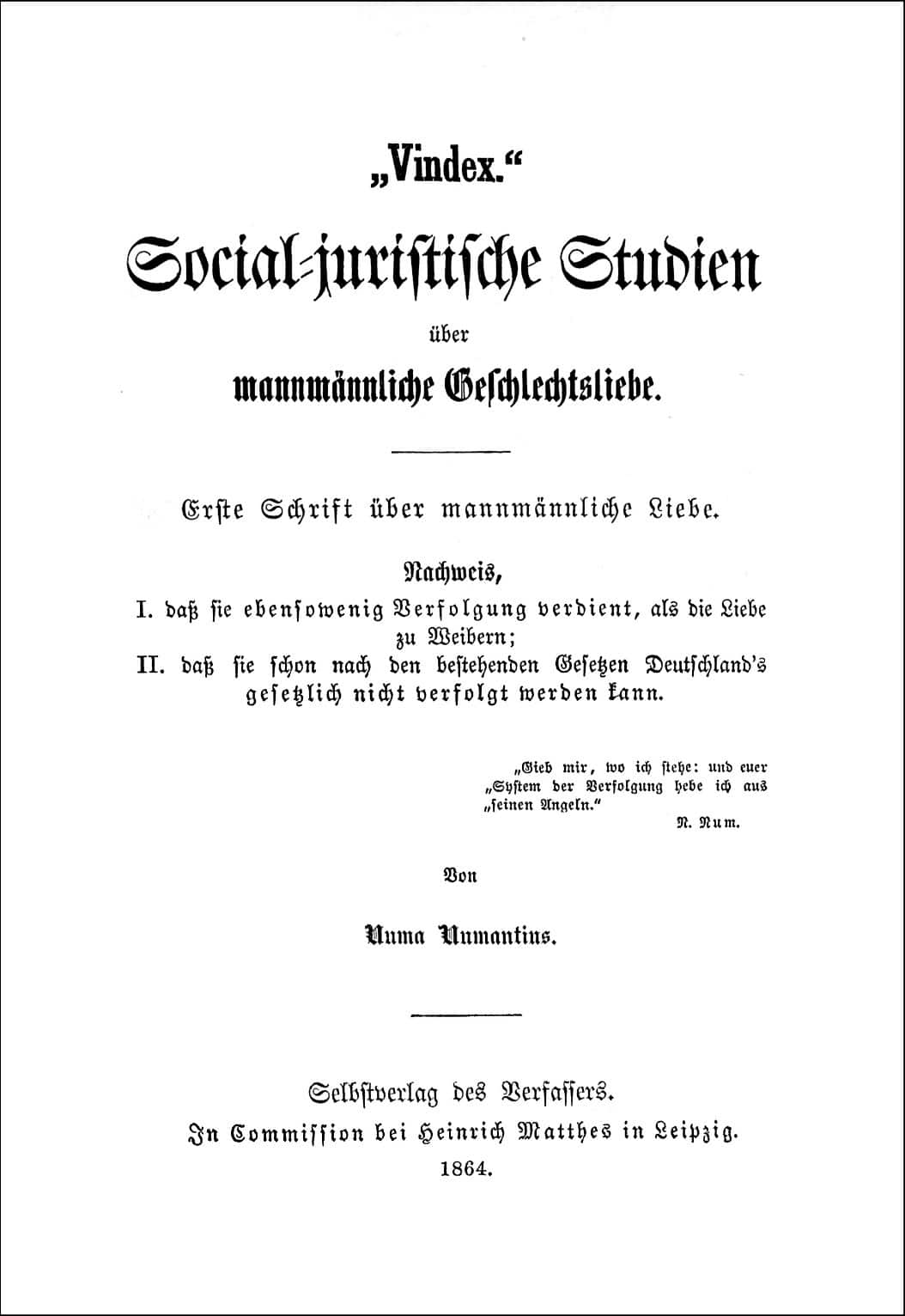
"Vindex", the first writing by Karl Heinrich Ulrichs, published under the pseudonym "Numa Numantius".
Source: Wikimedia Commons (https://commons.wikimedia.org/wiki/File:Ulrichs_1_-_Vindex.jpg)
Modern queer activism originated in Germany in the late nineteenth century. The primarily journalistic activity of the early pioneer Karl Heinrich Ulrichs (1825-1895) strongly influenced his later comrades-in-arms. Nevertheless, Ulrichs published his writings under the pseudonym "Numa Numantius", as the consequences of an affirmative treatment of homosexuality could have been serious.
Another queer pioneer was influenced by Ulrichs, namely Magnus Hirschfeld (1868-1935), co-founder of the Scientific-Humanitarian Committee (WhK) and editor of its organ, the "Jahrbuch für sexuelle Zwischenstufen". In 1919, he founded the Institute for Sexual Science, the first globally recognised queer educational institution, which was plundered soon after the Nazis came to power. What set Hirschfeld apart from other leaders of the "homosexual" movement was his inclusivity towards different forms of queerness and different social groups: "aunties", effeminate men, masculine women, trans* people and sex workers.
Explicit male prostitution was a central point of contention in the queer activist milieu of the time. Under the leadership of Friedrich Radszuweit, the Bund für Menschenrecht (BfM), the leading and largest queer umbrella organisation in Germany from 1923, acted according to the guiding principle of "respectability", which sacrificed solidarity with "indecent" queers. The Gemeinschaft der Eigenen (GdE), founded in 1903, on the other hand, was an all-male grouping of elitist and conservative anti-feminists who only saw women in a subordinate role as mothers and house carers.
The battle with "lewd writings"
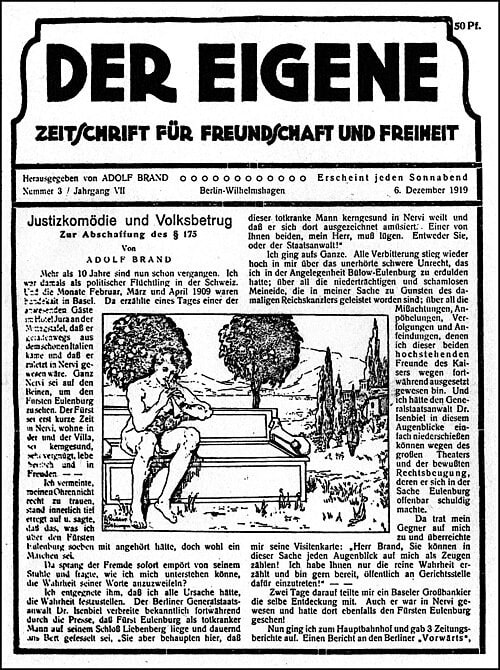
An issue of "Der Eigene" from 1919. The magazine regularly contained images of naked men and even boys and teenagers.
Source: Wikimedia Commons (https://commons.wikimedia.org/wiki/File:Der_Eigene_1919_vol_7.jpg)
Source: Wikimedia Commons (https://commons.wikimedia.org/wiki/File:Ulrichs_1_-_Vindex.jpg)
Despite his problematic ideological stance, Adolf Brand (1874-1945), co-founder and long-time director of the GdE, also made some contributions to queer emancipation. According to current knowledge, the magazine "Der Eigene", which he published irregularly from 1896, is the first homosexual magazine in the world, even if it was aimed at a more upscale (and implicitly male) readership. As "Der Eigene" often contained images of naked men and thus violated Section 184 (sale and distribution of "lewd" writings), Brand had to stand trial several times and even serve prison sentences. Incidentally, the "Jahrbuch für sexuelle Zwischenstufen", a scientific publication, was spared a similar fate.
After the Weimar Constitution came into force in 1919, queer emancipation developed into a mass movement. This was made possible by the publication of the magazine "Die Freundschaft", which networked queer people throughout Germany and initiated the founding of local "friendship associations". However, the editorial team had to reckon with inconvenience right from the start: A report was made to the authorities within the first few weeks. Although the editor Karl Schultz was acquitted in March 1920 of the charge of offending morality under § 184, a year later he was sentenced to six weeks in prison.
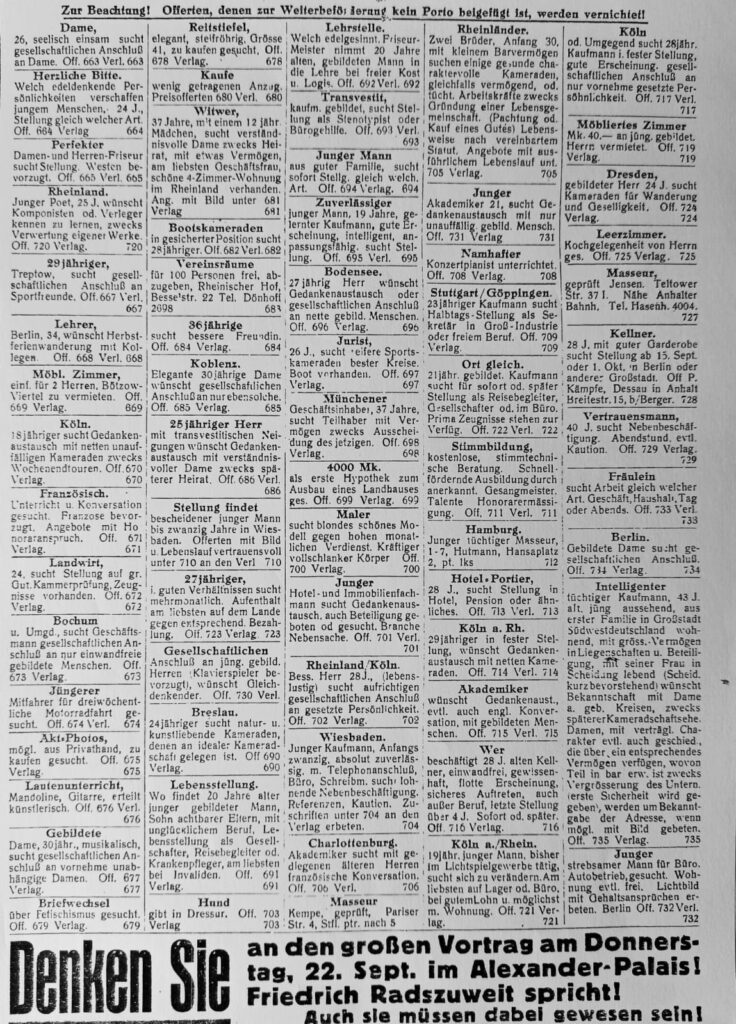
This time the offence was procuring. How was this charge justified? The decisive factor was the adverts, i.e. personal adverts, which encouraged queer people to get to know each other and possibly - according to the court's reasoning - also sexual contact. Consequently, they disappeared from the magazine and were now only available as part of a subscription to a separate extra sheet.
Preservation of youth
A sample advert page from "Die Freundin". Adverts were often the subject of great controversy and even criminal proceedings.
Source: Forum Queeres Archiv München (https://archiv.forummuenchen.org/zeitschrift/die-freundin/)
In February 1923, the legal problems of "Die Freundschaft" returned. In the course of renewed censorship proceedings, the magazine was suspended by the authorities for three months. In 1926, the Reichstag passed the law "for the protection of youth from obscene and dirty writings", in the creation of which the Christian "morality associations" played a key role. It introduced a list of obscene writings that included not only queer literature and on which individual editions could be placed. A corresponding entry meant that the respective edition could not be displayed publicly, but could only be sold on request (i.e. under the counter, so to speak). As the name of the law suggests, this was justified by the protection of minors.
Several issues of queer magazines, including "Frauenliebe" in 1927 and "Die Insel" in 1928, made it onto the list. A common counter-strategy was to sell the magazine under a different title so as not to interrupt the continuity of issues. In 1928-29, for example, "Die Freundin" was sold as "Ledige Frauen" after the former had been placed on the list. Sometimes individual newsagents got into difficulties without knowing about the ban on individual issues.
Other facets of censorship
Walter Homann's novel "Diary of a Male Bride". Even though the two censorship proceedings failed, cuts had to be made to the most controversial material.
Source: Männerschwarm Verlag (https://www.maennerschwarm.de/buch/tagebuch-einer-maennlichen-braut/)
Novels and films also fell victim to censorship. One example is Walter Homann's Diary of a male bridewhich was inspired by the story of the self-proclaimed "Comtesse" (or countess) Dina Alma de Paradeda. The novel was even censored twice (in 1907 and 1928). Even though both trials ended favourably for the book, the great furore surrounding its publication led to the most controversial material being cut in subsequent editions.
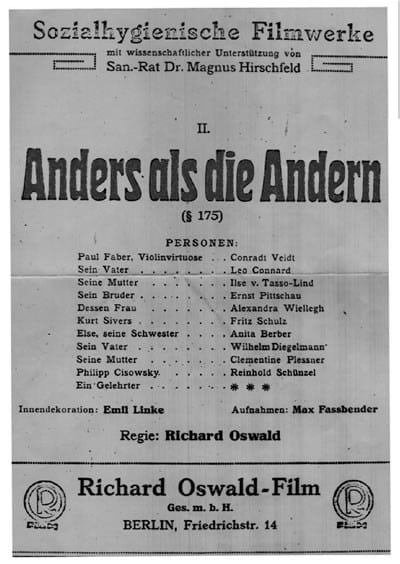
The first German film and one of the first in the world to address homosexuality - Richard Oswald's Different from the others -, was banned in August 1920, over a year after its premiere. Although the production is about the same-sex love between a musician and his adult pupil, there is hardly any affection in the film, let alone a kiss. Nevertheless, the film caused huge controversy and there were protests against its broadcast in many cities across Germany.
Hirschfeld, who played a key role in the film and had already been exposed to hostility in the past due to his work, became the arch-enemy of the extreme right as a result of the controversy. He was attacked several times, in October 1920 in Munich so badly that some newspapers prematurely announced his death. Some of his lectures were cancelled with explicit reference to his involvement in the film, others degenerated into riots with the use of stink bombs and fireworks.
Poster of the film "Anders als die Andern", which was banned in August 1920 after more than a year of protests.
Source: Wikimedia Commons (https://commons.wikimedia.org/wiki/File:Anders_als_die_andern_1919_poster.jpg)
Another form of "censorship" and intimidation that deserves its own article is the police surveillance of queer meeting places. In cities such as Dresden, Chemnitz, Munich and Hanover, queers were even registered and interrogated in the 1920s. Raids were not uncommon either: on 2 July 1921, for example, a party organised by the Görlitz Friendship Association at the Hotel Namenlos was interrupted by a local police operation. A total of 23 people were arrested and detained until 12 noon the next day, two of them even for a day longer. The charge was pimping, but in the end no charges were brought.
Technological repression
Today, of course, we live in a different world and enjoy significantly more acceptance and rights than our queer ancestors. But it is precisely these that are increasingly being called into question, jeopardising the achievements of the struggles of the last sixty years. Against this backdrop, the alliance between the far right and large technology companies seems all the more frightening.
What was openly and aggressively combated by the authorities a hundred years ago as fornication, a violation of morality or in the name of protecting minors is now being tackled much more subtly and seemingly harmlessly. Under the guise of "community guidelines", "safe" or "advertiser-friendly content", queer content, safer sex education and HIV prevention are censored. Some forms of censorship, such as shadow banning or age restrictions, are not immediately recognisable and are therefore much less visible. In addition, decisions on the authorisation of online content are increasingly being made by algorithms rather than humans.
In the worst-case scenario, this can cost lives. Queer young people in particular need access to information that not only educates them about sexual health, but also protects them from feelings of inferiority or even suicidal thoughts. HIV prevention and queer education work must not fall victim to the algorithm regime under any circumstances.
Whenever there are warnings about the dangers of the increasing right-wing radicalisation of society and the possibility of a far-right government, many people say: "It won't be that bad." A hundred years ago, the prospect of Adolf Hitler coming to power was played down in the same way. A few years ago, the risk of political data misuse by US big tech companies also seemed unlikely and was trivialised by many. Today, we can no longer be so sure.
Bibliography
Beachy, Robert. Gay Berlin: Birthplace of a Modern Identity. 2014. New York City: Vintage Books, 2015.
Foit, Mathias. Queer Urbanisms in Wilhelmine and Weimar Germany: Of Towns and Villages. Cham, Switzerland: Palgrave Macmillan, 2023.
Dobler, Jens. "Epilogue." In Diary of a male brideed. Dobler, 154-175, Hamburg: Männerschwarm Verlag, 2010.
-. Police and homosexuals in the Weimar Republic: On the construction of the scapegoat. Berlin: Metropol Verlag, 2020.
-"Censorship of books and magazines with homosexual themes in the Weimar Republic." Invertito - Yearbook for the history of homosexuality 2 (2000): 85-104.
Malakaj, Ervin. Different from the others. Montreal, Quebec: McGill-Queen's University Press, 2023.
Micheler, Stefan. Magazines, associations and clubs for same-sex desiring people in the Weimar Republic. Stefan Micheler Homepage. August 1, 2008. www.StefanMicheler.de/zvlggbm/stm_zvlggbm.pdf.
Vendrell, Javier Samper. The Seduction of Youth: Print Culture and Homosexual Rights in the Weimar Republic. Toronto: University of Toronto Press, 2020.
Just in time for Pride Month YouTube removed our channel without any warning. The reason? Our videos on Sexuality, queer realities of life and Safer sex would violate guidelines on "sex and nudity" - and were allegedly "a danger for the community".
That's a slap in the face - and not just for us, but for allwho are in favour of Education, visibility and sexual health use.
We make no porn. We make Empowerment - for gay, bi+, trans and queer people.
We now even have to write terms like "sex" with two Gs ("segg") or disguise them with special characters - just so the algorithm doesn't block us.
What now? We will continue. Loud. Visible. Uncomfortable.
We will not be silenced. Our work is important - and we are continuing it.
We tell you exactly what happened in the video below:
Explanation of the video
Campaign management: Jonathan Gregory Press and public relations: Chris*tian Gaa
Just in time for Pride Month, the German AIDS Service Organisation's prevention channel was deleted from YouTube. In this video, Jonathan explains the background and how this could have happened. Chris from the press department explains why the channel is so important for queer health education.
Editor's note: This article was written by cultural anthropologist Patrick Wielowiejski from his academic perspective. Wielowiejski has specifically analysed the AfD as part of his research. It is important for us to emphasise that many of the ideologies and positions described here are not limited to the AfD, but can also be found in other parts of society, which is why we have decided to publish them for discussion in our community.
According to the AfD, self-determination is actually a good thing. In the Lead Motion for their programme for the Bundestag elections, it states, among other things, that people with disabilities should be able to lead "as self-determined a life as possible"; a "state-generated pressure to vaccinate" is countered with "the right of citizens to self-determination over their physical integrity, which is enshrined in the German Basic Law"; and the demanded tightening of asylum and migration policy is also justified with this concept: "An existential question such as immigration must be decided in free self-determination at national level."
When it comes to gender identity, however, self-determination is a thing of the past for the AfD. It wants to repeal the "Law on self-determination with regard to gender registration" introduced by the traffic light coalition, which came into force on 1 November 2024. This law makes it easier for trans, inter and non-binary people to change their marital status and first name. In its definition of gender, it is not based on supposed biological facts, but on self-perceived gender identity. In contrast, the AfD demands: "The reality of bisexuality must be recognised again[.]" This expresses the AfD's anti-liberalism, as the idea of sexual and gender self-determination presupposes that the subject has a certain degree of freedom in relation to their own identity.
However, this does not mean that lesbians, gays, bisexuals and trans people are excluded from the AfD as such, which is often perceived as a contradiction by the public. In fact, the AfD mainly integrates homosexuals, especially gay men, into its ranks and right-wing trans people also organise themselves in the AfD. As long as they recognise the "reality of bisexuality" and thus reject queer views of gender and sexuality, LGBT people are tolerated by the AfD. How is this to be understood?
Between homonationalism and anti-liberalism
In ethnographic research between 2017 and 2019, I followed the connection between right-wing populism and homosexuality (Right-wing populism and homosexuality. An ethnography of enmity, Campus 2024, Open Access). I was interested in the ways in which the AfD refers to homosexuality today. The central protagonists of this political field are the "Alternative Homosexuals" (AHO) - a handful of gay AfD politicians whose aim is both to have an impact within the party and to convey to the outside world that being right-wing and gay at the same time is not mutually exclusive. Historically, this is nothing new - prominent right-wing homosexual men include the SA leader Ernst Röhm and the neo-Nazi Michael Kühnen. But while they were fought against from within their own ranks, members of the AHO are largely accepted in the AfD. At the time of my field research, it was even said that a prominent Berlin AfD politician claimed that he had never had to deal with as many homosexuals in his professional life as in the AfD.
"As a result, we are not primarily dealing with homophobia or trans-hostility (even if these have by no means disappeared completely), but above all with queer hostility."
One obvious reason for this shift is that support for liberal LGBT rights has become a badge of modernity par excellence and the moral flagship of the West. The US-American gender and queer theorist Jasbir Puar has labelled this situation "homonationalism" in her book Terrorist Assemblages called. Referring positively to the rights of gender and sexual minorities and claiming that they are endangered by an "Islamisation" of Europe is therefore simply strategically clever for the AfD - it is a rhetorical modernisation analogous to the dédiabolisation of the then French Front National (now Rassemblement National) by Marine Le Pen. The Islamophobic slogan "I have no desire to repeat the emancipation of women and gays", which the Dutch right-wing populist Pim Fortuyn formulated in the early 2000s, is now part of everyday right-wing thinking. With regard to the rights of trans people, a similar argument can be made, which political scientist Judith Goetz calls "Transchauvinism" labelled.
However, not everyone in the AfD and certainly not everyone on the far right can relate to "liberal Western values". Some do not see Islam as the greatest threat of the present day, but rather liberalism and US hegemony - such as the former history teacher and journalist Karlheinz Weißmann. LGBT people who make an issue of their "abnormality" (in the words of several of the people I spoke to) are still suspected of decadence. Anyone who speaks of emancipation assumes that unequal power relations can be changed - and this assumption is considered threatening by the far right. On the other hand, the ethnosexist figure of the patriarchal and homophobic Muslim man from the Middle East does indeed evoke a sense of decadence among some right-wing men. Fascination and admiration out.
This is why the LGBT right-wing populists of today present themselves as enemies not only of Islam, but also as enemies of the left. During an event organised by the AHO in Essen in June 2018, Matthias "the friendly face of the NS" Helferich, in which he said the following, among other things:
"When it comes to homosexuality, the concept of normality is always a point of contention. Do you know what I think? I think the Alternative Homosexual Organisation is terribly normal when I look at the left in this country. Because what belongs to normality is that you love your homeland and that you have a positive connection to your homeland and to your patriotic self. And I would much rather live in the normality of the alternative homosexual organisation than in the normality that is currently entering our country, in the normality of polygamous marriages, child marriages and forced marriages."
Right-wing homosexuals are therefore at least more "normal" than "the left in the country". For someone like Helferich, they should therefore be taken seriously as allies, at least strategically.
Essentialism instead of emancipation
A central element in the right-wing cultural struggle against the imagined left-wing hegemony is the fight against "gender ideology". The "exaggeration" of LGBT people and their concerns is part of this ideology in the eyes of the far right. LGBT people within the AfD must not only credibly demonstrate that they have nothing to do with this, but also refute the supposed assumptions of "gender ideology" in their arguments and performances. Accordingly, the guiding principle of their political action cannot be gender and sexual self-determination, but rather the orientation towards an essentialist understanding of gender and sexuality. A clear commitment to this is the inescapable condition for the integration of LGBT people into external rights and for their normalisation. As the aforementioned lead motion for the programme for the Bundestag elections states: "Femininity and masculinity [...] with their different potentials are something positive. This means that women and men can complement each other perfectly", then the LGBTs in the AfD must make it unmistakably clear that they see it the same way. In other words, they must be the biggest anti-genderists of all precisely because they are suspected of gender bias due to their gender or sexual identity.
For gay men, for example, this means that they have to affirm that they are unquestionably male. One of my dialogue partners - an AfD member of parliament, whom I'll call Andreas - once described it like this: "Loving a man as a man is a double decision for being male." Or in the words of Björn Höcke (in conversation with the artist and journalist Sebastian Hennig in the book Never in the same river twice): "There are quite a number of gay men who are more solidified in their masculinity than many 'straight' men - even in politics." As the aim of "gender ideology" is to equalise and ultimately abolish the sexes, the "alternative homosexuals" see their identity as gay men as a result. endangered.
These are arguments that were already shared by some parts of the homosexual emancipation movement at the beginning of the 20th century. Around 1900, for example, writer Adolf Brand's "Gemeinschaft der Eigenen" (community of one's own) was of the opinion that male homosexuality was a superior form of masculinity. It thus took a stand against Magnus Hirschfeld's theory of sexual intermediates and the idea of homosexuals as the "third sex". AfD member of the state parliament Andreas suggested I read Hans Blüher's The role of eroticism in male society from 1917, which was one of his sources of inspiration. Blüher was known as an anti-Semitic and anti-feminist writer and an early member of the German Wandervogel movement. He was of the opinion that the state and society were held together by masculine Eros - that is, the homoerotic male bond. However, the fact that Andreas himself did not conform to the image of the gay male hero and liked to flirt with a certain kind of behaviour towards me also points to the contradiction between political rhetoric and lived reality - not to mention the performativity of gender in the far right as well.
Gay antigenderism must therefore show that homosexuality has nothing to do with transgressing gender boundaries. While masculinity is even confirmed here, right-wing trans people have to argue differently, because for them the gender assigned at birth and the self-perceived gender fall apart. In her book, the social worker and gender researcher Katrin Degen Flexible normality biologistic, religious and pragmatic strategies that right-wing trans people use to argue that their own existence is compatible with a right-wing world view. For example, a woman who identifies as transsexual writes on the blog of the gay Catholic theologian and right-wing publicist David Berger that the only binary form of transsexuality exists in the world. "Brain gender" is "sometimes the opposite of genetic gender". It is therefore crucial for these actors to understand their own transgender identity in such a way that it confirms rather than refutes the gender binary: Even if it is a "Brain and genetics falling apart" gender identity is determined by biology and cannot be changed. Andreas described it like this: "It is precisely this knowledge that you are a woman in a male body or vice versa that proves that there are only these two genders."
Queer-hostile LGBTs - or would you prefer self-determination?
Gender and sexuality have always been central to the politics of the far right. In the anti-liberal culture war that the right currently invokes, this is expressed in such a way that an essentialist understanding of gender and sexuality is positioned against an emancipatory or constructivist one. The idea of self-determination is rejected as a left-wing fantasy of omnipotence. As a result, we are not primarily dealing with homophobia or transphobia (even if these have by no means disappeared completely), but above all with queerphobia. This means that some parts of the so-called community can be integrated into the historical bloc of the right - namely those who affirm the phantasm of a natural, stable, unambiguous identity. Or, in short, the least queer of them.
However, the right-wing alliances and their consensus remain contradictory and fragile. On the one hand, the AfD associates the integration of gender and sexual minorities with the hope of becoming more compatible with society as a whole. On the other hand, it is hard work for right-wing homosexuals and trans people to plausibilise both within the AfD and to the outside world why they fit in well with the right-wing camp. Above all, it is questionable whether the arguments put forward can convince LGBT people across the board. Perhaps self-determination is the more attractive political proposition after all.
As Pride celebrations grow and proliferate, they often become sites of controversy: What is being celebrated-the diversity of the community or just the visibility of a select few? Who gets to take part in this celebration, and who is left out or sidelined? From corporate sponsorships to grassroots protests, author Ahmed Awadalla examines the ever-evolving landscape of LGBTIQ+ Pride in Germany.
Berlin stands apart. If you ask someone in the city about attending a Pride event, they'll likely respond with another question: "Which one?" This is the essence of Berlin-a metropolis that hosts a multitude of queer marches and initiatives, each with its own distinct priorities and vision of the LGBTIQ+ experience. In a city this vast, with its diverse communities and subcultures, there's always a space where one can feel seen-or at least, it seems that way.
Having lived in Berlin for years, I've witnessed the Pride landscape shift and evolve, with each event embodying a different interpretation of queerness. What first stood out to me during my early summers in the city was the name "Christopher Street Day" (CSD)-a direct reference to the American Stonewall Riots. These riots erupted in response to persistent police harassment following a raid on a New York bar. Although a pivotal moment in queer history, the choice felt curious, if not a little dissonant, considering Germany's deep history of advocacy for queer rights.
Naturally, when I first arrived in Berlin, I was eager to join a queer march in the hope of finding community and connection. My first march wasn't a typical Pride event but a protest organised by Nasser Al-Ahmad, a young Lebanese man who faced brutal violence from his family after coming out. The march began outside a mosque in Neukölln to challenge the role of religious institutions in promoting homophobia. Despite Nasser's efforts to emphasise that homophobia wasn't just "a Muslim problem," media coverage framed the issue as a clash between queer and migrant communities, pitting them against each other.
As I marched, I quickly noticed how out of place I felt in the predominantly white crowd. At one point, a woman asked me to move aside, assuming I wasn't part of the protest, likely because of my appearance. This made me question my own belonging in a space that was supposed to be about solidarity and plurality. It highlighted the uncomfortable reality that even within queer spaces, not everyone feels welcomed or understood. Different people I spoke to had their own take on what Pride means to them. For some, it feels like home, while for others, it remains a space where their struggles are made invisible.
Between Celebration and Commercialisation
The first German CSD took place in Berlin in 1979, inspired by American Pride events but soon adapted to local politics. What began as passionate protests for LGBTQ+ rights has, over time, turned into something much more mainstream and commercialised. Big companies and political parties now play a more significant role. This trend is part of a larger pattern called "rainbow capitalism," where businesses use LGBTQ+ symbols and slogans for profit, while urgent issues facing the community, especially those on its margins, are pushed aside.
"Honestly, I couldn't stand it," said Mahdi, a community member who left CSD Berlin this year after just 10 minutes. "Pharma companies, banks, and internet giants-what do they have to do with our struggle?" Mahdi's frustration is palpable. For him, the sight of straight people occupying corporate floats felt like another layer of erasure. "I get that allies are important, but they need to be mindful of the space they take up," Mahdi added, reflecting a common sentiment among those who feel mainstream Pride has lost its way.
But not everyone shares this sense of alienation. "For me, my reasons for going to CSD are two-fold," said Cameron, a regular CSD attendee. "The principles of Pride are still very worthy. It's a day where we can celebrate our LGBTQ+ identities and reflect on how we're not just tolerated but accepted and even celebrated by wider society." Cameron acknowledges the criticisms about corporate influence but admits that, for him, it doesn't overshadow the event's value. "Yes, the parade has been hijacked by corporate interests, but the party atmosphere-dancing in the rain to Spice Girls with queer folks from all over the world-is still magical. It's just fun!"
Cameron recognises his own privilege within these spaces. "I haven't felt excluded because I fit the classic stereotype of a white gay male. I can see why others might feel less represented," he admitted. Hassan, a gay man of colour, shares Cameron's sentiment: "My birthday aligns with CSD Berlin, so my friends visit me from other cities, and we get to experience this collective joy, dressing however we want. It's a time to truly celebrate together."
Tensions Under the Rainbow
While some are disillusioned by Pride's shift away from its radical roots, others appreciate it as a space for self-acceptance. But this raises a fundamental question: Should Pride be about identity or action? Is it enough to reclaim our identities as a response to the shame society imposes, or should Pride be about taking meaningful steps towards change? And if so, what kind of action?
These debates aren't new. In the 1990s, the group Gay Shame emerged in the U.S. to challenge the focus on identity and visibility over activism. They argued that simply transforming shame into pride wasn't enough without confronting systemic oppression through tangible actions like supporting trans rights and fighting against economic inequality. Their stance echoed the message: "None of us is free until all of us are free."
In Berlin, I found a similar spirit at Alternative CSD (Kreuzberg Pride), which rejected corporate sponsorship and focused on grassroots activism, taking on issues like poverty and gentrification. But internal conflicts eventually led to its end, showing that even in activist spaces, disagreements can break down solidarity. After a hiatus, Internationalist Queer Pride emerged in 2021 with a bold political stance that demands revolutionary action to dismantle all forms of oppression. They advocate for environmental justice, decriminalising sex work, supporting indigenous and migrant rights, and abolishing border regimes
"It's empowering to see so many diverse groups coming together for a bigger cause," says Andreas, a cis white queer man who attended this year's Internationalist Queer Pride (IQP). However, he adds, "This year's event was traumatic for many participants due to the police's excessive use of violence." For Andreas, this repression is reminiscent of the early days of queer activism, like the Stonewall riots, when police were viewed as a threat, not allies. This controversy around the police's role is also present on a global scale. For example, Pride Toronto banned police participation following concerns about police brutality and racial profiling raised by the Black Lives Matter movement.
Dozens of arrests were reported during Internationalist Queer Pride (IQP) this year, directly linked to one of the most contentious issues in Germany: the ongoing atrocities in Palestine. Demonstrations in solidarity with Palestinian communities have frequently faced severe police crackdowns, viewed as an unprecedented restriction of free speech. Germany's stance is often framed through the concept of Reason of statewhich reflects the country's commitment to protecting Israel's security due to historical responsibility for the Holocaust. Critics argue that this has translated into unconditional support for Israeli violations of international law.
The Dyke* March and The Persistence of Patriarchy
The Dyke* March, which began in the 1990s to promote lesbian visibility, has since expanded to include women, trans, and non-binary individuals. Cisgender men are asked not to participate, creating a space where these voices and experiences are centered without being overshadowed. Like Kreuzberg Pride, the Dyke* March remains focused on activism and intersectionality, resisting the trend towards commercialisation. However, police violence was also reported at this year's Dyke* March, on the backdrop of Palestinian solidarity.
Two people I talked to have been regularly attending the Dyke* March. Sarah thinks that patriarchy is still a problem within the queer community and that it manifests in how many queer spaces cater primarily to the male experience. "Yes, there are more FLINTA* spaces and events now, but it's still not enough," she said. "We need to keep pushing for real change, not just more visibility." Mar, who identifies as non-binary, also finds it important to attend: "I can be read as a cis male because of my appearance, but I think building a shared understanding shouldn't be based solely on appearance. The experiences of not feeling safe in our bodies and in public spaces are significant things we should come together based on."
Right-Wing Return and the Full Circle
While the tensions between police and demonstrators in Berlin may seem like a historical throwback to the early days of activism, another issue warrants serious attention. In 2024, right-wing groups in Germany have increasingly targeted Pride events, particularly in East Germany. These anti-CSD marches are part of a broader trend of rising nationalism and xenophobia in the country. Although images of neo-Nazis in places like Bautzen have generated significant concern on social media, a persistent narrative in German politics portrays homophobia, transphobia, and anti-Semitism as problems imported from elsewhere. This downplays the actual threat posed by right-wing groups that have demonstrated their presence both on the streets and within the German parliament.
There is no better lesson than the one we are learning now: we must understand issues of xenophobia and injustices related to gender and sexuality as inseparable. With the current existential threats, Pride seems to have come full circle, and we must confront the question of what it means to gather collectively and for what purpose.