

Category: Politics

  • Queer-hostile attacks: Interview with MANEO

    Queer-hostile attacks: Interview with MANEO

    Bastian, could you please tell us more about the results of the MANEO report?

    In the 2022 reporting year, we recorded slightly more cases in Berlin than in the previous year (2022: 760, 2021: 731). Of these cases, 557 cases had anti-LGBTIQ* references (2021: 527). This is also significant for us, as it meant that we were significantly more challenged in our counselling than in the previous year. On the one hand, we managed to remove around 50% of the cases that were reported to us from the dark field - i.e. those that are not known to the police. Dark field refers to both cases that we received but were not reported to the police and cases that were not reported anywhere. In other cases, those affected have told us that they have already reported the cases to the police. In addition, we were able to conduct further research via the media, as the police regularly publish case studies via their police press office.

    How comparable are the results with other cities or federal states?

    The Federal Criminal Police Office publishes nationwide statistics on LGBTIQ*-hostile assaults recorded by the police, but the figures are not broken down by city but by federal state. In this respect, at least for the state of Berlin, we can draw on figures that do not exist in this quantity and number in Hamburg or Bremen as city states, let alone in the whole of North Rhine-Westphalia or Bavaria. 

    Yes, we have much higher numbers here in Berlin! But that's not because Berlin is particularly homo-, trans* or LGBTIQ*-hostile, but because we have created very good instruments here so that people can report cases more quickly and the law enforcement authorities can effectively prosecute them. This is very well developed here in Berlin, but not yet as it should be. On the one hand, very good conditions have already been created. On the other hand, they need to be further improved.

    Compared to the previous year, the current report identifies more cases that were not reported to the police. Why is that?

    There are many reasons for this. Either our work has enabled us to get more people to talk to us who have never spoken to us or the police before. Or we have managed to get people to come back to us when something has happened again. 

    There are also many other arguments. For example, we also have victims to whom this has happened several times. At some point, they no longer want to report it because it's too much stress for them. For example, a trans* person once told me: "I can't file three or four criminal complaints every day, I'll never manage it." 

    "I can't file three or four criminal charges every day."

    That has something to do with the conditions and not with the police. However, we are still trying to open the doors to the police, but I can also understand if some people say it's too much for them.

    Why did the cooperation between MANEO and the police not take place this year?

    Since 2021, the Attorney General's Office has prohibited the police from continuing to share statistical information. This concerned anonymised statistical data that we had previously exchanged with the police in order to improve our prevention work. Until then, the police had always given us a small amount of anonymised information: Date Time, location of the incident. 

    For example, when we realised that there had been more robberies in Tiergarten for two or three weeks, we reacted immediately and sent our local staff to Tiergarten, just like the police. We offered an information centre on site or talked to the people there. We were able to react. Or if there was a cluster of incidents somewhere, we were able to draw attention to an increased risk on social media.

    Unfortunately, this exchange no longer exists because the police are not even allowed to talk to us about anonymised key information for data protection reasons after the data protection officer of the Public Prosecutor General's Office identified legal problems.

    We have been able to do this exchange for years - without any problems. This enabled us to improve our prevention work every year, as we communicated a lot with each other, always in compliance with data protection. That was a matter of course for us.

    Communication with the police and our mediation between the victims and the police is of course still there, but it has become much more difficult.

    What types of assaults are recorded in the report?

    The majority of the cases we have recorded here take place on the streets and in public - including assaults on public transport, where we have recorded a particularly high number of cases. We also recorded cases that took place on social media or the internet, such as online hate speech. There are also other regions where assaults occur, e.g. in schools and educational institutions.

    Have you noticed a pattern of where and when the assaults occur most frequently?

    That's hard to capture! It's a bit more at the weekend, but mainly in places or at times when LGBTIQ* people are visible in public: Cafés, bars, clubs and events. As soon as they are visible in public, there is always a high probability of provocation, insults or harassment, both during the day and at night. A large number of the assaults we record take place in Schöneberg, but also in Kreuzberg, Friedrichshain, Neukölln and Mitte. These are the main locations that we recorded again last year.

    Recently, as a gay couple, my boyfriend and I were spat at on the street by a group of young men, which caused both anger and fear in me. Now I'm wondering how best to deal with this situation?

    No confrontation! If the situation is already so aggressive, you should not contribute to the aggression, but call the police immediately and say: "I'm in this place right now and, as a gay man, I've been spat at by people. Please come quickly, the perpetrators are still here right now or I'm watching where they're going." The police then come and establish the identity of the perpetrators and then a criminal complaint can be filed and prosecution can be initiated against the perpetrators. This is a very effective way of making a difference and showing resistance.

    At the same time, anyone who feels helpless in these situations can talk to us about it in order to strengthen themselves, improve their options for action or process these assaults. If further help is required, we can also mediate and establish contacts. 

    The important thing is not to let yourself down, not to accept that this is supposedly normal. It is not normal. We all have to take a stand and make it clear that we don't accept it. And that starts with all of us. Even with witnesses who have observed assaults. They have seen the perpetrators or can confirm that it happened. It is therefore important that witnesses also come forward. A few days ago, we passed on a press release from the police via social media. An hour later, a witness contacted us and said: "I was there and saw it happen. If the victim needs help, I'm available." We then re-established contact with the police.

    It is important not to let yourself down, not to accept that this is supposedly normal. It is not normal.

    How does MANEO contribute to the prevention of violence, what work is done here? 

    The violence prevention work that we primarily carry out consists of informing gay, bisexual and other MSM about risks and dangers. One of our main tasks is to address the scenes and sensitise them using a variety of information and materials. We have various topics with which we address the public with information material, including via social media. The main topics we have worked on so far are homophobic insults, homophobic robbery offences, sexual assault, domestic violence, forced marriages and knockout drugs. We have material on this and offer a lot of information that people can access and inform themselves about. We are also active on the ground and on social media. We actively work on the ground, which means that our employees are out and about in the scene every week with information stands: in crusing areas, in pubs or in front of and in clubs. However, we can only do this with the resources that are available to us. 

    And how can a victim of violence report an assault to you? 

    There are various ways to contact us. Firstly, you can call us every day - including weekends - between 5 and 7 pm. We are also available in person on weekdays from Monday to Friday at Bülowstraße 106 between 5pm and 7pm. You can also send us an e-mail or contact us via social media. There is also an online questionnaire on our homepage that you can fill out.

    We have a permanent scheduling problem because we are completely overloaded. Something has to change.

    What comes next? Are you working with politicians to take action?

    We use the report as a basis for discussions with politicians and the city administration. Victim support is a major area of work. Our figures show how much work we have to do. But at the same time, we can also show how few resources we have available to do this work. We have a permanent problem with deadlines because we are completely overloaded. Something has to change, we need more resources. Many people need help and this help is not being offered. The mental and physical health of LGBTIQ* people is under strain. This also leads to illness if people don't get the help and support they need. 

    The other is to develop preventative strategies and strengthen measures: Not to stop raising awareness in schools and promoting educational work in youth centres. This must continue and must not be cut back.

    These are all important arguments that we can provide to many institutions and organisations with our report. Politicians and administrations must be constantly encouraged not to neglect their efforts in the fight against LGBTIQ* hostility and misanthropy, but to continue them.

  • The last 175 prisoner of the Federal Republic of Germany

    The last 175 prisoner of the Federal Republic of Germany

    Prison for consensual gay sex: the last 175 prisoner was only released from prison in 2004 after serving a ten-year sentence. Manuel Izdebski on an unbelievable story and the insanity of the Criminalisation.

    The Federal Republic sentenced around 50,000 gays after Section 175 of the German Criminal Code because of their homosexuality. It was not until 1969 that consensual sex between adult men was no longer punishable - at that time, adult still meant at least 21 years old.

    Historical overview of paragraph 175

    1871

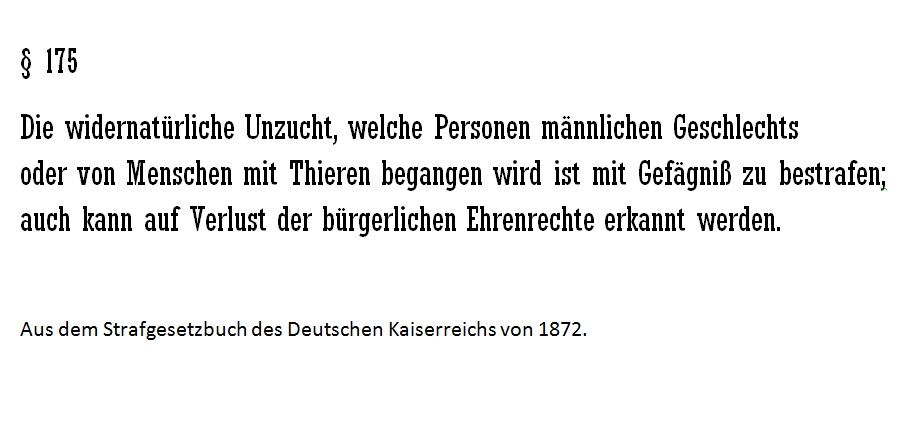
    Section 175 was introduced under the German Reich Penal Code. It criminalised sexual acts between men and shaped the state’s persecution of homosexual men for decades.

    1935-1945

    Under National Socialism, Section 175 was made considerably more stringent. The broadening of the scope of criminal liability led to systematic persecution, convictions and deportations.

    After 1945

    Even after the end of the Nazi regime, Section 175 remained in force for the time being. It was only through gradual reforms and social change that it was completely abolished in 1994.

    The detailed history of Paragraph 175

    However, the paragraph remained in a youth protection version until 1994 and provided for a different age of consent for heterosexual and homosexual contact: While homosexual acts with minors were generally prohibited, an absolute age of consent of 14 years applied to heterosexual contact.

    An additional 4,500 convictions were handed down between 1969 and 1994. One of the victims of this criminalisation was Frank Schneider*, who was sentenced to ten years in prison in a spectacular appeal trial in 1994. His offence: He had consensual sex with a 17-year-old teenager on several occasions when he was in his early 30s.

    Paragraph 175 of the German Criminal Code (Paragraf 175 StGB) existed from 1 January 1872 (entry into force of the Reich Criminal Code) until 11 June 1994.

    Imprisonment until the end - despite the abolition of Paragraph 175

    Schneider is regarded as the last 175 prisoner in the Federal Republic of Germany. He was only released from prison in 2004 after serving his entire sentence. Three petitions for clemency and several applications for early release after serving two thirds of his sentence were rejected by the judiciary. The fact that his offence was no longer a criminal offence only a few months after the trial due to the abolition of Paragraph 175 was of no consequence, as Schneider had a relevant previous conviction: he had already been convicted once for having sex with a 16-year-old teenager - not a criminal offence for heterosexuals.

    "While we were already dancing at a CSD, others of us were still in prison," comments historian Alexander Wäldner on the case. He has been researching the persecution of homosexuals for 15 years. He became aware of Frank Schneider's fate by chance: "We didn't even think that someone could still be in prison," he says.

    The consequences of the conviction - a ruined life

    Schneider now lives a secluded life far from home in a foreign city. He is an early retiree and has to supplement his small pension with basic income support. The conviction has destroyed his middle-class existence. All his possessions were liquidated during his imprisonment. As a convicted sex offender, he was never able to regain his footing and find a job. He declined an interview request despite assurances of anonymity. Schneider does not want to remember this dark chapter of his life story. Alexander Wäldner kept in touch with him via a third party. He describes him as a man from a humble background who earned his living as a labourer before his prison sentence and had never developed a gay identity. His simple education also proved to be a disadvantage during the trial. "Others would have been able to present themselves better in court," explains Wäldner.

    The insanity of criminalisation

    Schneider's fate bears witness to the insanity of criminalisation. The German judiciary once again used him to harshly persecute homosexuals, just a few months before the final end of the notorious paragraph.

    Schneider is one of the groups of cases that can claim compensation as a victim of Paragraph 175, according to the key points paper by Federal Minister of Justice Heiko Maas. The Bundestag must now pass a corresponding law that also rehabilitates the convicted men.

    "You can't make amends," says historian Wäldner, "but you can set an example!"

    *Name changed by the editors


    Frequently asked questions about the term „175“

    The term „175“ often appears in connection with the persecution of homosexual men in Germany.
    Here we answer key questions about the meaning of the term and its historical context.

    What does the term „175“ mean?

    Men who were convicted under Paragraph 175 were referred to as „175ers“. The term was not an official legal term, but an informal designation for those affected by state prosecution.

    Why was Paragraph 175 so momentous?

    Paragraph 175 criminalised sexual acts between men. This meant that homosexual men could be persecuted, imprisoned and socially marginalised for decades - often with lifelong consequences.

    Why were „175ers“ still in prison after 1945?

    Paragraph 175 was not immediately repealed after the end of National Socialism. In the Federal Republic of Germany, even the stricter Nazi version continued to apply for a long time, which is why convictions were still possible after 1945.

    Why did the abolition of Paragraph 175 have no effect on some of those affected?

    In many cases, previous convictions continued to be regarded as aggravating offences. Even if the paragraph was later abolished, this often had no legal consequences for men who had already been convicted.

    Why is the term „175“ still relevant today?

    The term symbolises state injustice and the long persecution of homosexual men. It is a reminder that legal discrimination can destroy real lives.

    Blog posts about queer history and enlightenment

    Exciting articles on queer history, social debates and political developments.

    Need someone to talk to?

    Whether acute or simply for orientation - sometimes it helps to talk to someone in confidence.
    Use the Gay Health Chat - the button at the bottom right will accompany you on the page. There you can chat anonymously and free of charge:

    - Personal live advice in the chat
    - Help by e-mail or telephone
    - Information on health, law, everyday life and more

  • Federal Government Commissioner for Queer Issues: "I take a clear stance on incitement to violence!"

    Federal Government Commissioner for Queer Issues: "I take a clear stance on incitement to violence!"

    Mr Lehmann, in 2021 you were directly elected to the Bundestag by more than 70,000 Cologne residents. Since November, you have been Parliamentary State Secretary in the Ministry of Family Affairs and since January, you have also been the Federal Government's Queer Commissioner. With all these successes: Do you personally still experience disadvantages or discrimination because you are gay?

    In the 20 years that I have been gay, I have of course also been discriminated against from time to time. For example, my husband and I have been verbally abused on the street because we were walking hand in hand or attacked on the internet. Nevertheless, I have certainly experienced less everyday discrimination than other people because I am in a privileged role as a politician. My party has always fought for the rights of LGBTIQ* and other minorities. I am naturally surrounded by a very safe and open environment.

    You recently reported a hate preacher from Görlitz who agitated against queer people in a video and wished them dead. How do you generally deal with homophobic attacks? When do you defend yourself - and when do you ignore them so as not to attract additional attention to extremists?

    When it comes to calls for violence or a call for murder, as in the case of this hate preacher, I take a clear stance. I call in the state security services and press charges. In my political work, I unfortunately have to live with hate comments online, which have increased massively now that I am even more in the public eye due to my new position as Queer Representative. I ignore a lot of it, but here too I report comments and block the authors when boundaries are crossed.

    Discrimination within the LGBTIQ* community: Even within the queer community, trans* people and non-binary people often encounter reservations. How inclusive do you find the queer scene?

    The LGBTIQ* community is very diverse - and just as diverse are the demands that the different groups place on politics. As queer commissioner, I am the point of contact for everyone. I try to listen and incorporate the needs of the community into government work. Despite all the differences within the community, I also see a lot of potential for alliances. And I am convinced that if we want to achieve something in terms of queer politics in this legislature, we need mutual solidarity. We need to stand up together for the rights of the LGBTIQ* community - for example, currently with the planned self-determination law, which is intended to replace the so-called "Transsexuals Act". There is a lot of headwind at the moment and we will still have to have many a discussion and do a lot of persuasive work until the law is finalised. Support from within the community is therefore important.

    As a queer representative, do you also feel responsible for more tolerance within the community - and how could we promote it?

    In any case, I see this as one of my tasks. I think the most important thing is to stay in dialogue with each other and to realise that we can only achieve the ambitious goals that we have set out in the coalition agreement if the community gets involved and acts in solidarity. Then we can make a real start for diversity, self-determination and equal rights for LGBTIQ* people in this legislative period. This summer, for example, I want to give the go-ahead for the first nationwide action plan for diversity and against queer hostility.

    The associations and initiatives of the queer community are making a very important contribution to this action plan - we are starting a dialogue process about what is important to them and where further support is needed. Family law should also finally be updated and adapted to social realities. After all, families are diverse and do not always consist of just a mother, father and child. We therefore want to reform parentage law and provide legal protection for multiple parenthoods. There are various interests within the community on all of these topics, which are expressed and also heard.

    "Medically, HIV is now well manageable. Discrimination, on the other hand, makes people ill."

    Today, people with HIV can live with the virus almost without any problems - and HIV is not transmissible under therapy. A major problem for them, however, is the Stigmatisation of HIV. Almost 80 per cent find it risky to talk about their infection because they are often confronted with prejudices - on a date, for example. In your role, how do you want to contribute to further reducing the stigmatisation of people with HIV?

    HIV is now well manageable medically. Discrimination, on the other hand, makes people ill. For many people with HIV, the fear of rejection and marginalisation outweighs the health consequences. I am therefore in favour of ensuring that the action plan for diversity and against queer hostility also includes measures such as strengthening educational work on HIV. I will ask the Federal Ministry of Health and the Federal Centre for Health Education to play an active role here in order to make doctors more aware of current treatment and prevention options and to prevent stigmatisation. Because nobody with HIV should have to hide.

    According to surveys only one fifth of Germans know that HIV therapy reliably prevents the transmission of HIV. What is it like in your circle of friends? Do they all already know about protection through therapy?

    In my queer circle of acquaintances, largely yes. But I recently explained at length to a heterosexual friend who has a lot of fears about HIV and Aids what PrEP is and that HIV treatment can prevent the transmission of the virus. She didn't know any of this and was relieved and grateful for the information afterwards.

    "PrEP has proven to be highly effective protection in recent years (...). Now it's a matter of ensuring supply in rural areas too."

    For more than two years, the PrEP as a health insurance benefit, including for gay men. What is your assessment after two years of PrEP on prescription?

    Nowadays there are three good and effective methods of prevention: condoms, PrEP and therapy. PrEP has proven to be highly effective protection in recent years - as shown by research conducted by the RKI to accompany and evaluate the introduction of PrEP. According to this, it is estimated that up to 21,600 people in Germany were already using PrEP in 2020, almost predominantly men. We also know that there are very large regional differences in PrEP use - use is particularly widespread in large cities such as Berlin. Now it's all about that, to ensure supply in rural areas as well and in regions where there are fewer doctors who prescribe PrEP - and at the same time to disseminate information about PrEP even further into the community.

    How much has PrEP changed gay (sex) life?

    I think almost every gay man knows the feeling of waiting for the results of an HIV test at regular intervals and hoping that the test is negative. This constant fear of infection can be demoralising and has often been a burden at the back of your mind - even though sexuality should actually be liberating and free of fear. PrEP has given gay men additional security - for many, PrEP is a liberation, even if it does not protect against other STIs.

    "This constant fear of infection can be demoralising and was often a burden in the back of our minds - even though sexuality should actually be liberating and free of fear."

    Your partner Arndt Klocke has already been outed as a PrEP user in an interview and also showed his face on social media with ICH WEISS WAS ICH TU in favour of PrEP. Now, of course, we are very interested: Which of the three safer sex methods to protect against HIV do you use and why?

    I've stuck with the good old condom so far. (laughs)

    Arndt Klocke and you have been a couple for 20 years. So to finish, please give us a relationship tip: how do you manage to have a happy relationship - despite a career and a lot of commuting between NRW and Berlin?

    My husband and I make sure that we have time together - our private lives are sacred to both of us. We spend the weekends together as often as possible, either in Cologne or Berlin. We go to the cinema a lot, we're interested in culture, sport and travelling. And somehow the commute is exhausting, but it's also good for the relationship because we always look forward to seeing each other again.

    You and Mr Klocke were recently on the podcast Queer stuff as a guest. There you also talked about sex outside of a relationship. You said that you would "grant and wish for open relationships for straight people too." Why would you recommend an open relationship?

    I would not like to recommend any particular Relationship model. Because how relationships are lived, what makes you happy and what fulfilling sexuality means is something that everyone has to decide for themselves and negotiate with other people. What I would definitely recommend, however, is openness - both within partnerships and externally. Because that frees you up and also creates new spaces for other people to dare to do the same. Self-determined sexuality with changing partners, committed monogamous partnerships and all variations in between: Being able to decide for yourself without stigma is at the heart of a liberal society. And this also includes a sex-positive policy.

  • How the compensation for §175 and §151 judgements works

    How the compensation for §175 and §151 judgements works

    Who was criminalised by Paragraphs 175 and 151?
    §Section 175 came into force in 1872, one year after the founding of the German Empire, and criminalised "unnatural fornication between persons of the male sex". In 1935, the Nazis tightened the paragraph. All acts with "voluptuous intent" were now considered a criminal offence. Mere touching could already be prosecuted.

    After the war, §175 remained unchanged in the Federal Republic in the Nazi version for more than two decades. In 1969, it was then defused for the first time and a second time in 1973. Now men over the age of 18 could be punished if they had sex with boys under the age of 18, while the age of consent for girls was 14 (although the court could refrain from punishing the man for girls aged between 14 and 16 if he was under 21). The reason for this unequal treatment was the homophobic so-called "seduction theory", i.e. the idea that young people could be "seduced" into homosexuality.

    In 1950, the GDR returned to the original version of §175 (before National Socialism), although from the end of the 1950s onwards hardly anyone was sentenced under this paragraph. In 1968, the GDR then introduced its own penal code. Section 151 was introduced in it. This criminalised sexual acts by all people under the age of 18 with young people of the same sex. This meant that lesbian and bisexual women were also criminalised. Section 151 was cancelled without replacement in 1988.

    After a brief phase of legalisation, male homosexuality was criminalised again in East Germany after reunification, as §175 was only abolished in 1994 (also due to pressure from the East).

    In the legal sense of the time, the two paragraphs criminalised same-sex sexual acts. From today's perspective, however, it can be assumed that not only gay and bisexual cis men (or in the GDR also cis women) were criminalised. In fact, all people who were assigned to the male sex at birth and had sex with people who were also assigned to the male sex were criminalised in the Federal Republic of Germany. Paragraph 175 therefore also criminalised trans* women, for example, who had sex with people who were assigned to the male sex. In the GDR, Section 151 criminalised all people who had sex with other people if both were assigned the same sex at birth. This also affected trans* men, for example.

    It is important to know: The right to compensation applies regardless of your current and former gender or sexual identity.

    Jan, who is entitled to compensation?

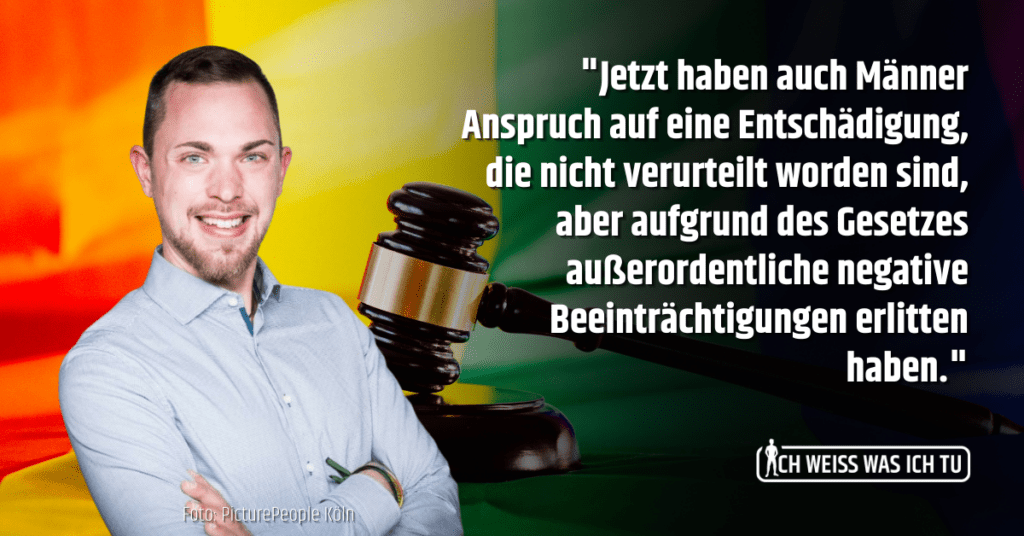
    All people who were convicted on the basis of § 175 StGB after 8 May 1945 or on the basis of § 151, which was valid in the former GDR. However, it should be noted that you are only entitled to compensation if the partner with whom you were arrested was over 16 years old. There is no entitlement to compensation for sex with minors. A directive was added to the Compensation Act in 2019. Men who have not been convicted but have suffered extraordinary negative effects as a result of the law are now also entitled to compensation.

    What does this mean?

    Let me give you an example: the police or the public prosecutor's office were not discreet in their investigations. For example, those affected were involuntarily outed at work and lost their job or were given notice to leave their home. However, the criminal prosecution or the pre-trial detention suffered must be based on suspicion in connection with an allegation of an offence under Section 175. These men are also entitled to compensation.

    Now men who have not been convicted but have suffered extraordinary negative effects as a result of the law are also entitled to compensation.
    Jan Bockemühl advises on BISS e.v. Men who wish to apply for compensation for convictions under § 175 (FRG) and § 151 (GDR).

    Where and by when can the application be submitted?

    There is a rush here. Applications can only be submitted to the Federal Office of Justice in Bonn until 21 July 2022.

    Which documents must be submitted?

    In the best case scenario, a copy of the judgement or documents relating to the periods of imprisonment suffered are available and can be attached to the informal application. Otherwise, a certificate of rehabilitation must first be applied for from the public prosecutor's office. An application form for compensation under the Directive is available on the website of the Federal Office of Justice. We are happy to support those affected with the application process via our free hotline 0800 175 2017.

    How high is the expected compensation?

    This also varies from case to case. The law stipulates 3,000 euros for each conviction, 1,500 euros for each year or part thereof of deprivation of liberty and 500 euros for any preliminary proceedings initiated. In addition, a one-off payment of 1,500 euros is possible for exceptionally negative effects.

    Do you know a person who was also convicted under §175 (FRG) or §151 (GDR)? Then encourage them to apply for compensation. You can find all information at Federal Office of Justiceand under www.schwuleundalter.de/entschaedigung-und-rehabilitierung/
    You can find everything about gay life in old age at www.iwwit.de/schwules-leben/alter.
    Addendum: After this article was finalised, it became known that the The current government is planning to maintain claims for compensation possibly beyond 22 July after all. Nevertheless, it may be advisable to submit an application quickly. You can also get expert advice here at BISS e. V..
  • Conviction under §175: Klaus was compensated after more than 40 years

    Conviction under §175: Klaus was compensated after more than 40 years

    Trigger warning: This article is about institutionalised homophobia and conversion measures.

    A December afternoon in Ludwigshafen. Klaus. S. is looking for sex. He walks into a well-known bar on Ludwigplatz. The smell of urine fills his nose as he enters the small room. He notices a man. Looks nice, he thinks to himself. The two men decide to swap the cold place for the slightly more comfortable toilets in a nearby department stores'. "That was our mistake," says Klaus today. "We must have been watched as we entered, because a short time later the police were standing outside the cubicle and took us out". It was 1964 and Paragraph 175, which criminalised homosexuality, was still in force. "We were taken to the police station in the "Green Minna". And as I wasn't yet 21 (the age of majority at the time), I was taken home to have my address checked," says the Ludwigshafen native, who was born in 1947.

    First taken to the police station and then home...

    Klaus could not hope for understanding here, quite the opposite. His father was still steeped in the ideas of the National Socialists and his mother was a very religious woman. He was worried about his neighbours, his siblings and the gossip in the community. "They told me not to talk about it with anyone". The hope that the charges would be dropped because of his age was not realised. Fornication with men is the charge. The trial began in spring 1965. "I was still lucky," reports Klaus. "A young youth counsellor did a lot for me. I'll never forget that". His punishment: psychological treatment for re-education. Today it would be called a conversion programme. If he had been sentenced to prison, his apprenticeship as a technical draughtsman would have been jeopardised. "As it was, it went off quite lightly," says Klaus.

    Fornication with men is the accusation. His punishment: psychological treatment for re-education. Today it would be called a conversion measure.

    His sentence: 2 years, 1 visit a week to a psychologist

    "From then on, I had to see a psychologist once a week for two years". He has blocked out the conversations. He only remembers drawing a tree and the famous blob pictures. Called the Rorschach test in professional circles. "But I only saw dicks," laughs Klaus, "and I told the psychologist that. He wasn't happy about it".

    Klaus suppresses his feelings and his desire. The psychologist is vindicated and dismisses Klaus as cured.

    Klaus suppresses his feelings and his desire. He is afraid of being caught again. This time, he knows that a conviction would mean prison. He joins a youth group and meets a girl. "I really liked her. But I was glad that she didn't make any sexual advances". He wants to marry her, despite everything. Before he takes her to his psychologist, he confesses everything to her. "She reacted very understandingly". The psychologist is vindicated, rambles on about a phase that all boys go through and dismisses Klaus as cured. Before the wedding, his mother destroys all the documents that could be his undoing at some point.

    Fragile happiness

    Klaus lives with his wife in Ludwigshafen and a daughter is born. But their happiness is fragile. The longing for sex with men remains. He leads a double life, like so many others at the time. His love for a man he meets gives him strength. This is followed by a separation from his wife. This is followed by a messy divorce and a ten-year battle to be allowed to see his daughter. Klaus meets his current husband and lives with him. "We lived inconspicuously, but not in hiding".

    Who was criminalised by Paragraphs 175 and 151?
    §Section 175 came into force in 1872, one year after the founding of the German Empire, and criminalised "unnatural fornication between persons of the male sex". In 1935, the Nazis tightened the paragraph. All acts with "voluptuous intent" were now considered a criminal offence. Mere touching could already be prosecuted.

    After the war, §175 remained unchanged in the Federal Republic in the Nazi version for more than two decades. In 1969, it was then defused for the first time and a second time in 1973. Now men over the age of 18 could be punished if they had sex with boys under the age of 18, while the age of consent for girls was 14 (although the court could refrain from punishing the man for girls aged between 14 and 16 if he was under 21). The reason for this unequal treatment was the homophobic so-called "seduction theory", i.e. the idea that young people could be "seduced" into homosexuality.

    In 1950, the GDR returned to the original version of §175 (before National Socialism), although from the end of the 1950s onwards hardly anyone was sentenced under this paragraph. In 1968, the GDR then introduced its own penal code. Section 151 was introduced in it. This criminalised sexual acts by all people under the age of 18 with young people of the same sex. This meant that lesbian and bisexual women were also criminalised. Section 151 was cancelled without replacement in 1988.

    After a brief phase of legalisation, male homosexuality was criminalised again in East Germany after reunification, as §175 was only abolished in 1994 (also due to pressure from the East).

    In the legal sense of the time, the two paragraphs criminalised same-sex sexual acts. From today's perspective, however, it can be assumed that not only gay and bisexual cis men (or in the GDR also cis women) were criminalised. In fact, all people who were assigned to the male sex at birth and had sex with people who were also assigned to the male sex were criminalised in the Federal Republic of Germany. Paragraph 175 therefore also criminalised trans* women, for example, who had sex with people who were assigned to the male sex. In the GDR, Section 151 criminalised all people who had sex with other people if both were assigned the same sex at birth. This also affected trans* men, for example.

    It is important to know: The right to compensation applies regardless of your current and former gender or sexual identity.

    An exhibition changes everything

    In June 1994, §175 was deleted from the penal code. He was probably aware of this, but the news had no significance for him. Through an exhibition about gay life in Ludwigshafen in the local city museum, he got in touch with the Magnus Hirschfeld Federal Foundation in Berlin. There he was encouraged to submit an application to the Federal Office of Justice in Bonn. "I was able to submit the application quite informally," he recalls. But now his mother's diligence took its revenge. His application was rejected by the responsible public prosecutor's office. The reason: there were no documents to confirm his conviction. A second application also fails.

    I was very sceptical about whether it would work, but I didn't want to give up.
    Klaus didn't want to give up. And rightly so: he received his compensation for the injustice done to him with §175.

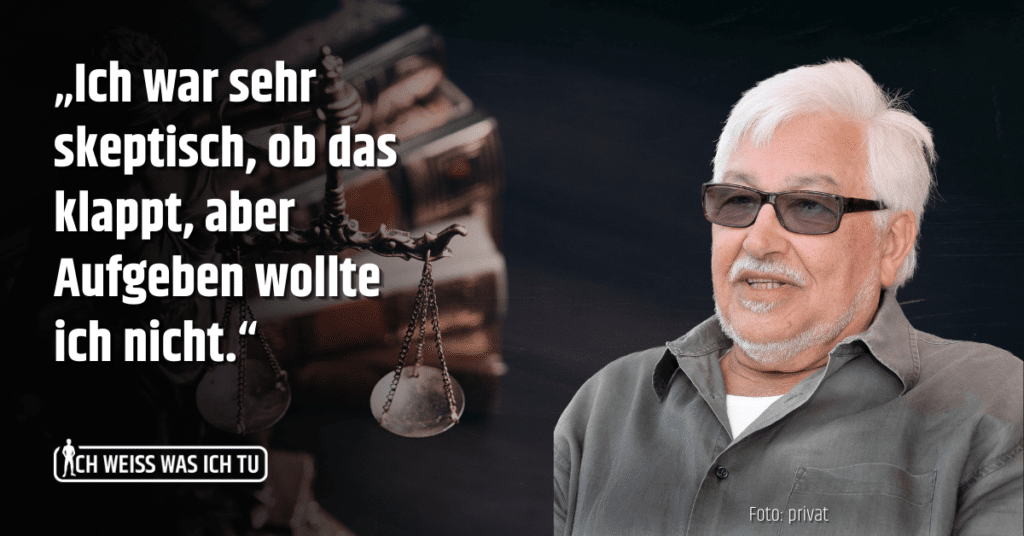
    Klaus is about to give up when he hears BISS e. V. experiences. Here he will Competent advice and support. BISS also talks to the responsible public prosecutor's office. This is because every conviction must be accompanied by transcripts, which must be made available to those affected on request. They supposedly no longer exist after 40 years. An affidavit is required from him. In the end, he had all the relevant documents together. "I was very sceptical as to whether it would work," he recalls, "but I didn't want to give up.

    "Recognising the German state was more important to me"

    His application is finally granted. He was awarded 3,000 euros for the arrest and conviction, and later another 1,500 for coercive therapy. "Of course I was happy about the money," says Klaus. "But what was more important to me was that the German state recognised that I had been wronged here. He and his husband used the money to go on holiday to Sylt for a week. "Really fancy, with all the comforts". "And we also bought ourselves a new service, as we don't have all the cups in the cupboard yet," he laughs. Klaus was able to put the experience behind him. Even though it was sometimes difficult, he has no regrets about fighting for his rights.

    He has no regrets about fighting for his rights.

    What Klaus S. wants for the future.

    He now lives in Mannheim and has become an activist. He is involved in the City of Mannheim's round table on sexual and gender diversity and runs a group for gay senior citizens. He has no great wishes for the future. He would like to see as many men as possible apply for compensation, "And I would like people to accept everyone for who they are, no matter who they love".

    Do you know a person who was also convicted under §175 (FRG) or §151 (GDR)? Then encourage them to apply for compensation. You can find all the information in this IWWIT blog post, at the Federal Office of Justiceand under https://schwuleundalter.de/entschaedigung-und-rehabilitierung/
    You can find everything about gay life in old age at https://www.iwwit.de/schwules-leben/alter.
    Addendum: After this article was finalised, it became known that the The current government is planning to maintain claims for compensation possibly beyond 22 July after all. Nevertheless, it may be advisable to submit an application quickly. You can also get expert advice here at BISS e. V..
  • Sex work and corona: against the expansion of the prohibited zone

    Sex work and corona: against the expansion of the prohibited zone

    Opponents of sex work are instrumentalising the coronavirus crisis and campaigning for a nationwide ban on buying sex. Sex workers are already among those who have been hit particularly hard.

    During the coronavirus crisis, those in favour of a ban on buying sex are scenting the morning air. It was therefore no coincidence that over a hundred activists from the "Nordic Model Alliance" met in Bonn at the end of September for a major consultation. Speakers included the most important players in the movement: Alice Schwarzer (publisher and managing director of EMMA), Inge Bell from "Terre des Femmes" and Sabine Constabel from the "Sisters" organisation.

    "They all hope to overcome the restrictions imposed by the Corona pandemic to be able to instrumentalise them in order to enforce a ban on buying sex," says Daria, spokesperson for the Professional Association for Erotic and Sexual Services (BesD) in Baden-Württemberg and a member of the board of AIDS-Hilfe Stuttgart since the end of October 2020.

    The south-west in particular has become the battleground of the "abolitionists", as the movement's activists like to call themselves in reference to the freeing of slaves in the USA. This is largely due to the Baden-Württemberg SPD member of parliament Leni Breymaier, who acts as their political spearhead. Breymaier has worked long and hard to bring both her SPD state association and the city of Stuttgart behind her.

    Stigmatisation of sex workers harms prevention

    In terms of content, those in favour of a sex purchase ban are treading on surprisingly thin ice. On the surface, they are concerned with noble goals: Women's rights and combating human trafficking. However, it is unclear whether the ban on buying sex will actually curb sex work and human trafficking. The methodology of many studies is questionable and data can be interpreted in different ways.

    However, the proponents leave open the question of how stigmatisation of sex work is supposed to work without simultaneously stigmatising those working in it in a society that still discriminates against and marginalises sex workers today.

    On the other hand, a broad alliance is fighting for improvements in the everyday lives of sex workers, or at least to maintain the status quo. It ranges from Professional association for erotic and sexual services (BesD) via the German AIDS Service Organisation, the German Women's Council and the German Association of Women Lawyers up to the Protestant Diaconia. They all fear that a ban on buying sex will above all increase social discrimination against prostitutes and make health prevention more difficult.

    Situation with male-male sex work

    Cis, trans* and queer sex workers were and are particularly affected by the coronavirus measures. In a joint Position paper were already noted by hustler projects in early summer for the area of "young cis men and queer* sex workers" during the coronavirus restrictions: "In some cases, sex workers have no alternative but to suspend their work. To ensure their survival, they have to accept situational and self-determined exposure to health hazards and risks, as well as fines. This also applies in particular to the sexual work of cis men*, queer* and trans* people in scene contexts. [...] Currently, the threat of homelessness is exacerbated by the loss of income. Since the occupancy of emergency shelters is generally regulated and is severely restricted in times of Covid-19, they often have no choice but to stay on the streets."

    Many have been catapulted back into previous situations of violence as a result of the ban on prostitution and the associated loss of their sources of income: "Being forced back into the nuclear family, into violent relationships of dependency, into refugee accommodation and onto the streets is an even greater challenge in the current situation."

    The emergency situation leads to greater vulnerability of sex workers

    The same applies to cis-female and trans* sex workers. "The clients are becoming more blatant," says Daria Oniér, "because who is hanging around in the dark zone: people who don't want to spend anything, people with high pressure or violent offenders."

    BesD press spokesman André Nolte describes the situation as follows: "Agreements are broken. Prices are often being cut, but that's not even the biggest problem of all. Especially as a woman, when you can no longer work in a brothel but have to move into a flat, it can happen that there are suddenly two guys there instead of one."

    Many sex workers were catapulted back into previous situations of violence

    Human trafficking did not stop under coronavirus conditions, but the fight against it did. The Berlin Senate announced in its Answer from 17 September to a minor question from the FDP in the Berlin House of Representatives admitted that "non-suspicious checks ... were not carried out" because "the approach based on targeted and consensual contact with sex workers was practically unfeasible at a time when prostitution was banned under the SARS-CoV-2 Infection Protection Ordinance". In other words, closing brothels and banning sex work is a major opportunity to effectively combat human trafficking and forced prostitution.

    Sex work: short autumn of lifting bans

    In Berlin, as in most federal states, sex work was permitted again in autumn after being banned in spring and summer, subject to various conditions. Ralf Rötten from "Help for boys e.V." felt. This is a Berlin-based project for young men who go prostitution. He says: "Many of our clients who were away at the beginning of the coronavirus crisis have returned from their home countries."

    Nevertheless, things have not returned to normal. Due to the strict hygiene concepts, fewer visitors came to the association's drop-in centre on the edge of the gay neighbourhood in Berlin. People were no longer allowed to stay overnight and visitor lists had to be kept - which of course contradicts anonymous counselling, but was mandatory because the facility is considered a catering-type establishment.

    "Sex workers have not only been confronted with the issue of health since coronavirus"

    Rötten has also observed the extent to which the lobby to ban the purchase of sex has gained the upper hand during the crisis and warns: "If there is an illegalisation of clients, then this will affect all clients, which has obviously not yet been understood in the gay scene. We need to actively campaign for the preservation of a diverse but also fair landscape of sexual services."

    In most federal states, as in Berlin, a general ban on prostitution remained in place until the beginning of September. This was longer than in comparable sectors of body-related services, despite the fact that the professional association for erotic and sexual services had issued a Detailed hygiene concept had presented. This ranged from talking to customers with mouth and nose protection to coronavirus-compatible positions and airing out afterwards. "Sex workers have not only been confronted with the issue of health since coronavirus," says BesD spokesperson André Nolte. "Why do the courts have to explain this to politicians in many federal states?"

    The November lockdown is once again hitting sex workers particularly hard

    In mid-October, only Hesse and Mecklenburg-Western Pomerania were still prohibited zones for sex work, but with the second lockdown from 2 November, sex work and most "body-related services" are once again prohibited. The Berlin Infection Protection Ordinance, for example, states that "The provision and utilisation of sexual services with physical contact and erotic massages" are prohibitedin North Rhine-Westphalia is the "Operation of brothels, prostitution centres and similar establishments prohibited".

    The situation for sex workers is once again bleak and the future is uncertain. But the last few weeks have shown one thing: Anyone who wants to protect sex workers in Baden-Württemberg and elsewhere in Germany from discrimination and the illegalisation of their working conditions needs more staying power than ever in these times

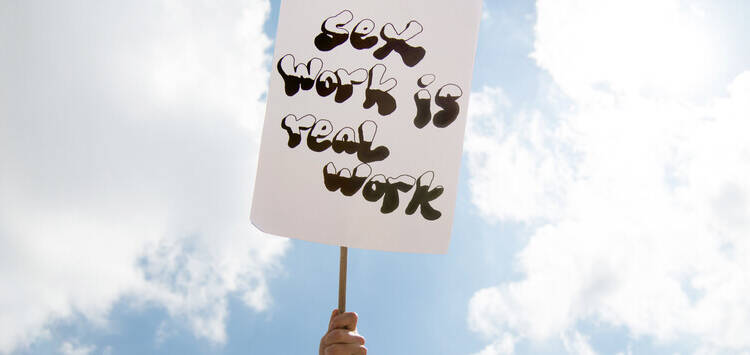
    Sexwork is real work
    Photo: DAH | Renata Chueire

    Editor's note: This article appears in an abridged version. The long version has been published by our colleagues at magazin.hiv.

  • Hedy: Rooms where we know we belong: That's where we belong!

    Hedy: Rooms where we know we belong: That's where we belong!

    Eye contact instead of video tiles

    Hedy can no longer see tiles! She has been in too many Zoom conferences over the past six months, too often she could only see her dialogue partners as tiny videos. The Berlin native coaches managers and trains workforces, especially when it comes to health. During the lockdown, she was only able to give her training courses online. "Technically, it worked well," says the 61-year-old. But Hedy is convinced that even the best technology cannot replace personal encounters: "We are social beings and depend on meeting each other in person! Fortunately, things improved again during the summer - but we can't go back to the time before coronavirus any time soon. After corona is before corona!"

    Hedy is a coach, therapist and communication specialist.

    The last few months have probably been particularly difficult for many people from the queer community, Hedy surmises. "Many of us live alone. That makes it harder to keep in touch." When hugs are also taboo, it's time to get down to business. "Singles in particular have to see how they can get through this time."

    The scene audience fans out

    To make matters worse, many meeting places for the queer community were closed and events were cancelled. This hit lesbians even harder than gays, explains Hedy. "We women earn around 20 per cent less than men and spend correspondingly less. That alone makes it harder for women's shops."

    Even in the big city of Berlin, the Beguine only a small art bar where - in classic feminist fashion - only women* are allowed. After all, the Begine team was able to bridge the worst of the coronavirus period with donations. However, most women's bars had already given up before the pandemic. Or they changed their concept.

    The IWWIT print advert for the #WirFürQueer campaign with 6 queer people
    For Hedy (above, left), personal encounters cannot be replaced by even the best technology.

    "The spaces for us lesbians have become fewer - and more open," explains Hedy. The "women only" door policy no longer works as it used to. The audience is diversifying. Trans* men and trans* women want in just as much as visitors who don't categorise themselves as either men or women.

    "We humans need safe spaces"

    At Hedy's birthday party, two of her friends discussed it intensively. One of them is helping to organise a Berlin film festival. The flyers now say "Lesbian Non-Binary Filmfest". The other stumbled over the word "non-binary" and realised: "I'm just a lesbian. Please explain that to me!" Hedy was fascinated: "There were only 16 years between the two of them, but their views were still very different." The hostess could understand both sides. "I can't get my head round a lot of new terms either, because they're just so complex," says Hedy, laughing. "Sometimes I wish I didn't have to research a discourse before I could join in."

    Hedy views the change in her familiar community with both joy and melancholy. "The younger generation takes the new opportunities for granted. My generation rather regrets that our spaces are changing so much." Hedy has long campaigned for these open spaces and is currently on the board of the Lesbian ring. The association networks lesbian* groups nationwide. They must and will continue to exist in the future, Hedy emphasises. "We people need safe spaces where we know we belong: That's where I belong!" This could be the partnership, the family of choice - or community centres such as Begine or "Wheel and deed". Many felt safe and "at home" there.

    Rooms
    Hedy sees the change in her familiar community with both joy and melancholy.

    Tough fronts through the community

    These retreats of all places are now on the move. "That irritates a lot of people," says Hedy. "A lot of questions arise: What is being taken away from me? And what can I gain?" Through her profession as a coach and therapist, she knows how easily people clash in such transitional phases, especially younger and older people.

    Hedy finds the message from #wirfürqueer"We stick together." But sticking together takes strength. As a communications specialist, Hedy wants "a culture of communication in which we listen to each other and get to know different positions - and without immediately doing a 180 when I hear a different view on things." At the moment, Hedy has the impression that hard lines are running through the community. "That's what drives me! The question is: how can we manage to listen to each other better?"

    There is no way around it: If we want to get through the tough times together, we have to be able to talk to each other. Hedy is certain of this - and is ready for constructive debate. "If others want to discuss this with me in public, I'm happy to do so! I'm keen to play my part in keeping our community together!"


    The queer scene is also affected by the Coronavirus pandemic affected, whether through possible loneliness or financial difficulties. Do you want to help or are you looking for help? #WeForQueer lists projects that offer help or are looking for support themselves. Click through and find a suitable aid or solidarity campaign!