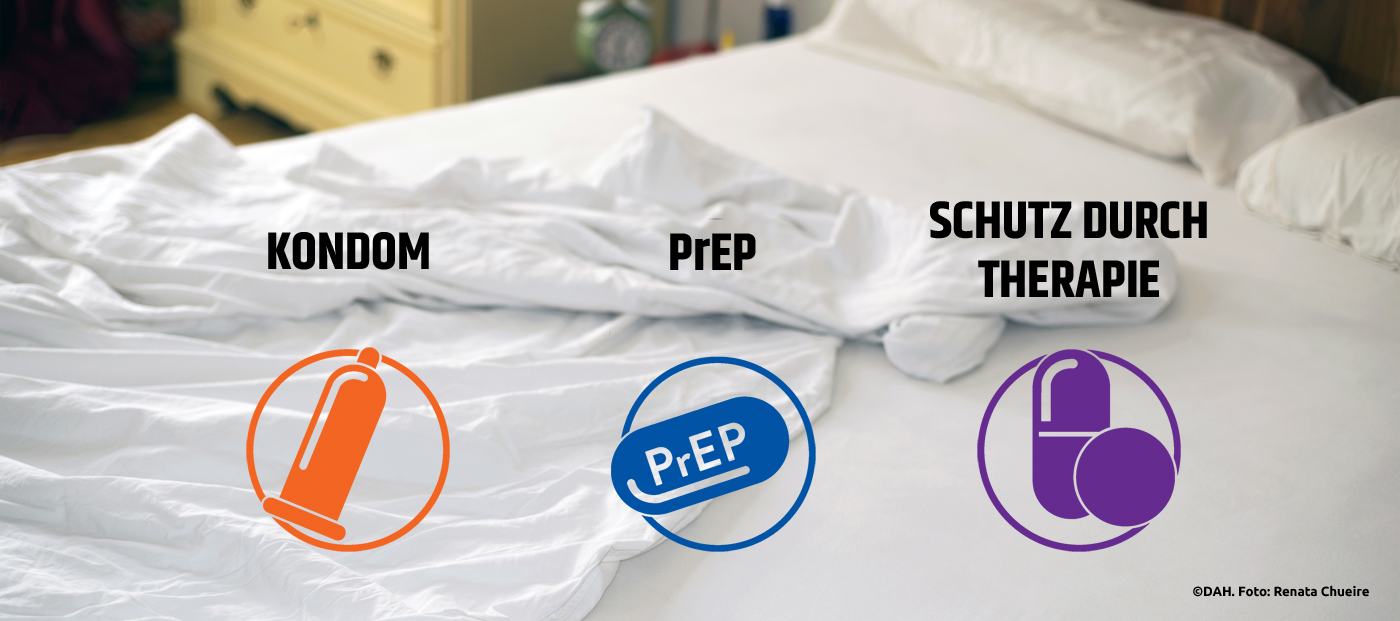
The rule of thumb used to be: only have sex with a condom! There are now other options for protection against HIV. We asked around to find out how safer sex is practised today
Condoms: tried and tested and widely used
Sex is known to be the most beautiful thing in the world. And the fact that HIV can be transmitted during sex doesn't have to spoil the fun for anyone. After all, there are a whole range of ways to protect yourself today. The good old condom is still the most tried and tested and most widely used method.
"Without rubber - I'm not up for that"
Kathrin always has her personal stash to hand: "I can find the little box under my bed even in the dark and in almost any body position," reveals the 28-year-old, laughing coyly. She also keeps two well-packed condoms in her rucksack and handbag. "Just in case. You never know who you might meet," she says with a cheeky grin. "I just don't want to have to rely on my one-night stand, who I might meet in a club, being equipped with rubbers. And without any - I'm not up for that."
The fear of HIV transmission only plays a subordinate role for Kathrin. "I can also easily do without the clap."
A more relaxed sex life thanks to PrEP
For Matthias*, too, sex with a condom has always been a matter of course. And yet it has already happened to him that the condom was left off unplanned - for example in the gay sauna. "All of a sudden, my head is switched off during sex and only my cock decides what happens. Afterwards I regret it and I panic slightly: what if something has actually gone wrong?"
To avoid such situations, Matthias has been taking HIV protection pills, known as PrEP, for some time. Taking the HIV medication regularly prevents the virus from multiplying in the body cells of HIV-negative people - and thus protects them from infection.
His sex life is much more relaxed with PrEP. And yet the condom has not become obsolete for him.
For Matthias, this method of protection has made his sex life much more relaxed. However, the classic condom is far from obsolete for him. "The condom is a must-have for me, but PrEP is a nice-to-have: a good way to protect yourself if you don't use condoms." He therefore believes it is important to be well informed about this method of protection - and to seek medical advice when taking PrEP.
Double protection thanks to PrEP and "protection through therapy"
For Jutta*, PrEP offered an opportunity to have condom-free sex with her HIV-positive partner Gerd - and to be doubly protected. This is because her partner has been taking HIV medication for a long time. As a result, the amount of virus in his blood is so low that HIV is no longer detectable in him: HIV can therefore not be transmitted sexually.
"It was very important to me to be able to feel my husband as intensely as I would ideally like to. The rubber also reminds you that there is a danger - no matter how irrational the thought. I knew that Gerd was no longer infectious, but when it comes to emotions, the mind is sometimes simply inferior."
Protection through therapy works
This "gut feeling", which prevented Jutta from letting go completely despite knowing better, was something Jeff also had at first in his relationship with an HIV-positive man. However, he informed himself intensively about the non-infectiousness of people with HIV who are successfully treated and was quickly convinced of the protective effect of HIV therapy.
"It was friends we told about it who were more sceptical. We had to explain it to them first."
"'Protection through therapy' requires deep trust"
When Stefan found out about his HIV infection seven years ago, he first had to come to terms with the news, but he didn't go into shock. "I realised that I wanted to start HIV treatment quite quickly. Also so that I can have sex with my boyfriend without a condom once the viral load has fallen below the detection limit," says the 45-year-old. "In all three relationships I've had since then, I've slept with my partners without a condom. And all three are still negative today." For him, this is the best proof that "protection through therapy" works.
Jeff is now single again. He now handles safer sex very differently, depending on the situation. For him, sex without a condom is only conceivable with HIV-positive men who, like his ex-partner, are below the detection limit. "That presupposes that you know each other very well and that there is a deep level of trust," explains Jeff. "I could never be sure about one-night stands, and that's why it still only happens with a condom."
However, this is not a major problem for him, so PrEP is not an urgent wish for him at the moment. "But who knows how I'll feel about it in a few months' time." Just having the option is an enrichment for him. Because ultimately, says Jeff, the HIV-negative person has to decide how they want to maintain this status - whether through PrEP, "protection through therapy", the condom or a combination: "Safer sex is all of these ways," he says.
Safer Sex 3.0: The three effective methods of protection against HIV
More information can be found on the website www.iwwit.de
The PrEP-Start under the magnifying glass: What does it involve? And how long does it take?
You have decided to use the PrEP to take? And would you like to start right now? Well, you can't just get PrEP at every corner. We asked prepsters, doctors, a checkpoint and a pharmacist what exactly is involved in starting PrEP and, above all, how long it can take from deciding to take PrEP to taking your first tablets. We also give you tips on what you need to think about before you can start PrEP.
A little patience is required when starting PrEP. We'll tell you what to look out for and how long it takes.
What do the PrEPsters say?
Volker
Volker comes from Berlin. He is 45 years old and has been taking PrEP since April this year. The decision has slowly matured for him. He heard about PrEP for the first time in the scene. "I then attended an information evening with the Berliner AIDS-Hilfe organisation and did some more research on my own," he says, describing his approach. He went to his GP in Berlin, who also looks after him otherwise. "I spoke to him again," he says. The detailed consultation encouraged Volker to start PrEP. He waited a week for the appointment. This was followed by the tests prescribed or recommended for PrEP: HIV, hepatitis B and sexually transmitted infections such as syphilis, chlamydia and gonorrhoea. After all the results were available a few days later, he received his first prescription for the blister PrEP and went to the pharmacy with it. After another two days, the time had come. Volker held his first blister with 28 PrEP tablets in his hands. "All in all, it took me 10 days before I was able to start PrEP"he summarises.
Marc
Marc is 47 years old and comes from Göttingen in Lower Saxony. The biggest difference to Volker, who can choose between several practices and pharmacies in Berlin, is that Marc does not have this choice in Göttingen. "A single doctor in Göttingen, who otherwise specialises in caring for patients with HIV, takes care of the PrEPsters in and around Göttingen," says Marc. Despite this somewhat difficult starting point, Marc only had to wait a week for his first appointment. And the time until the test results were available and he received his first prescription was also around 10 days for him. Marc doesn't have a pharmacy in Göttingen that can get him the blister PrEP. Marc therefore only has the option of choosing a more expensive product from another manufacturer. The advantage of this option is that the product is available immediately. All in all, it took Marc about two and a half weeks.
In order for a pharmacy to offer the blister PrEP, the pharmacy must participate in the blister pilot project. There are currently around 65 pharmacies in Germany that are also members of the German Association of HIV Competent Pharmacies. The pharmacy staff must also undergo additional training.
Marcel
Marcel had to make the greatest effort. He is 35 and comes from Karlsruhe in Baden- Württemberg. "There's not a doctor for miles around who looks after PrEPsters here," reports Marcel. He would have had to travel to either Stuttgart or Mannheim. Too much effort. Marcel finally approached his family doctor. "I literally spammed him with information," he describes his approach. "But my doctor responded really well and was willing to familiarise himself with a subject he wasn't used to." His doctor did some research and Marcel was back with him after 48 hours. Marcel has been able to take PrEP since this spring. And the family doctor also takes over the PrEP checks that are prescribed every three months. If you factor out the week it took Marcel to find a doctor, it also took two weeks from the first check-up to taking the first pill.
First stop: The doctors
Dr Kümmerle (Cologne)
"We also plan half an hour for an initial consultation."
Ebertplatz in the centre of Cologne. This is where Dr Tim Kümmerle She runs a joint practice with six colleagues. "A total of 150 patients who take PrEP come to us every quarter," says Kümmerle. Anyone who needs an appointment for an initial consultation waits between two and three weeks. "We also schedule half an hour for an initial consultation. And experience has shown that this is realistic." Kümmerle explains that the men who want to take PrEP are already quite well informed, but that one or two questions still come up during the consultation. The consultation is followed by the usual tests for HIV and other sexually transmitted infections. Dr Kümmerle usually receives the results from his laboratory after three days. Only three times in the past two years has it not been possible to prescribe PrEP to a patient. "The first check revealed that two were already HIV-positive and a third had acute hepatitis," Kümmerle explains. The Cologne-based doctor sees his patients regularly, as the routine PrEP check is scheduled every three months. If everything is OK, the prescription is issued for the next three months.
"We also plan half an hour for an initial meeting. And experience has shown that this is realistic."
Dr Kümmerle (Cologne)
A waiting time of two to three weeks for an appointment for initial PrEP counselling is also possible in the practice of Dr Roger Vogelmann is the standard in Mannheim. There are two other practices in the city that offer PrEPster counselling. Dr Vogelmann shares his Cologne colleague's observations regarding the level of information and the need for advice among his patients.
Dr Vogelmann (Mannheim)
Dr Vogelmann cooperates with a checkpoint for PrEP.
The biggest difference to his colleagues in Cologne is that Dr Vogelmann cooperates with a checkpoint. "For capacity reasons and because it is more favourable for the PrEPster, we recommend that our patients have the prescribed checks there. We only determine the creatinine level, which provides information about the condition of the kidneys, here at the practice. The checkpoint cannot do this at the moment," he explained. This is so important because the active ingredients contained in PrEP can put too much strain on the kidneys in a few cases. So far, there have been no cases in his practice where he has been unable to prescribe PrEP.
Tip: On iwwit.de you will find two linked Lists of doctors in Germany who can advise you on PrEP and prescribe it. In order for doctors to prescribe PrEP, they must have the official training materials on the PrEP active ingredient.
Second stop: The checkpoint
Max-Josef-Straße in Mannheim's Neckarstadt district is one of the most beautiful streets in Mannheim. Old stately houses and lots of trees. Here has KOSI.MA the competence centre for sexually transmitted infections in Mannheim. Every second Thursday and now every fourth Wednesday of the month, people can get tested for HIV and STIs here and receive comprehensive advice on all questions relating to safer sex and sexual health.
As with all counselling offered at the KOSI.MA checkpoint, PrEP counselling is anonymous.
"Since the beginning of the year, we have also been offering the PrEP check. We work with the PrEP check booklet developed by the Hamburg counselling centre Hein und Fiete. The blue booklet was reissued for our federal state in Baden-Württemberg in the working group for men who have sex with men (MSM) after consultation with Hamburg," reports Marc Fischer, head of the KOSI.MA checkpoint. As with all counselling offered here, PrEP counselling is anonymous. "We therefore work with the RKI code, a combination of numbers and letters of the first and last name," Marc explains the procedure. He and his team then forward the results from the laboratory directly to the treating doctors. This procedure has proven its worth.
Third station: The pharmacist
Ralf Busch is a pharmacist in Mannheim. In addition to a second pharmacy in the city, he is also authorised to dispense PrEP in blister packs. As described above, this is because he participates in the blister pack programme as a member of the DAHKA. A total of 60 PrEPsters come to him regularly. The vast majority of them buy the blister PrEP. With the Blister-PrEP, the tablets are shrink-wrapped in small disposable bags (so-called blisters). At around 40 euros, the Blister-PrEP is cheaper than products from other manufacturers. However, unlike the blister PrEP, these are available immediately. If no weekends or public holidays delay the order, his customers have their Blister-PrEP within two days. He and his team do not usually have to spend a lot of time advising customers. "The guys are all well informed," says Busch, describing his impression. "If there are any questions, they usually relate to possible interactions with other medications that are also being taken."
In autumn 2017, thanks to the commitment of a pharmacist in Cologne, PrEP was made relatively affordable and at the same time legally accessible to many people for the first time. One year on, many things are still not ideal. In some cities, the cheaper blister PrEP is still not available in pharmacies. Or there are no doctors who can provide it. The costs that everyone has to pay for a PrEP check at a doctor's appointment also vary: Depending on the practice, they can range from €30 to €75. And some people certainly wait longer than three weeks for an appointment for an initial PrEP consultation. But especially in larger cities, PrEPsters in Germany are quite well catered for.
Our tips to ensure that everything runs smoothly for YOU too:
Remember, it takes an average of two to three weeks between the first call to the doctor to arrange a PrEP appointment and the day you receive your PrEP tablets.
Of course, it is important that you have not been in a high-risk situation for 6 weeks before the HIV test at the doctor. Keyword "diagnostic window" from HIV tests. All info about all checks before and during PrEP is also available at iwwit.de.
Once you've had your first appointment with the doctor, make an appointment for your next PrEP check as soon as you leave to avoid longer waiting times!
Allow around two days for your tablets to be ordered - if you opt for the blister PrEP.
Keep an eye on your supplies - get a repeat prescription in good time and take it to the pharmacy!
Have fun having sex! 😉
Editor's note: The title of this article explicitly does not claim that the safer sex method PrEP offers 100 per cent protection against HIV. The same of course also applies to the other two safer sex methods, condoms and protection through therapy. This is why regular checks for HIV and other STIs are a must for everyone. More about the test on iwwit.de
Milan (26) takes part in the PrEP study DISCOVER part. The aim is to find out whether the combination drug Descovy is just as good for the HIV pre-exposure prophylaxis can be used like its predecessor Truvada. Milan reports on his motivation and experiences in the IWWIT blog.
In order to prove the suitability of Descovy for PrEP, the large-scale comparative study DISCOVER was launched at the beginning of this year, in which around 5,000 HIV-negative men and trans* women with an increased risk of infection are taking part in the USA and Europe. The medication is free of charge for the participants, as are the study-related examinations and laboratory tests.
This means that for the first time in Germany, a small number of interested parties have free access to Truvada. However, the participants do not know whether they will receive the proven HIV-protective drug or its successor Descovy.
One of 5,000 participants in the DISCOVER PrEP study
Milan found out about the study in a rather unusual way: An acquaintance of his happens to work in one of the five HIV focal point practices that are taking part in the study in Germany and providing the participants with medication and medical support for at least 48 weeks.
Milan first heard about the possibility of protecting himself against HIV with PrEP around two years ago: during a visit to the doctor.
"The medication alone would have cost me 800 euros a month"
As ideal as this variant of HIV prevention seemed for Milan: "The medication alone would have cost me around 800 euros per month, which I didn't want to and couldn't afford." Participating in the DISCOVER study, on the other hand, offered the prospect of receiving PrEP medication free of charge for one, maybe even two years. Without further ado, he applied.
A year of waiting for the start of the degree programme
His friends, whom he had told about his application, kept their fingers crossed for him - and now had to endure his impatience at times. After all, patience was particularly important in the run-up to the study.
As it turned out, this was just in time, as the list was closed just a few days later. Milan got one of the last places.
Secret hope for sex without a condom
And if it hadn't worked out? "I don't know what I would have done then," says Milan.
"When I wasn't so sexually experienced, I always used a condom, but then skipped it more and more often. In my dating profile, I had clicked on 'always have safe sex', but I always dated with the secret hope that sex would perhaps be without a condom after all. It was kind of exciting not knowing until the last moment whether this wish would be fulfilled."
Always a guilty conscience
Milan tried to eliminate the risk of infection as far as possible. "The safest thing was to have sex without a condom with HIV-positive men below the detection limit. But there were always situations that made you feel guilty later on."
An example? Milan laughs sheepishly. "You get a bit high, go home with someone, and as soon as you sober up again, you ask yourself: 'What actually happened? And then you have good reason to worry."
"How much longer should I go on like this?"
Milan experienced such situations three times in two years and then had a PEP prescribed to be on the safe side. "That's crazy, isn't it? How much longer could I go on like this? That's why I absolutely had to get PrEP."
Before he could actually start PrEP, Milan underwent a comprehensive medical examination, was checked for sexually transmitted infections including HIV and informed about the study. A week later, he underwent another rapid HIV test and was given his first month's supply of tablets at this appointment.
Two pills a day, one of which is a placebo
Milan now has to take two pills every day. One looks like Truvada, the other like Descovy. But one of the two pills is a placebo. So Milan will only find out which medication he is actually taking at the end of the trial. Does this matter to him?
"Not at all. We've been told that both drugs offer effective protection. As long as I'm protected, I don't need to be worried."
"I was aware that this was a turning point in my life."
And then the time had come. Milan no longer questioned his decision in favour of PrEP. No flinching, no hesitation, no uncertainty.
"Of course it was clear that I would take it, after all I had been waiting for it for over a year. But it was definitely a special moment. I was aware that this was a turning point in my life. I will now take two tablets every day for perhaps several years and have the medication in my body."
It is important that the medication is taken at the same time if possible. Milan's pill time is every day at 6 p.m., and apart from once on holiday, it has always worked so far.
Physical side effects: none
And what about the side effects? After all, these are at the centre of interest in the DISCOVER PrEP study.
Milan doesn't really know how to answer this question. He hasn't had any physical problems such as those listed in the package leaflet for Truvada - diarrhoea, nausea and vomiting, skin rash and itching. Not even before, when he was taking Truvada as part of the PEP.
"But I felt a bit depressed for the first two weeks. I can't say whether it was because of the tablets. Maybe I was just in a bad mood?".
After two weeks, says Milan, this phase was already over and after 14 days of taking the tablets regularly he was officially protected.
Sex without psychological stress and the regret afterwards
Until then, I had to promise my doctor that I wouldn't have sex without a condom. But I didn't feel like having sex at the time anyway, with or without. So the timing was perfect," says Milan. "We went on holiday straight afterwards: to Tel Aviv for Gay Pride."
From now on, sex was possible without a condom, without the fear of having exposed yourself to an HIV risk. Without the psychological stress and regret afterwards.
"It gives you something, but it also takes something away from you."
And what was it like to finally reach your destination? Milan is silent, searching for the right words and then, contrary to expectations, becomes very serious. "It gives you something, but it also takes something away from you".
He tries to explain: "I can now have as much sex as I want without having to think about it, and that's what I do now. Without a guilty conscience. My sex life has been wilder since then, but on the other hand I feel that I'm no longer easily satisfied. I see myself as quite picky and spoilt, not to say arrogant."
Learning to deal with PrEP freedom
He can't really explain this development, he can only surmise "I believe that the freedom that PrEP gives me has brought me to this point. However, this is not the fault of PrEP, but rather my own inability to deal with this freedom. PrEP is just a tool and you have to learn how to use it. And that involves more than just taking the tablets regularly."
Milan was not surprised that PrEP and the associated opportunities for sexual experience would have a lasting effect. In fact, this was one of the reasons why he wanted to take part in the study.
"I'm curious to see what it does to me."
"I wanted to have sex without a condom, without the fear of the lifelong consequences of an HIV infection. And I wanted to experience first-hand what it's like for HIV-positive people to have to take tablets every day. I am curious to see what these sexual experiences will do to me. Whether this time on PrEP will help me in my personal development, whether my attitude to life and my attitude to sexuality will change."
Hope for change
Milan is not only curious about this, he is also hoping for these changes. At the moment, sexuality is taking up a lot of space in his life, he says openly. Even more than he would actually like.
"Actually, I don't always just want to deal with sex, I want to concentrate on more serious things. Some people will certainly laugh about it, and maybe I'm just naive. Let's see how I feel about it in maybe a year's time."
But for now, Milan is making the most of his new sexual freedom. He is hardly ever online anymore. "Going to a sex club is much more effective," jokes Milan. "I don't want to waste so much time chatting to get laid."
Regular check-ups
Milan has to attend a check-up at regular intervals as part of the study. On the one hand, he is tested for HIV and other sexually transmitted diseases. He is also checked to see if there are any noticeable changes in his kidney values and bone density - both of which are possible side effects of PrEP. Milan has now even experienced close friends having to discontinue treatment because they were unable to tolerate the medication.
"I hope I don't have to stop the study."
Milan's next visit to the practice isn't actually for another four weeks, but now he's due to come in earlier. The results of the last check-up are available and there is something to clarify. Milan doesn't know what this means.
Has he caught something and needs treatment? Or have he been diagnosed with lasting side effects from the medication? "I just hope that I don't have to stop the trial because of this," says Milan. "But I don't want to drive myself crazy unnecessarily. It won't be anything bad."