

Tag: HIV

  • Gay. Bipolar. HIV-positive. An interview with Torsten Poggenpohl

    Gay. Bipolar. HIV-positive. An interview with Torsten Poggenpohl

    Illustration: Otávio Santiago, otaviosantiago.com


    Torsten Poggenpohl had to cope with two life-changing diagnoses within a short space of time. He is HIV-positive and the infection is already well advanced. And he was diagnosed with bipolar disorder. In this interview, Torsten Poggenpohl explains how he learnt to deal with this mental illness and how he got his life back on track.

    When did you realise that your mental state cannot be explained by temporary mood swings, but has deeper causes?

    Torsten: I didn't actually realise it until I was already in the closed psychiatric ward in Stuttgart. Those close to me had realised it much earlier, but I didn't give them any hints.

    I think the most difficult moment with a mental illness is gaining introspection - the ability to recognise that you are ill and need help. Probably the most important moment and this process within the illness took a while for me.

    My personal turning point was reading Sebastian Schlösser's book "Lieber Matz, Dein Papa hat 'ne Meise", in which I completely recognised myself. I was already in a psychiatric ward at the time. I knew that I had what he had. It was only afterwards that I realised what situation I was actually in and how much scorched earth I had left behind.

    What was your life like at that moment?

    From one day to the next, I was catapulted from a middle-class life to the abyss of society. I had completely dismantled my previous life and spent an insane amount of money in a manic phase.

    How did it come about?

    I had worked as an area sales manager for a luxury fragrance company, was very successful and responsible for millions in sales. I then temporarily took over another area of work from a colleague and therefore often worked 80 hours a week. This pushed me over the edge in terms of mental stress, but I didn't realise that at the time. However, it probably had the effect of triggering my genetic bipolar disorder.

    In my mania, I wanted to open an exclusive nightclub. It was a megalomaniac project that I wanted to pull off in a big way. Not only for this, but also for my other restless life, I ran up huge debts.

    Was there no one around you who tried to stop you?

    It is typical of a manic person that they always feel they are absolutely right and reject all good advice. I had previously been admitted to a psychiatric ward in Hamburg for a week when I was severely manic, but I couldn't be taught anything there. I didn't want to admit what was wrong with me. For the people around me, I was almost unstoppable in this state.

    You were diagnosed with HIV in the middle of this manic phase. Why did you get tested back then?

    I had to take out life insurance for my loans and, in turn, submit an HIV test. I hadn't expected the test to be positive. But what was worse was that my helper cell count had already dropped to 16, which meant that my immune system was already dangerously weakened and I had to be treated immediately. It really was a matter of sheer survival. I was therefore put on sick leave. My employer then terminated my contract without notice while I was on sick leave, regardless of the consequences. So I had also lost my job and therefore my income.

    Fortunately, I had legal expenses insurance and was able to file an action for unfair dismissal despite the exceptional psychological situation. With the extraordinary dismissal without notice, the employer had clearly expressed that he had no interest in working with me for even one more day, so there could be no reinstatement.

    Within a very short space of time, you were in a life-threatening situation, both mentally and physically, and at the same time you were deprived of your livelihood. You had amassed a mountain of debt and disappointed many people close to you as a result. How did you cope with it all?

    I was in a manic state during this time and was correspondingly restless and unstable. It's difficult for outsiders to understand. Luckily, I'm a pragmatic optimist who embraces life. That probably saved my life. Because this mania sucked me in and only spat me out again months later, so - thank God - there was no room for gloom, melancholy or any bad fantasies.

    Did you find the realisation that you suffer from a biopolar disorder liberating or rather frightening and disturbing?

    It was indeed a kind of liberation. From that moment on, everything became so much easier. I had really developed into a model patient with a lot of self-discipline, because I never want to suffer a relapse again. And I know that this is also in my hands. For example, from that day onwards I didn't drink a drop of alcohol because it doesn't go well with my mood-stabilising medication and can trigger the bipolar disorder.

    And how did you cope with your HIV infection? The test result came in the middle of a manic, euphoric phase.

    I belong to the safer sex generation. That means I was well informed about HIV and always used condoms. However, I have also had two high-risk contacts in my life. Once, a condom broke during sex with my first boyfriend, who wasn't completely honest. The other time I had sex with someone who meant a lot to me and whom I therefore trusted very much. In one situation, I therefore didn't pay attention to safer sex. Although I am otherwise a very rational person, I managed to completely ignore these two events and had never taken a test of my own accord. Until I had to do it for life insurance.

    Nevertheless, I took the diagnosis very seriously, even if I wasn't deadly serious. I was never hopeless, I'm too much of a life-affirming person for that. However, I initially had enormous difficulties with the treatment. As it turned out later, my medication triggered the mental illness and really fuelled this carnival of synapses in my head. At times, I was therefore advised to stop taking my HIV medication. But my helper cells had only just risen a little

    It is almost impossible for outsiders to empathise with your situation at that time: You were seriously ill physically and mentally, ruined financially and professionally and there was no light on the horizon. What was there to support you? So what was keeping you alive in the truest sense of the word?

    Bipolar disorder, like many other mental illnesses, is a marathon. But before you can even start running, you first have to know which way to go. This is an exhausting process of self-knowledge and self-reflection. I was incredibly lucky to have the support of many people around me. People who supported me stage by stage in a relay race. When one of them was exhausted, they passed on the baton.

    Why was it so important that different people shared this task?

    You can become a real puke during a mania. Many people who suffer from a biopolar disorder or other severe mental illnesses often leave a lot of scorched earth behind, which also breaks up friendships. So if anything has saved me, it's the incredible network around me. It has supported me through all phases of the illness.

    In bipolar disorder, the condition moves back and forth between two extremes. At one extreme is mania, at the other is deepest depression. In this state, even my speech centre was affected and I simply stopped speaking. That's why friends used to visit me in the clinic in pairs so that they could at least talk to each other.

    I went through some really dark times, but for over ten years now my medication has been so well adjusted that I no longer have these mood swings.

    Now, both mental illness and HIV, but also homosexuality, are still associated with stigmatisation and fears of various kinds in parts of society. Was it a problem for you to have to go through several coming-outs at once?

    My gay coming out was anything but easy. I grew up in a small town near Osnabrück and went to a private Christian grammar school there. I would never have been able to come out there. So I only came out at the age of 22 during my studies, but only to school friends and only some time later to my parents. Unfortunately, their reactions weren't great and it put a strain on our relationship for many years. Funnily enough, they reacted very differently to the two illnesses. They were only afraid that their child might die.

    Unlike when I was gay, I dealt with my illnesses very openly and proactively from the very beginning, for example in my working environment. I didn't allow myself to be stigmatised at all. My experience is that if you talk openly about your HIV infection or mental illness, you take the wind out of the sails of potential opponents. I know that not everyone can do this. As I've always been a rather extroverted person, it's certainly easier for me than for some others. In a way, I've put the whole world on notice. That certainly had something to do with my mania. But once a message like that is out there, you can't catch it.

    How did you deal with your HIV infection yourself?

    I got on quite well with it. Until my first serious date after my diagnosis. We had some really romantic weeks together, making out, sitting in the park together and evenings out at a restaurant. Then I finally dared to tell him that I was positive but also well treated. He was very confused and I was surprised at how little he knew about HIV and the treatment options. I did my best to educate him and allay his irrational fears - but to no avail. His brother, who had seen a photo of me, warned him about me because I supposedly looked ill. I was devastated after that and my self-esteem was at rock bottom. Then I found out about the Positive Encounters by chance.

    So you travelled to this nationwide conference by and with people with HIV?

    It was simply sensational for me to meet 400 people there who are all HIV-positive and were able to deal with it as a matter of course. This experience completely changed my own attitude. From then on, I put on a kind of protective shield and simply let people's stupidity about HIV bounce off me. I know that I can't necessarily change people, but I can change the way I treat them. When I meet someone new, I tell them about my illnesses right at the beginning. Either someone can deal with it and wants to learn - or not. In that case, please let them leave my life straight away. Because my time on this planet is finite and I spend it with people who are worth it, not with those who can't deal with my underlying illnesses.

    What helped you find your way back to life after your time in hospital?

    In addition to my voluntary work in the patient café, which gave me the necessary daily structure, I set up a regulars' table on a private level after my release from the psychiatric ward. There, we were able to talk about our experiences in the clinic and our time afterwards in an informal and relaxed atmosphere. If someone from outside had been watching us, they would never have realised that this fun, lively group had met at the lowest point of their lives in a psychiatric ward.

    Wouldn't that have been possible with people from your family or circle of friends?

    Not in this way. For one thing, you want to be seen as recovered and able to perform again in everyday life. On the other hand, in this very special context, we were able to share our specific experiences at eye level, such as how a particular medication works or how we deal with sleep problems.

    You have recorded your experiences in your book "einfach!ch schwul.bipolar.positiv." and talk to visitors at the readings. In your opinion, how does the gay community deal with mental illness? How much awareness is there in the scene, how openly is it talked about?

    At these events, I experience time and again how good it is for visitors that I talk about my illnesses so clearly and honestly. And this openness encourages many people to be more open about their own illnesses. It would therefore not only be good for the community, but for society as a whole, to find a better way of dealing with illness in general. This means, for example, that we allow people to be ill and also to take the time to recover.

    Why is it so important to deal with mental illness or HIV infection?

    I found it frightening when I heard that 75% of people with HIV keep their status secret. On the one hand, I can understand that. However, I also know that such a life secret can make you mentally ill. That's why it's worth fighting for people to be able to be open about their HIV infection or their mental illness, because keeping it secret adds another burden to their shoulders and makes life even harder.

    However, opening up to your own environment also harbours the risk of being stigmatised by others.

    You can only destigmatise mental illness, HIV infection or homosexuality if you show your face and tell your own story. Not all people are able to do this. That's why I raise my voice for them to some extent. I've had some difficult years behind me. But for me, everything that has happened is ultimately fine because it has made me the person I am today. I have written down my story because I want to give others courage and confidence and perhaps offer them a shortcut to a new normality.

    Thank you very much for your openness and the interview!

    More about Torsten Poggenphohl on his website www.torstenpoggenpohl.de

    His book "einfach !ch. schwul.biplar. positive." (468 pages, 19.90 euros) has been published by Book On Demand.

  • 5 questions for the Gay Health Chat

    5 questions for the Gay Health Chat

    Hello Klaus! Congratulations on five years Gay Health Chat! What exactly is the Gay Health Chat and who is it aimed at?

    Thank you very much!

    The Gay Health Chat is an internet counselling service. It works without registration and is free of charge. It is aimed at gay men and all men who have sex with men. This also includes trans* men, as well as non-binary and gender non-conforming people who feel they belong to the gay community.

    Why was the Gay Health Chat created?

    Small counselling centres and AIDS service organisations simply don't always have the money or resources to set up an online chat. With Gay Health Chat, Deutsche Aidshilfe provides the technology and ensures good quality. The counsellors then join in from 46 counselling centres: from Austria, Germany and Switzerland.

    Who advises at the Gay Health Chat and how are the counsellors trained?

    Everyone who works for us has been trained as an HIV/STI counsellor by Deutsche Aidshilfe. And we regularly train everyone in online communication, because it is much more difficult to assess how the other person is doing when typing and without visual contact. This year, we are also adding additional training to become first aiders for mental health problems. Our counsellors are all gay or queer themselves and work, for example, at gay checkpoints, in the IWWIT team or at AIDS service organisations - a very colourful mix.

    What kind of questions do people come to the Gay Health Chat with?

    Most of the questions have to do with sex. We're the AIDS service organisation and we know our way around that particularly well. But since corona, more and more people have been chatting to us because they feel like shit, are lonely and can't cope. We can help them too.

    Which topics are people perhaps not yet so aware of, but which you can still advise on?

    We talk a lot and have learnt a lot about drugs during sex in recent years: why is it particularly hot and what steps are necessary when it's no longer fun - we can now offer good help. In addition, every counsellor has experienced coming out as a gay man and can therefore understand everyone else who is currently dealing with this issue. How can I become a self-confident, courageous person in this world? That is our goal.

    Klaus, thank you very much for the interview!

    You can reach the Gay Health Chat at gayhealthchat.com.
    You can find everything about gay life at iwwit.de/gay-life!
  • Federal Government Commissioner for Queer Issues: "I take a clear stance on incitement to violence!"

    Federal Government Commissioner for Queer Issues: "I take a clear stance on incitement to violence!"

    Mr Lehmann, in 2021 you were directly elected to the Bundestag by more than 70,000 Cologne residents. Since November, you have been Parliamentary State Secretary in the Ministry of Family Affairs and since January, you have also been the Federal Government's Queer Commissioner. With all these successes: Do you personally still experience disadvantages or discrimination because you are gay?

    In the 20 years that I have been gay, I have of course also been discriminated against from time to time. For example, my husband and I have been verbally abused on the street because we were walking hand in hand or attacked on the internet. Nevertheless, I have certainly experienced less everyday discrimination than other people because I am in a privileged role as a politician. My party has always fought for the rights of LGBTIQ* and other minorities. I am naturally surrounded by a very safe and open environment.

    You recently reported a hate preacher from Görlitz who agitated against queer people in a video and wished them dead. How do you generally deal with homophobic attacks? When do you defend yourself - and when do you ignore them so as not to attract additional attention to extremists?

    When it comes to calls for violence or a call for murder, as in the case of this hate preacher, I take a clear stance. I call in the state security services and press charges. In my political work, I unfortunately have to live with hate comments online, which have increased massively now that I am even more in the public eye due to my new position as Queer Representative. I ignore a lot of it, but here too I report comments and block the authors when boundaries are crossed.

    Discrimination within the LGBTIQ* community: Even within the queer community, trans* people and non-binary people often encounter reservations. How inclusive do you find the queer scene?

    The LGBTIQ* community is very diverse - and just as diverse are the demands that the different groups place on politics. As queer commissioner, I am the point of contact for everyone. I try to listen and incorporate the needs of the community into government work. Despite all the differences within the community, I also see a lot of potential for alliances. And I am convinced that if we want to achieve something in terms of queer politics in this legislature, we need mutual solidarity. We need to stand up together for the rights of the LGBTIQ* community - for example, currently with the planned self-determination law, which is intended to replace the so-called "Transsexuals Act". There is a lot of headwind at the moment and we will still have to have many a discussion and do a lot of persuasive work until the law is finalised. Support from within the community is therefore important.

    As a queer representative, do you also feel responsible for more tolerance within the community - and how could we promote it?

    In any case, I see this as one of my tasks. I think the most important thing is to stay in dialogue with each other and to realise that we can only achieve the ambitious goals that we have set out in the coalition agreement if the community gets involved and acts in solidarity. Then we can make a real start for diversity, self-determination and equal rights for LGBTIQ* people in this legislative period. This summer, for example, I want to give the go-ahead for the first nationwide action plan for diversity and against queer hostility.

    The associations and initiatives of the queer community are making a very important contribution to this action plan - we are starting a dialogue process about what is important to them and where further support is needed. Family law should also finally be updated and adapted to social realities. After all, families are diverse and do not always consist of just a mother, father and child. We therefore want to reform parentage law and provide legal protection for multiple parenthoods. There are various interests within the community on all of these topics, which are expressed and also heard.

    "Medically, HIV is now well manageable. Discrimination, on the other hand, makes people ill."

    Today, people with HIV can live with the virus almost without any problems - and HIV is not transmissible under therapy. A major problem for them, however, is the Stigmatisation of HIV. Almost 80 per cent find it risky to talk about their infection because they are often confronted with prejudices - on a date, for example. In your role, how do you want to contribute to further reducing the stigmatisation of people with HIV?

    HIV is now well manageable medically. Discrimination, on the other hand, makes people ill. For many people with HIV, the fear of rejection and marginalisation outweighs the health consequences. I am therefore in favour of ensuring that the action plan for diversity and against queer hostility also includes measures such as strengthening educational work on HIV. I will ask the Federal Ministry of Health and the Federal Centre for Health Education to play an active role here in order to make doctors more aware of current treatment and prevention options and to prevent stigmatisation. Because nobody with HIV should have to hide.

    According to surveys only one fifth of Germans know that HIV therapy reliably prevents the transmission of HIV. What is it like in your circle of friends? Do they all already know about protection through therapy?

    In my queer circle of acquaintances, largely yes. But I recently explained at length to a heterosexual friend who has a lot of fears about HIV and Aids what PrEP is and that HIV treatment can prevent the transmission of the virus. She didn't know any of this and was relieved and grateful for the information afterwards.

    "PrEP has proven to be highly effective protection in recent years (...). Now it's a matter of ensuring supply in rural areas too."

    For more than two years, the PrEP as a health insurance benefit, including for gay men. What is your assessment after two years of PrEP on prescription?

    Nowadays there are three good and effective methods of prevention: condoms, PrEP and therapy. PrEP has proven to be highly effective protection in recent years - as shown by research conducted by the RKI to accompany and evaluate the introduction of PrEP. According to this, it is estimated that up to 21,600 people in Germany were already using PrEP in 2020, almost predominantly men. We also know that there are very large regional differences in PrEP use - use is particularly widespread in large cities such as Berlin. Now it's all about that, to ensure supply in rural areas as well and in regions where there are fewer doctors who prescribe PrEP - and at the same time to disseminate information about PrEP even further into the community.

    How much has PrEP changed gay (sex) life?

    I think almost every gay man knows the feeling of waiting for the results of an HIV test at regular intervals and hoping that the test is negative. This constant fear of infection can be demoralising and has often been a burden at the back of your mind - even though sexuality should actually be liberating and free of fear. PrEP has given gay men additional security - for many, PrEP is a liberation, even if it does not protect against other STIs.

    "This constant fear of infection can be demoralising and was often a burden in the back of our minds - even though sexuality should actually be liberating and free of fear."

    Your partner Arndt Klocke has already been outed as a PrEP user in an interview and also showed his face on social media with ICH WEISS WAS ICH TU in favour of PrEP. Now, of course, we are very interested: Which of the three safer sex methods to protect against HIV do you use and why?

    I've stuck with the good old condom so far. (laughs)

    Arndt Klocke and you have been a couple for 20 years. So to finish, please give us a relationship tip: how do you manage to have a happy relationship - despite a career and a lot of commuting between NRW and Berlin?

    My husband and I make sure that we have time together - our private lives are sacred to both of us. We spend the weekends together as often as possible, either in Cologne or Berlin. We go to the cinema a lot, we're interested in culture, sport and travelling. And somehow the commute is exhausting, but it's also good for the relationship because we always look forward to seeing each other again.

    You and Mr Klocke were recently on the podcast Queer stuff as a guest. There you also talked about sex outside of a relationship. You said that you would "grant and wish for open relationships for straight people too." Why would you recommend an open relationship?

    I would not like to recommend any particular Relationship model. Because how relationships are lived, what makes you happy and what fulfilling sexuality means is something that everyone has to decide for themselves and negotiate with other people. What I would definitely recommend, however, is openness - both within partnerships and externally. Because that frees you up and also creates new spaces for other people to dare to do the same. Self-determined sexuality with changing partners, committed monogamous partnerships and all variations in between: Being able to decide for yourself without stigma is at the heart of a liberal society. And this also includes a sex-positive policy.

  • Protection through therapy: "Don't look for a condom for long, just have sex"

    Protection through therapy: "Don't look for a condom for long, just have sex"

    Stefan is HIV-positive. Fucking with a condom is not for the 46-year-old journalist from Saarbrücken. Fortunately, thanks to successful HIV therapy, he can do without the rubber. A conversation about protection through therapy and sex without worries.

    Stefan, what does "protection through therapy" mean?
    Thanks to the successful HIV treatment, there are no more viruses detectable in my blood - so I can no longer transmit any during sex.

    Hard to believe.
    I always use my own case to explain it: when I started treatment, I had 93,000 HIV viruses per microlitre of blood. After one month, it was only 20,000. Two months later, the value was below 2,000. Today, my viral load is no longer detectable. If I have a piece of paper and pen with me, I draw a nice curve. Then people suddenly realise that where there are no viruses, none can be transmitted.

    Protection through condoms or protection through therapy - which do you prefer?
    I have to be honest: I think sex with a condom sucks! The moment you know "I'm below the detection limit!", you're totally relaxed because you know that practically nothing can happen. When you wake up at night and you're horny, you don't spend a lot of time looking for condoms, you just start having sex.

    Your boyfriend is negative. Did you do without condoms from the start?
    No. We used condoms for the first two or three months. My boyfriend knew about the principle of "protection through therapy". But it took a while for the information to get from his head to his stomach and then to his cock. We've been together for a good two years now, have sex without condoms - and he's still HIV-negative. Logically enough.

    How do you protect yourself during sex with other men?
    Our rule is: outside of the relationship, we use condoms so that we don't bring diseases like syphilis into the relationship. We are immunised against hepatitis A and B. The open relationship wasn't that important to me. I'm now at an age where I don't have to have sex all the time. (laughs) But my friend said that would be good.

    As a role model for ICH WEISS WAS ICH TU, you often travel around Germany and meet lots of gay men. Do they know that therapy protects as well as a condom?
    In my experience, a third know about it, a third have heard about it - and a third are clueless. Perhaps the facts are a little more present in large cities than in smaller ones, but the difference is not huge.

    Is that the end of the matter?
    No, not everyone has got the message yet. In the last 20 years, there has been a huge leap forward medically. General knowledge lags behind this reality. This is a shame because it prevents normal, fear-free sexuality. This message must out, because that is an enormous relief. Especially for couples where one is positive and the other negative. That's why I'm a role model, because then others see it: Oh, they do it like that too - and it works.

    What is your message to the gay community?
    Don't be afraid to practise protection through therapy! It is an enormous relief. Sometimes you hear the argument that protection through therapy promotes carefree sex. Then I ask: What's the problem if I can have carefree sex? Sex without worries - that's a wonderful thing!

    Stefan
    Does the community know about 'protection through therapy'? In Stefan's experience, a third know about it, a third have heard of it - and a third are clueless. (Photo: iwwit.de)
  • Even today, people with HIV are still marginalised in the scene

    Even today, people with HIV are still marginalised in the scene

    The "positive voices 2.0" study was published in September 2021. It shows: As a rule, people with HIV can live very well with their infection. This was confirmed by almost 90% of respondents. However, the problem with living with HIV is discrimination and stigmatisation - even in the gay community.

    This was reason enough for us to make the results of the study one of our main topics this year! People living with HIV were involved in this survey from the very beginning. People with HIV interviewed other people with HIV. This created an important situation of trust so that the interviewees could share their authentic experiences.

    Some people with HIV also have their say in our new video! Watch it here:

    At ICH WEISS WAS ICH TU (IWWIT), people with HIV have been an important part of our campaign from the very beginning. Just like authentic images of life with HIV. They prevent stigmatisation and discrimination.

    If you would like to support us in our work, then share this video! And tell people about a very special piece of good news: HIV is not transmissible under therapy. Because that's what the study also showed: This news has greatly relieved those affected.

    Show solidarity wherever people with HIV are marginalised or discriminated against! And find out more at iwwit.de! Here you will find lots more information about living with HIV. And you will find information on how you or others can defend yourself against discrimination and marginalisation.

  • Prejudices make you ill. HIV under therapy does not.

    Prejudices make you ill. HIV under therapy does not.

    The "positive voices 2.0" study has shown: The majority of people with HIV surveyed can now live well with the infection. But at the same time, many experience discrimination and marginalisation on a daily basis!

    All of this has a significant negative impact on health, well-being and sexual satisfaction. Added to this are feelings of shame and guilt.

    The study also shows that more than 50% of respondents have been rejected at least once during sex in the past 12 months. And this despite the fact that there is protection through therapy.

    Watch our video now:

    The good news is that since Protection through therapy 40 per cent of those surveyed experience less discrimination. The HIV medication suppresses the multiplication of HIV in the body. HIV can then no longer be transmitted during sex.

    So if you have already asked yourself what you can do to combat discrimination against people with HIV, then this would be the first step. Pass it on: HIV is not transmissible under therapy. Tell your friends, family or work colleagues.

    And there's more you can do. Show solidarity wherever people with HIV are marginalised or discriminated against! And find out more at iwwit.de! Here you will find lots more information about living with HIV. And you will find information on how you or others can defend yourself against discrimination and marginalisation.

    We also show in our Campaign authentic images of people with HIV, because they are an indispensable part of our community.

    You want more? Then get in touch with IWWIT - and tell us what you think! Or tell us about your ideas or wishes on the topic of living with HIV: On Facebook, Instagram or classically by e-mail. We look forward to seeing you!

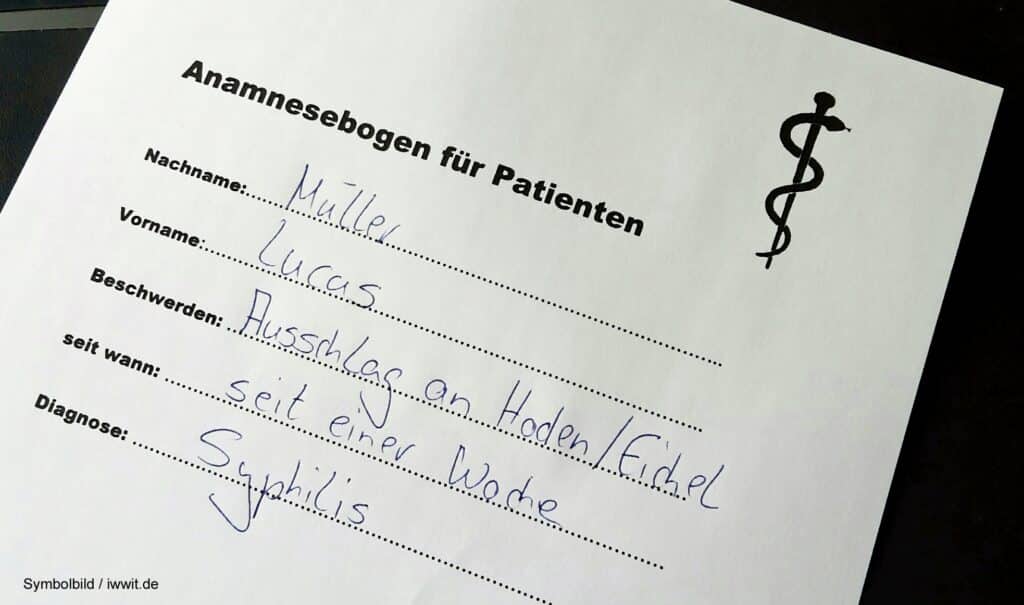
  • "Syphilis can also be contracted through kissing or oral sex." - In conversation with a general practitioner

    "Syphilis can also be contracted through kissing or oral sex." - In conversation with a general practitioner

    The Robert Koch Institute has recorded a continuous increase in syphilis cases in Germany since 2010. More than 80 per cent of these cases can be traced back to sexual contact between men. To what extent are these figures also reflected in everyday medical practice? An interview with the Berlin general practitioner and infectiologist Dr Christoph Schuler

    Dr. Christoph Schuler – Experience report on syphilis in gay men
    „We see new cases of syphilis every week“ – Interview with Dr. Schuler from Berlin

    Syphilis in gay men: a persistent problem in practice

    Christoph Schuler, your patient base also includes a large percentage of gay men. To what extent does syphilis play a role in your everyday practice?
    We certainly have a new case in our practice every week on average, and have had one for several years. The number of cases has not necessarily increased in recent months, but it has remained very constant at a high level over a long period of time.

    From your practical experience, can you identify certain patient groups that are particularly affected?
    We discover a lot of syphilis infections in our HIV patients, if only because they are regularly screened for sexually transmitted infections (STIs).

    How gay men can become infected with syphilis

    This means that new infections are detected automatically and at a very early stage.
    Correct. On the other hand, there are many non-positive patients who come to us because of suspicious symptoms or who have had a routine STI test done on their own initiative.

    Some have also been tested elsewhere, for example at testing facilities in gay counselling centres, and then visited us after being diagnosed. And last but not least, there are also men who have learnt from their sexual partner that they have been diagnosed with syphilis and have therefore had themselves tested.

    Does it also happen that the same patient gets infected again and again?
    This is indeed the case, but with syphilis in particular it is very difficult to distinguish whether it is a new infection or a flare-up of an inadequately treated infection.

    Could the fact that the number of infections is so consistently high or even rising possibly be due to a change in sexual behaviour? Namely that gay men are having more sex without condoms again?
    I don't see a direct connection. Of course, condoms are dispensed with more often because HIV treatment is effective.

    ... and therefore the virus can no longer be transmitted.
    Secondly, safe sex with a condom is not a practice that can completely rule out syphilis infection. You can also become infected through kissing or oral sex.

    In our practical experience, however, there are certainly scenes in which syphilis infections are more likely to occur, for example in men who are sexually active or go to sex parties. If new infections occur here, they are also passed on quickly. This makes it all the more important to inform your sexual partners if you have been diagnosed with an infection so that your partner can be treated.

    Stigmatisation of syphilis among homosexual patients

    Syphilis appears to be more morally burdensome than other sexually transmitted diseases. Is it really easier for patients to go to the doctor for gonorrhoea, for example?
    That is indeed the case. Patients in particular who have never had to deal with an STI before and only have occasional sexual contact feel quite offended and are sometimes a little shocked. This is clearly due to the stigmatising character that syphilis still has. Even if syphilis is treated: a scar remains visible in the blood for life. But the treatment also differs from that of many other STIs: The injections can be quite painful and - depending on how late the infection was discovered - may need to be repeated at weekly intervals. If you have allergies, daily infusions or several weeks of tablets may also be necessary. The treatment of gonorrhoea or chlamydia, on the other hand, is much simpler and less complicated.

    The alt text describes the image content in a factual and accessible manner, including a focus phrase.
    Diagnosis and progression: How syphilis is documented in practice

    Why syphilis is particularly common among gay men

    Unlike with hepatitis A, for example, once you have recovered from syphilis you are not automatically protected from a new infection. How do people deal with it if they catch it more than once?
    Recently, I have seen more and more patients who are very frustrated and say: "I'm not going to do anything anymore". Not only has the number of syphilis cases increased, but gonorrhoea and chlamydia are also more widespread. Some people have obviously lost their desire to have sex, at least when it comes to sex in public places.

    Thank you very much for the interview!

    More about syphilis with transmission, treatment and protection you can find out here in the clip

  • Mr Gay Germany: "Proud to be alive!"

    Mr Gay Germany: "Proud to be alive!"

    For the first time, Max Appenroth, an openly trans* person, was elected Mr Gay Germany. We spoke to Max about the contest, trans* hostility in the gay community and Max's campaign #ProudToBeAlive.

    Trigger warning: This interview is about trans* hostility, mental well-being and suicide, among other things.


    Max, you've had several coming-outs, would you like to tell us about them?

    When I was 13, I came out as a lesbian. It was my first coming out. At the time, it felt wrong for me as a "woman" with men. At some point I realised that I wasn't a woman and had another coming out as trans*. I also more or less came out as a gay person because my identity and my changed appearance gave me access to other spaces such as gay bars and saunas and allowed me to live my sexuality differently. Then two years ago I had a different kind of coming out as a non-binary trans* person. So I feel comfortable in the male spectrum, but I am clearly more than "just" a man.

    What does the term "non-binary people" mean?
    Non-binary people can see themselves as "both male and female" or as "neither male nor female" or reject the dual-gender construct altogether.

    When did you feel most comfortable in your body during this time?

    Now I feel very comfortable in my body. I don't like the narrative that trans* people are born in the wrong body. I was born in the perfect body! There was only one time when I didn't feel comfortable with certain parts of my body and wanted to modify them to feel 100% comfortable in this body. That was ten years ago when I had an operation to have my breasts removed. Since then, my body is just perfect the way it is.

    What does the term "transition" mean?
    Transition describes the (medical, legal, social, physical) process of people who do not identify with the gender assigned to them at birth to express and approximate their gender identity and physical experience.

    What was the route to the operation like?

    Difficult! Finding expert information on the subject of transition is not easy. You have to find out everything for yourself: What do I want? What options do I have? In addition, in Germany it usually takes one to two years from the application to the health insurance company to the operation. And the applications are often rejected. Then you have to appeal and then wait again for processing until you finally get the OK. I wouldn't have been able to stand it any longer, both mentally and physically, because I had my breasts tied off and everything pressed flat. That means your chest is permanently compressed, you can't breathe, you can't really walk upright, you have back pain. So I had my breast operation in the USA. I had to pay a lot myself, but it meant I could avoid a really bad process with the health insurance company and get to my destination faster.

    What does the term "cis men" mean?
    Cis men were assigned the gender "male" at birth and they still identify with it today.

    Does the infrastructure of Germany's queer scene lack prevention messages and organisations for trans* people?

    Absolutely! Even though Germany is generally a great country when it comes to healthcare, this doesn't apply to trans* people because there is far too little knowledge about our bodies and needs. Even in queer initiatives that are committed to healthcare, much more simply needs to be done so that we are seen and can really participate. In other words, not that something is done for us by someone, but that we as a community are allowed to do it for ourselves.

    For example, prevention campaigns: If no trans* people are involved, how do you know how best to address the community? If only gay cis men can be seen on all the posters, but no trans* people, I don't feel addressed. You simply have to look at how you represent the communities and how you work with them in order to really do the best possible work that also reflects the needs of the community. I work primarily in the field of HIV prevention, especially for trans* people, and I can see how much work still needs to be done.

    Gay. Trans*. Part of the scene!
    Our brochure "Gay. Trans*. Part of the scene!" offers gay trans* and cis men, gender-nonconforming and non-binary people who feel part of the gay community all the information they need on respectful behaviour within our diverse scene, gay sex and protection against HIV (safer sex). Brief information on trans* history and important activists as well as links to more information round off the brochure. You can find it at iwwit.de/trans!
    Max smiles into the camera.
    Max wants to focus more on the high suicide rate among queer teenagers and young adults.

    How can your work and the community benefit from your victory as Mr Gay Germany?

    Thanks to the increased visibility I now have, more people follow me on social media or I am invited to various events. This gives me more reach and of course also has an impact on my work because more people are aware of the problems and the difficult situation and are listening.

    What was your motivation to take part in the competition?

    I stumbled across it by chance on social media and realised that it's not just a beauty contest, but that content takes centre stage. Each person has to stand up for a specific issue and launch a campaign for it. I thought that was pretty cool and got to grips with it. As a trans* person, I always get hostility from the gay community, so I also thought that I would like to show people in a contest like this that we trans* people are very much part of the community.

    "Just because they can't imagine having sex with a trans* person doesn't mean that has to apply to everyone in the gay community."

    So you experience discrimination from the gay community?

    The gay community is one of my communities and I feel at home there. But sometimes I hear things like "You have no place here" or "That's not a "real" man, so you can't be in the gay community". Maybe there's a lack of education here: not everyone has to find me attractive or imagine going to bed with me. I don't want to go to bed with everyone either. But just because I personally can't imagine something, or don't like something, doesn't mean that others can't like it. Just because they can't imagine having sex with a trans* person doesn't mean that everyone in the gay community has to.

    "You don't have to be able to understand my identity to accept me."

    What would you say to these people?

    As trans* people, we are not taking anything away from anyone. I don't want to abolish any gender. I just want to be able to live with respect and dignity, just like everyone else. People don't have to be able to understand my identity to accept me. I can't understand a lot of things either. But that doesn't mean it can't exist just because I don't understand it. Nevertheless, this is the best proof that my work for more trans* visibility is still needed, and in fact, comments like this act like petrol in my engine. That's exactly why I'm doing more.

    "For me, comments like that are like petrol in my engine."

    Back to the competition: how did it go?

    Everything went relatively quickly. I applied online at the end of October and had my first telephone interview a week later. Then I had to develop a community campaign in the next three days. I thought about a campaign and presented it. Shortly afterwards, I found out that I was in the semi-finals. Between the semi-final and the final, you have to continue building the campaign to show the jury in the final how you are working on it. The final came exactly six weeks after the first phone call.
    The other competitors were of different ages and backgrounds. Not all of them were totally slim and muscular either, but simply had different body shapes. I thought it was nice to see that it wasn't just about muscle-bound cis men. It was a short, intense time, but when I heard my name in the final, it was an indescribable moment. It was a huge load off my mind.

    What is your campaign about?

    It is called #ProudToBeAlive (proud to be alive) and deals with the high suicide rate among queer teenagers and young adults. Unfortunately, this is a topic that we rarely talk about. I would like to improve this situation in two ways: Firstly, by creating a professional crisis support structure for young LGBTQIA+ in the form of online counselling parallel to telephone counselling, through which help is offered in acute situations.

    And in the long term, I want to increase the visibility of queer people in children's and young adult literature. When queer children and young people see in children's books that there are other people who are just like them - in other words, when they always find themselves - they get the feeling that they are not alone. And that you are okay just the way you are. I believe that if they realise this from an early age, they could lead a completely different life than if they had to cope with it alone. My first trans*-empowering children's book will be published in German and English at the beginning of April, it's called "No matter what changes, the heart remains exactly the same".

    Max, good luck with it and thank you very much for the interview!

    Trans* men, non-binary and gender non-conforming people are part of the gay scene! Find out more about our campaign "Gay. Trans*. Part of the scene!" Click on www.iwwit.de/trans!

    Gay Health Chat
    Are you looking for someone to talk to? Someone who will listen to you and possibly give you advice? Then chat with counsellors from the community at www.gayhealthchat.de!
    Hint
    There are situations that are anything but easy. There is help here:
    - Telephone counselling: 0800-1110111 and 0800-1110222
    - German Depression Relief Foundation

  • Age difference in a relationship: When love knows no age

    Age difference in a relationship: When love knows no age

    The "gay generation" is getting on in years. The over-60s are confidently taking advantage of what the gay scene has to offer - as long as their health plays along. A mood report from Hamburg.

    Age difference relationship: Growing older in the gay scene

    "I'm not going to do that scene to myself when I'm 70," Karl-Heinz realises. He no longer wants to wait in a bar for his prince charming. "You just have to realise that: For the scene is You feel old, even if you have a completely different impression," explains the retired vocational school teacher. "If you look at yourself in the mirror every day, you don't realise how you're ageing."

    Avoiding bars is easy for the single man. He prefers to look for sex outdoors, for example in the city park. "I enjoy the chase," says Karl-Heinz and laughs. "The guys I get there wouldn't look at my arse in a bar."

    New ways of meeting in old age

    Cruising can also be very sociable. Almost 20 years ago, Karl-Heinz met a man almost 20 years his junior while cruising the dunes of Ibiza. They didn't have sex, but when they met again in the beach supermarket, they arranged to meet for dinner. This is how Karl-Heinz met a gay trekking group. Since then, he has hiked with them at least once a year through the low mountain ranges and knows the Harz Mountains almost by heart.

    Karl-Heinz no longer goes to gay bars - but is still well connected with other gays. Together with a fellow volunteer from the gay information shop, he is currently organising Hein & Fiete a "Gay History Tour" through St Pauli. Like Karl-Heinz, many older men are present in the community - they are used to it. "There is a lot of interest in specific counselling and leisure activities for gay and bisexual men over 50," says Heiko Gerlach. Together with Christian Szillat, the qualified nurse surveyed gay men in Hamburg and analysed the answers on behalf of the AIDS-Hilfe Hamburg analysed. "Männerliebende Männer 50 plus in Hamburg" is the name of her study, which she published on Radio Pink Channel have introduced themselves. A special generation, according to the two experts: they were the first to live their homosexuality relatively openly. It is not surprising that they are now openly demanding that their circumstances be taken into account in old age.

    When health determines everyday life

    So as long as the body keeps up, gay life continues happily beyond the age of fifty. Eckhard also used to go to the sauna regularly a few years ago. He still knows what's on offer: Partner discount on Fridays, wellness on Sundays and "40up" on Wednesdays with a discount for over-40s. "She could do a '70up' day for me," says Eckhard and smiles. In recent years, the trained electrician has spent more time in hospital than in the sauna. Following a heart operation, Eckhard moved into a retirement home in St. Georg in 2013, in the "Regenbogen" ward. "That doesn't mean anything," says Eckhard, "I'm the only gay person here for miles around."

    For a long time, Eckhard could not imagine that he would ever need help. He even put his HIV infection behind him. Eckhard was diagnosed in 1990 and persevered until the first combination therapies were available. "Now I've been below the detection limit for over twelve years," he says proudly. "HIV doesn't cause me any problems - they only came as I got older." In the meantime, a few have come together. Eckhard's table in the 20 square metre room is neatly lined up: a wristband for measuring blood pressure, a device for measuring blood sugar, an insulin syringe. There is also an asthma spray and a cardboard box of cough sweets. "This variety of complaints is driving me crazy," says Karl-Heinz. "It's always in the back of my mind: what's next?"

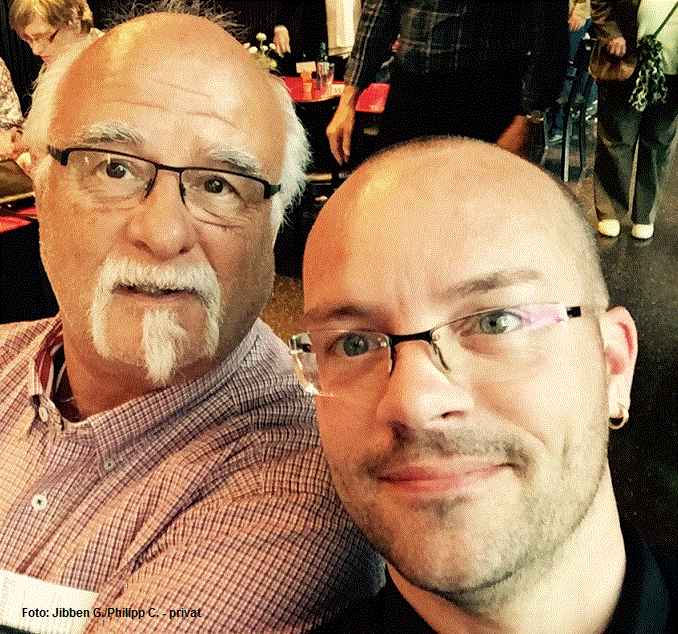
    Gay couple with an age difference: Jibben (68) and Philipp (41) in Hamburg
    Jibben (68) has been together with Philipp (41) for 15 years and they got married in 2006. "Philipp is of course also a reason why I stay fit," says Jibben.

    Age difference relationship: Two generations, one everyday life

    Jibben also sometimes worries "that his bones aren't cooperating as well". But he doesn't let that get him down. His antidote: do a lot. The 68-year-old manages three websites, including the gay and lesbian portal hamburg.gay-web.info. „I hope that's one reason why I'm still fit upstairs,“ says the broad-shouldered man with the white goatee, tapping his head. „Philipp is also a reason, of course,“ adds Jibben gently, „as a young husband, that sometimes keeps you on your toes.“

    Partnership across age boundaries

    Jibben has been together with Philipp (41; seen together in the photo) for 15 years and they got married in 2006. Every year at the Hamburg Pride street festival, the two of them sit in the organisation container, take in lost property and use radios to ensure that every stand has electricity and water. Jibben hasn't had enough of the scene yet. „That's also because I went to a gay bar for the first time when I was 50,“ Jibben surmises. „In hindsight, I wish I'd started earlier,“ says Jibben, „because I definitely missed out on a lot.“

    FAQ: Age difference relationship in the gay community

    Relationships with an age difference raise many questions - especially in the gay community. In this FAQ, we answer key questions about partnership, acceptance, challenges and social perception.

    What does a big age difference mean in a relationship?

    A large age difference in the relationship describes partnerships in which there are several decades between the partners. In the gay community, this constellation is comparatively common and often more socially visible than in heterosexual relationships.

    Are relationships with an age difference stable in the long term?

    Yes, many relationships with an age difference are stable and long-term. It is not the years of life that are decisive, but shared values, mutual respect and similar ideas about living together. The article shows that such partnerships can work for many years.

    Why are age differences more visible in the gay scene?

    For historical reasons, many gay men were only able to live their sexuality openly later. As a result, encounters between generations occur more frequently - for example in the scene, in voluntary work or through shared interests. The age difference in the relationship is often consciously accepted.

    What challenges does a relationship with an age difference entail?

    Different life phases, health issues or social expectations can present challenges. At the same time, many couples report that openness and communication help to constructively bridge these differences.

    Does age still play a big role in the gay community today?

    Age continues to play a role, for example in access to the scene or physical expectations. However, it is becoming increasingly apparent that rigid age limits are becoming less important - especially in relationships where closeness and trust are more important than numbers.

    How is the age difference in the relationship perceived from the outside?

    The perception is different. While some couples are confronted with prejudice, others experience a great deal of acceptance. Social discourse has opened up and relationships with an age difference are now viewed in a more differentiated way than in the past.

    Voices from the community

    Reports, experiences and perspectives on love, ageing, health and cohesion in the community.

    Need someone to talk to?

    Whether acute or simply for orientation - sometimes it helps to talk to someone in confidence.
    Use the Gay Health Chat - the button at the bottom right will accompany you on the page. There you can chat anonymously and free of charge:

    - Personal live advice in the chat
    - Help by e-mail or telephone
    - Information on health, law, everyday life and more