

Tag: Cruising

  • Age difference in a relationship: When love knows no age

    Age difference in a relationship: When love knows no age

    The "gay generation" is getting on in years. The over-60s are confidently taking advantage of what the gay scene has to offer - as long as their health plays along. A mood report from Hamburg.

    Age difference relationship: Growing older in the gay scene

    "I'm not going to do that scene to myself when I'm 70," Karl-Heinz realises. He no longer wants to wait in a bar for his prince charming. "You just have to realise that: For the scene is You feel old, even if you have a completely different impression," explains the retired vocational school teacher. "If you look at yourself in the mirror every day, you don't realise how you're ageing."

    Avoiding bars is easy for the single man. He prefers to look for sex outdoors, for example in the city park. "I enjoy the chase," says Karl-Heinz and laughs. "The guys I get there wouldn't look at my arse in a bar."

    New ways of meeting in old age

    Cruising can also be very sociable. Almost 20 years ago, Karl-Heinz met a man almost 20 years his junior while cruising the dunes of Ibiza. They didn't have sex, but when they met again in the beach supermarket, they arranged to meet for dinner. This is how Karl-Heinz met a gay trekking group. Since then, he has hiked with them at least once a year through the low mountain ranges and knows the Harz Mountains almost by heart.

    Karl-Heinz no longer goes to gay bars - but is still well connected with other gays. Together with a fellow volunteer from the gay information shop, he is currently organising Hein & Fiete a "Gay History Tour" through St Pauli. Like Karl-Heinz, many older men are present in the community - they are used to it. "There is a lot of interest in specific counselling and leisure activities for gay and bisexual men over 50," says Heiko Gerlach. Together with Christian Szillat, the qualified nurse surveyed gay men in Hamburg and analysed the answers on behalf of the AIDS-Hilfe Hamburg analysed. "Männerliebende Männer 50 plus in Hamburg" is the name of her study, which she published on Radio Pink Channel have introduced themselves. A special generation, according to the two experts: they were the first to live their homosexuality relatively openly. It is not surprising that they are now openly demanding that their circumstances be taken into account in old age.

    When health determines everyday life

    So as long as the body keeps up, gay life continues happily beyond the age of fifty. Eckhard also used to go to the sauna regularly a few years ago. He still knows what's on offer: Partner discount on Fridays, wellness on Sundays and "40up" on Wednesdays with a discount for over-40s. "She could do a '70up' day for me," says Eckhard and smiles. In recent years, the trained electrician has spent more time in hospital than in the sauna. Following a heart operation, Eckhard moved into a retirement home in St. Georg in 2013, in the "Regenbogen" ward. "That doesn't mean anything," says Eckhard, "I'm the only gay person here for miles around."

    For a long time, Eckhard could not imagine that he would ever need help. He even put his HIV infection behind him. Eckhard was diagnosed in 1990 and persevered until the first combination therapies were available. "Now I've been below the detection limit for over twelve years," he says proudly. "HIV doesn't cause me any problems - they only came as I got older." In the meantime, a few have come together. Eckhard's table in the 20 square metre room is neatly lined up: a wristband for measuring blood pressure, a device for measuring blood sugar, an insulin syringe. There is also an asthma spray and a cardboard box of cough sweets. "This variety of complaints is driving me crazy," says Karl-Heinz. "It's always in the back of my mind: what's next?"
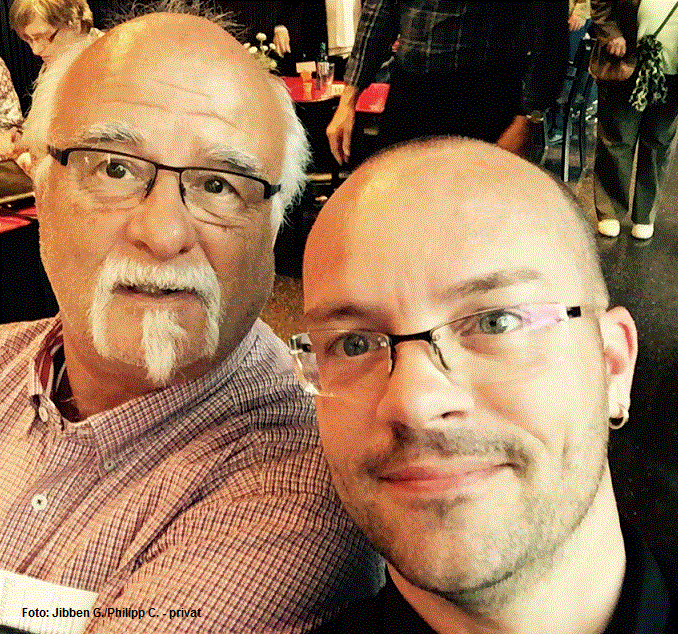
    Gay couple with an age difference: Jibben (68) and Philipp (41) in Hamburg
    Jibben (68) has been together with Philipp (41) for 15 years and they got married in 2006. "Philipp is of course also a reason why I stay fit," says Jibben.

    Age difference relationship: Two generations, one everyday life

    Jibben also sometimes worries "that his bones aren't cooperating as well". But he doesn't let that get him down. His antidote: do a lot. The 68-year-old manages three websites, including the gay and lesbian portal hamburg.gay-web.info. „I hope that's one reason why I'm still fit upstairs,“ says the broad-shouldered man with the white goatee, tapping his head. „Philipp is also a reason, of course,“ adds Jibben gently, „as a young husband, that sometimes keeps you on your toes.“

    Partnership across age boundaries

    Jibben has been together with Philipp (41; seen together in the photo) for 15 years and they got married in 2006. Every year at the Hamburg Pride street festival, the two of them sit in the organisation container, take in lost property and use radios to ensure that every stand has electricity and water. Jibben hasn't had enough of the scene yet. „That's also because I went to a gay bar for the first time when I was 50,“ Jibben surmises. „In hindsight, I wish I'd started earlier,“ says Jibben, „because I definitely missed out on a lot.“

    FAQ: Age difference relationship in the gay community

    Relationships with an age difference raise many questions - especially in the gay community. In this FAQ, we answer key questions about partnership, acceptance, challenges and social perception.

    What does a big age difference mean in a relationship?

    A large age difference in the relationship describes partnerships in which there are several decades between the partners. In the gay community, this constellation is comparatively common and often more socially visible than in heterosexual relationships.

    Are relationships with an age difference stable in the long term?

    Yes, many relationships with an age difference are stable and long-term. It is not the years of life that are decisive, but shared values, mutual respect and similar ideas about living together. The article shows that such partnerships can work for many years.

    Why are age differences more visible in the gay scene?

    For historical reasons, many gay men were only able to live their sexuality openly later. As a result, encounters between generations occur more frequently - for example in the scene, in voluntary work or through shared interests. The age difference in the relationship is often consciously accepted.

    What challenges does a relationship with an age difference entail?

    Different life phases, health issues or social expectations can present challenges. At the same time, many couples report that openness and communication help to constructively bridge these differences.

    Does age still play a big role in the gay community today?

    Age continues to play a role, for example in access to the scene or physical expectations. However, it is becoming increasingly apparent that rigid age limits are becoming less important - especially in relationships where closeness and trust are more important than numbers.

    How is the age difference in the relationship perceived from the outside?

    The perception is different. While some couples are confronted with prejudice, others experience a great deal of acceptance. Social discourse has opened up and relationships with an age difference are now viewed in a more differentiated way than in the past.

    Voices from the community

    Reports, experiences and perspectives on love, ageing, health and cohesion in the community.

    Need someone to talk to?

    Whether acute or simply for orientation - sometimes it helps to talk to someone in confidence.
    Use the Gay Health Chat - the button at the bottom right will accompany you on the page. There you can chat anonymously and free of charge:

    - Personal live advice in the chat
    - Help by e-mail or telephone
    - Information on health, law, everyday life and more

  • Queer life after a year of the pandemic: "We are systemically relevant"

    Queer life after a year of the pandemic: "We are systemically relevant"

    Covid-19 has been shaping our everyday lives for more than a year now and is changing subcultural spaces and safer spaces. What does queer life look like during the pandemic in Germany? An interim assessment.

    Nothing has preoccupied us as much since last year as the coronavirus pandemic and the subsequent restrictions. Whether lockdown light, breakwater lockdown or hard lockdown, it is clear that public facilities have since been considered a health risk, including safe spaces for queer people. The operators of darkrooms, bars and clubs have been virtually banned from working since then, with a brief interruption, and employees are on short-time work or without orders. 

    During the crisis, many aid organisations are also restricting their services or are now only offering counselling sessions online or by telephone. The Specialist centre for queer refugees of the Gay counselling Berlin takes a different approach. Hans Kalben is a social pedagogue and has been team leader of the specialist centre since 2015. "The hurdles for digital appointments are often too high for our target group," says Kalben. Although Kalben now works from home more often, a large proportion of counselling sessions still take place on site: "Many refugees don't have a device or Wi-Fi or simply don't have any privacy in the shared accommodation."

    Many aid organisations are restricting their services during the crisis.

    Before the outbreak of the pandemic, a meeting was held every Tuesday and Friday at Café Kuchus in Berlin-Kreuzberg, for which nobody had to register. Although the advice centre is currently communicating that the meetings are cancelled due to the coronavirus, staff are always unofficially available for counselling sessions: "We have found that many people who need help still come." Since last March, there has been an increased need for counselling sessions, even though fewer people are arriving in Germany than before the outbreak of the crisis. "People who have been living in the country illegally for some time and who are otherwise keeping their heads above water with sex work or other precarious employment have increasingly sought help," says Kalben. Due to the lockdown, an asylum procedure is the last chance for many of these people. 

    Negative asylum decisions and deportations despite corona

    What Kalben and his team have repeatedly found difficult over the past year is communicating the coronavirus protection measures correctly. "Refugees in shared accommodation don't have the opportunity to protect themselves or comply with all coronavirus hygiene measures," he says. The fear of infecting refugees with Covid-19 during counselling sessions is also a burden. To prevent this, the advice centre works with spit protection partitions, aerosol devices, masks and social distancing rules: "It's a daily challenge to provide the best possible advice and avoid health risks." 

    Deportations continue to take place even though the situation in many of the refugees' countries of origin has deteriorated dramatically.

    Despite the lockdown and crisis situation, work is continuing at the authorities and the Federal Office for Migration and Refugees. According to Kalben, refugees are still receiving negative asylum decisions despite the pandemic without the deadlines being adapted to the special situation. Even deportations continue to take place, even though the situation in many of the refugees' countries of origin has deteriorated dramatically. "An asylum procedure is always difficult, but the pandemic makes it even more complicated to meet all deadlines on time," says Kalben.

    Due to the global health emergency, hospitals were repeatedly instructed to postpone scheduled operations. This also affected gender reassignment surgery on trans people, which was not considered medically necessary unless it was for the treatment of complications. Hospitals have been working at their limits for more than a year, which is why rallies and Pride parades are now being organised online instead of on the streets. DJ sets at queer clubs are currently only taking place as live streams. 

    Digital queer life

    The Pornfilmfestival Berlinwhich actually requires close physical contact, only took place in front of a small number of guests last year. "It was sometimes frustrating to work on a festival that can't and shouldn't be the way you want it to be," says curator Paulita Pappel. The few tickets that were available were sold out after a short time. "But that wasn't difficult given the reduced number of cinema seats," says Paulita Pappel. In addition to her work for the festival, she also has the Online platform "Lusterywhich features privately filmed videos of couples. While many porn productions were halted due to the lockdown, the platform turned out to be a pandemic-proof model: "We received more submissions during the crisis and had a larger number of viewers." 

    With the loss of many events, the pandemic has meant that the visibility of queer life in German cities has been severely restricted for more than a year. The inauguration ceremony of a project in Mainz fell victim to the pandemic. The opening of the queer housing project Queer in the quatierwhich opened last February in Mainz's Neustadt district, coincided with the start of the first lockdown in Germany. Joachim Schulte, 67, had been planning the housing project for the past few years and had to organise the inauguration party on Zoom. Shortly before the pandemic, 32 queer people of different ages moved into 21 flats in Mainz. However, the housing project, which was intended as a safe space, only functioned to a very limited extent during the crisis. "We would all have liked to have got to know each other better during the initial phase of the project," says Schulte.

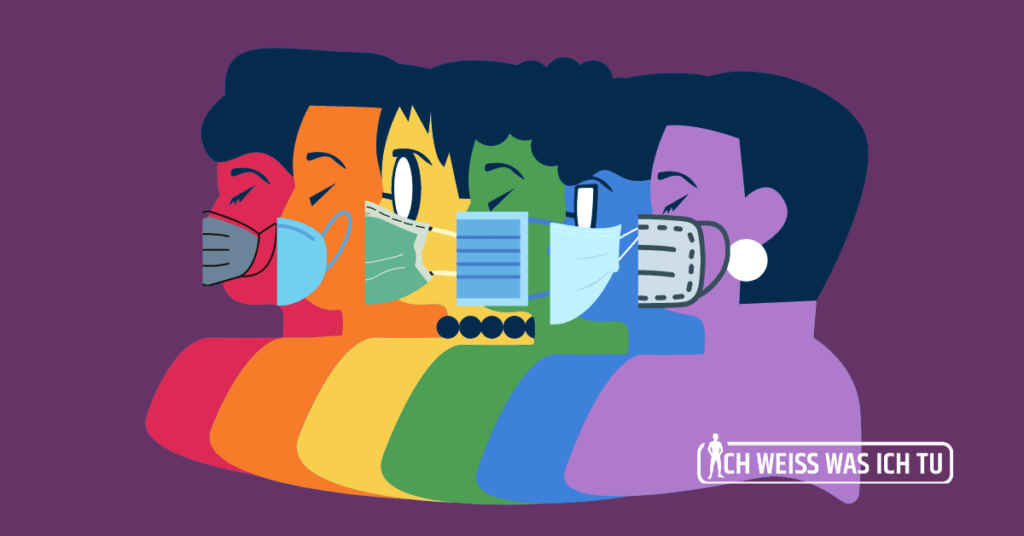
    Graphic of 6 people wearing a corona mask, each person coloured in one of the colours of the rainbow flag.

    Likes and a "Yaas" instead of hugs and kisses

    At the moment, people usually meet at the rubbish bin or when someone comes in from the shops. The centrepiece of the housing project cannot currently be used due to the hygiene measures in place: "The communal flat, which we wanted to use as a meeting place for everyone, is empty." As many residents belong to the risk group, they are particularly careful: "In the summer, we met in the park at a distance, but we couldn't really get to know each other." Apart from the Zoom conferences, the group is planning smaller coronavirus-compliant activities. For example, some residents bake cakes, put them in the communal flat and let everyone know that they can pick up a slice one by one. They want to make up for all the time they missed together after the crisis. "There is great disappointment that we can only enjoy the community to a limited extent."

    In the coronavirus year 2020, there were few opportunities to come together and be visible as a queer community. Drag queen Pansy from Berlin now works at the vaccination centre and takes her drag shows online. Hugs and kisses turned into likes and a "Yaas" in the comment columns. Although small demonstrations such as the Dyke March in Berlin took to the streets, everyone was advised to keep a safe distance and wear face masks whenever possible. Even the second year of the pandemic seems to be dominated by lockdowns, with major events still a long way off. 

    Away from private living spaces

    Since the outbreak of the crisis, there have been few opportunities to meet in queer organisations outside of private homes. Although a lot of economic aid has already been cancelled, many businesses and people who visit them are suffering from the consequences of the crisis after a year of pandemic and permanent lockdown. With brief interruptions last summer, venues with darkrooms have been closed across Germany. Thomas Pfizenmaier, who Fetish and cruising bar New Action in Berlin-Schöneberg and another fetish bar in Hamburg, found another way to generate revenue for his business between lockdowns. Immediately after his bar was allowed to reopen after the first lockdown, Pfizenmaier applied for a licence for outdoor catering. 

    Coffee and cake instead of fetish and sex

    "My partner then got into the kitchen and baked cakes," he says. He didn't want to rely on donations, so in the meantime he served coffee and cake in his pop-up café "Corinna" during the day, although the fetish bar was usually only open at night. An interim solution for the summer, but one that no longer has much to do with fetish, darkrooms or sex. As the coronavirus aid applied for can only be used for operating costs, he has been living off his savings as a bar operator since March: "I've been using up my pension savings for almost a year now." However, he is not yet thinking about giving up, even though the losses are increasing and his landlords do not seem to be accommodating: "In Hamburg, there was even a rent increase during the crisis." 

    "I've been using up my pension savings for almost a year now."

    Pfizenmaier thinks that many gay men are seeking shelter in private during the pandemic. However, unlike in New Action, no names, registration addresses or arrival and departure times are recorded there. "If tens of men meet up at home via online platforms and something happens, this potential infection can neither be controlled nor tracked."

    "We are systemically relevant for the preservation of gay culture, lifestyles and alternative family relationships."

    At least for now, Pfizenmaier assumes that New Action will reopen for its customers after the crisis. "I hope that once the pandemic is over, the gay community will remember who has supported them throughout the year," he says. His bar is not just a catering business, but, like all other queer venues, serves as an important shelter for gay subcultures: "We are essential for the preservation of gay culture, lifestyles and alternative family relationships."

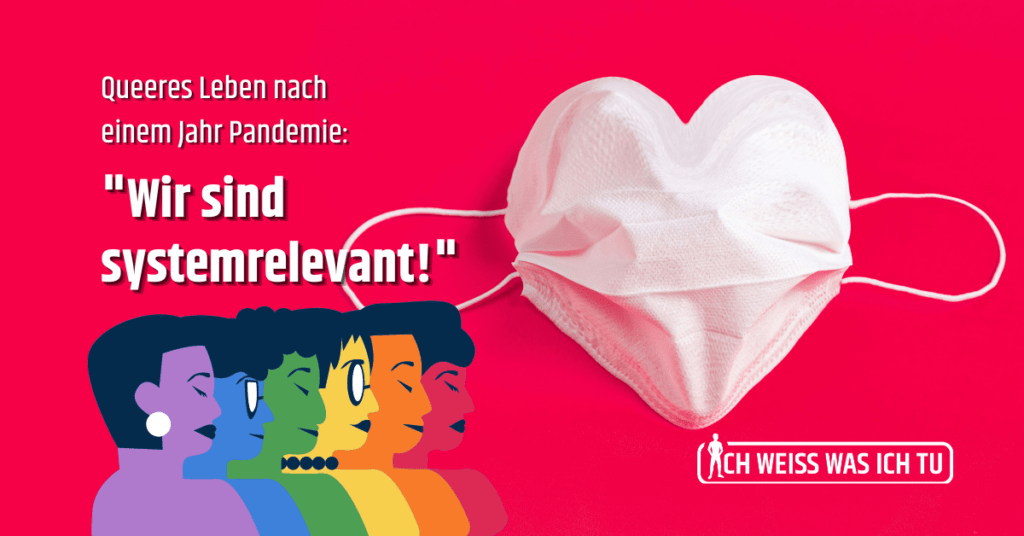
    A disposable heart-shaped mask on a red background. Next to it are 6 people, each depicted in a colour of the rainbow.

    IWWIT is here for you! 

    The queer scene has also been affected by the coronavirus pandemic, whether through possible loneliness in isolation or financial difficulties.

    But we won't leave you hanging! That's why we have launched our #WirFürQueer campaign: You are not alone! We help each other! Together we can make it through these tough times! You can find more information at iwwit.de/we-for-queer.

    On gayhealthchat.com we also offer advice every day between 5 and 8 p.m. - quickly, confidentially and free of charge.