

Tag: Berlin

  • Sex work in Berlin: Out of the shadows

    Sex work in Berlin: Out of the shadows

    What is the idea behind SMART Berlin - Who do you advise and how does counselling usually work? 

    SMART Berlin is a counselling centre and information project for (cis and trans) male, non-binary and trans female sex workers. Our aim is to offer sex workers a wide range of support - whether they are starting out, exiting, reorienting or professionalising. We offer counselling and information on all kinds of topics related to this work: sexual health, rights, laws, dealing with clients and colleagues, resources needed, etc. Sex workers can come to our regular weekly counselling sessions. Or they can contact us via email, phone or social media.

    What is the life situation of the people who come to you? 

    The people who come to us are often at different points in their careers, but all have the desire to somehow make their work more professional, more successful and also less precarious. Some are just starting out, others have been with us for a long time. People often have a specific need, such as an STI test, or are looking for certain resources. Or they are unsure how to deal with a certain law that affects their work. As the lives of sex workers change frequently, many are often only visiting Berlin and we see them again when they are back in the city.

    You can find Smart Berlin at www.smart-berlin.org

    What questions frequently arise?  

    Frequently asked questions concern, for example, sexual health, which we address with information and the opportunity to visit a doctor who works with us. There are also often uncertainties about the so-called Prostitute Protection Actwhich, for example, provides for the compulsory registration of sex workers. Here, too, we try to provide as much information as possible about the risks and rights. Apart from that, of course, everyday working life plays a major role, dealing with customers, advertising your own services, etc. It is not uncommon for people to also have very personal needs to explore how they can deal with other life factors, such as migration or trans identity, in relation to their work.

    Unfortunately, people in sex work live and work in the shadows, sometimes leading downright double lives. This is due to the persistent social stigmatisation, institutional discrimination and legal disadvantages.

    Sex work is certainly less taboo than it used to be - but people still work in an area that is socially little or not recognised at all. How does this affect the escorts you speak to? 

    Unfortunately, people in sex work live and work in the shadows, sometimes leading downright double lives. This is due to the persistent social stigmatisation (e.g. lack of acceptance by family and friends, lack of appreciation of the work and generally widespread prejudices), institutional discrimination (e.g. in the housing and labour market or in banking), as well as legal discrimination (e.g. through the obligation to register or the overlap with migration requirements).

    For many, this naturally leads to insecurities and (existential) fears. Some internalise feelings of shame, while others are very proud of themselves and their work and demand the rights and recognition to which they are entitled. The reactions to these complex problems are therefore very different, but everyone agrees that they deserve better treatment from society, but also from the state and politicians. 

    At this point, we also see a social responsibility: in discussions, terms such as (forced) prostitution, human trafficking and sex work are repeatedly mixed up, which ultimately harms all those affected and does not offer them the necessary support. We should listen to the people affected and avert coercion in the causes, as well as meet the needs of sex workers and support them in their life situations.

    In discussions, terms such as (forced) prostitution, human trafficking and sex work are repeatedly mixed up, which ultimately harms all those affected.

    Now we've had two to three years of the pandemic, how has that changed sex work overall?  

    During the pandemic, the problems that already existed increased significantly. Income went down the drain, homelessness increased. Many had to continue working somehow but wanted to stay healthy at the same time. At times, there was a ban on sex work, which was one of the last COVID measures to be relaxed - at a time when clubs, restaurants and massage parlours had long since reopened. The already difficult situation was exploited to make calls for a ban on sex work more acceptable, and sex workers were sometimes chalked up as a health risk in the old fashioned way. Of course, trust is also lost among those affected when such discriminatory statements are made. We have noticed that the climate against sex workers has become harsher and more aggressive in some cases, both politically and on the street.

    At the same time, the work of counselling centres like ours has of course also been affected by COVID, which is why we have not been able to offer the level of support we would have liked or needed. We have noticed that mental health, social isolation, loss of contact and drug use have become more prevalent issues since the pandemic.

    However, sex workers have an incredible amount of patience and finesse to adapt to changing conditions and find their own way of dealing with them. Access to resources and dialogue with colleagues are crucial criteria for making a difference.

    We are living in difficult economic times, do you think this also affects sex work? Can sex workers still make a living from their work?

    Of course, the difficult economic situation also affects sex workers. Not only is less money being spent on sexual services and therefore less income is available, but the cost of living has also risen and more money is being spent on rent, food, clothing, etc. As in all self-employed professions, it is often unclear how much money you will actually earn. Sometimes there is a good month that allows you to build up reserves, sometimes there is a bad month where you have to rely on your own savings. Planning for the future is therefore much more difficult. Many sex workers therefore often work in other jobs or use their skills for other professions, thus providing a kind of basic security. Nonetheless, many people value sex work as a relatively flexible and independent way of earning an income. The economic circumstances are very different for all sex workers and are individually characterised. There are people who want to escape poverty through sex work and still live and work precariously, and there are also people who offer sexual services very successfully and do so as a full-time job and sole source of income. In both cases, the activity must be understood and respected as work and the focus should be on how people can work and live in a better, safer and more self-determined way. What makes the difference and influences experiences are often intersecting forms of discrimination or privilege: language skills, migration status, gender, different access to resources or communities etc. Unfortunately, all of this also makes a difference to earnings and everyday working life.

    PrEP is a big topic in the scene. How do you deal with it, what advice do you have? Also with regard to sexually transmitted diseases and sexual health in general? 

    Our health counselling naturally also includes the topic of PrEP and we advise the use of PrEP and mediate with organisations to obtain them. At the same time, we also clarify that PrEP only protects against HIV, but not against other, sometimes even more common sexually transmitted diseases. We therefore recommend using condoms at the same time - especially as the use of condoms is also prescribed in the so-called Prostitutes Protection Act. [Editor's note: Condoms protect against HIV transmission. They also reduce the risk of contracting other sexually transmitted diseases. However, they do not offer complete protection against sexually transmitted diseases. That's why regular tests are important. More information at www.iwwit.de/kondome.] Many sex workers are interested in not contracting sexually transmitted diseases, after all, their own body is also a work tool somewhere and there would be no paid sick leave in the event of a breakdown. We therefore encounter interest and initiative in this topic and realise that many sex workers already have at least some basic knowledge on the subject and would like to find out more.

    Caspar is a sex worker. And he is trans*male. Caspar likes his job. For him, sex work is a job like any other, which he sometimes finds great, sometimes shitty. Caspar takes PrEP to protect himself from HIV.

    Sex under the influence of drugs or substances is also a topic that occupies the scene. What advice would you give to people who come to you?  

    Our approach is that of "harm reduction", i.e. the reduction of dangers. We provide information on the safer use of drugs or, if necessary, refer people to medical staff and addiction support centres. In terms of work, we believe that it is best to work sober, also in order to be better able to deal with potentially dangerous situations. However, the demand for chemsex from clients is sometimes high. We therefore also appeal to customers to act fairly and responsibly when booking sexual services.

    Currently, the so-called "Prostitutes Protection Act" is perceived more as harassment, discrimination and (partial) criminalisation than as protection. What is really needed is equal treatment by law and the establishment of actual (labour) rights - with the participation and consultation of sex workers themselves.

    You are not an activist alliance, but nevertheless the question: Have you Demands on politicians, such as the Senate, on what needs to change when it comes to sex work should? What do the escorts want? 

    As a funded advice centre, we are in contact with the Senate and try to contribute our expertise to various working groups. We see ourselves clearly on the side of sex workers and try to improve their situation wherever possible. As sex work is a deeply politicised and regulated professional field, we naturally also have perspectives on politics that are influenced by contact with our clientele. In Berlin, we participated in the "Sex work round table" with the Senate, authorities, operators and sex workers. Very good recommendations for action were developed, but these have not yet been sufficiently implemented. We would like to see these ideas implemented faster and better. At the same time, projects that support sex workers or are even led by sex workers themselves must be further promoted and expanded.

    What we often hear from sex workers is that they would like to see a revision of the current legal situation. At the moment, the so-called "Prostitutes Protection Act" is perceived more as harassment, discrimination and (partial) criminalisation than as protection. What is really needed is equal treatment by law and the establishment of actual (labour) rights - with the participation and consultation of the sex workers themselves. Such a legal text would also be an important prerequisite for countering the ongoing stigmatisation and discrimination of sex workers. On the one hand, we need to provide better education in society, but we also need to enshrine equal treatment and an improvement in living conditions in law. If sex work is currently subject to heaps of special regulations, is portrayed as immoral or a health risk, then it is not surprising that discrimination against sex workers continues and even causes existential problems for institutions, for example if someone cannot apply for a flat because they cannot declare their job or if a bank once again blocks the account of a person in sex work. We therefore hope that our work and the important work of other colleagues will be continued and promoted, that those affected will receive more support, that their needs will be met through legal rights and that the many forms of discrimination and stigmatisation will be countered through education and equal treatment.


    HIV protection in sex work? Trans* man Caspar favours PrEP! Watch the video here: https://www.youtube.com/watch?v=Vxwz_OHgwEU
  • Growing old without being alone - multigenerational homes in Berlin as an alternative

    Growing old without being alone - multigenerational homes in Berlin as an alternative

    Germans are getting older and older, and this particularly affects gay men, who are usually left without a family in old age - and without children to look after them. There are still too few housing projects for homosexual senior citizens in Germany. One ray of hope is the first multi-generation house that opened in Berlin in early summer.

    Almost 30 years have passed since Peter was diagnosed with HIV. The Welshman is now 70 and has seen many friends and acquaintances die of AIDS. Until his stroke just over a year ago, he lived in the St. Georg district of Hamburg. But the lift was too small for the wheelchair and Peter had to look for alternatives. He specifically researched gay housing projects because he didn't want to live in one of the usual retirement homes. But he didn't find anything in Hamburg, not even in London. He only found what he was looking for in Berlin. He now has a room in the "Lebensort Vielfalt" care flat share.

    Multi-generation house Berlin - a housing project with diversity and community

    The Charlottenburg multi-generation house was opened just a few months ago. On a total of five floors, there are 24 flats in various sizes - mostly wheelchair-accessible and equipped with barrier-free bathrooms - as well as a shared flat for people in need of care. Men between 31 and 85 live here. In addition to a garden, common room and a café, Lebensort Vielfalt also has Germany's largest lending library with books, brochures etc. on the subject of LGBTIQ; the gay counselling service - the project's sponsor - is also located in the building.

    Growing old together: Experiences of residents in a place of diversity

    The first ideas for such a housing project were already being considered almost ten years ago - but sometimes it failed due to lack of money, sometimes a housing association offered properties in less attractive areas.

    "Nobody wanted to move there!" says 67-year-old Bernd Gaiser, who, like more than 30 residents of Lebensort Vielfalt, has now found a home in the centre of Charlottenburg. The tenant spokesman explains that the multi-generational house is open to everyone: Homos and heteros, regardless of gender. However, the five women here are clearly in the minority, and there is only one lesbian among them. There were also plans to accommodate a flat share for transgender people in one of the larger flats, but the potential residents fell out before moving in. Even a straight family was once interested in one of the flats - it is not known why this ultimately failed. Perhaps they didn't want to leave their 17-year-old son to a horde of gay men, Bernd and his neighbours Klaus and Jürgen speculate smugly.

    Around half of the residents have HIV. Among them are 48-year-old Klaus and his partner. Klaus appreciates the fact that he has very short distances to travel when he needs to talk to someone or obtain information - the psychosocial counselling service is located in the same building. He and his partner only recently moved from Hesse to Berlin. Although there were once plans for a similar project in Frankfurt, the "PfleGAYheim" never materialised.

    Diversity as a place to live is unique - you have to search for something of comparable size for a very long time. A "model project that is unique in Europe", was how Mayor Wowereit described it at the opening ceremony. It took six years to prepare and one and a half years to build. A total of around six million euros was invested, over half of which came from the Stiftung Deutsche Klassenlotterie Berlin.

    Housing in old age: costs, barriers and queer alternatives in Germany

    Rents here are around the neighbourhood average. Bernd pays 611 euros warm for his 47 square metres. However, he also lives at the top in a nice maisonette flat - the flats on the 3rd and 4th floors are slightly cheaper. His neighbour, 67-year-old Jürgen, enquired at various Berlin institutions before moving in. But monthly fees of up to 1,700 euros put him off - not including any care services. But there is also the other side - not everyone can afford to live in a "place of diversity". Many prospective tenants have been put off because of the rents. So Jürgen got his flat quite quickly - he was originally 76th on the long waiting list.

    There are few successful projects nationwide that are comparable. In Dresden, an attempt was made to establish a gay and lesbian housing project. According to co-initiator Horst Rasche, they had to abandon the idea because they couldn't find enough tenants. "Younger people are hardly interested in a housing project, while older people find it difficult. They are often not out or even still married." Today, only three of the building's 14 residents are homosexual.

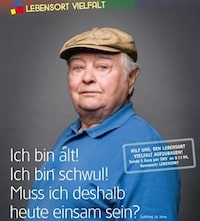
    Elderly man in an advert for the multi-generation house in Berlin
    Diversity as a place to live in Berlin at its opening on 8 June 2012

    In Cologne there is the Villa Anders. The non-profit housing project is aimed at lesbians, gays and transgender people. Singles and couples are welcome, as are rainbow families. The rosaAlternative, or "rosaAlter" for short, was opened in a central location in Munich in 2010. The shared flat has five single rooms of around 17 square metres and two rooms for couples measuring around 32 square metres. The kitchen and bathroom are shared. The project is run by AIDS-Hilfe, which is located in the same building. This is a great advantage for the residents - currently only men with HIV live here. In principle, however, the project is open to anyone who would like to live here, says Manuel Otten, who works as a social pedagogue at AIDS-Hilfe and is responsible for the residents' concerns as a moderator.

    Berlin multi-generation centre as a model project for ageing with dignity

    In addition to the shared flat, the upper floor also offers assisted living. "In advanced stages of the illness, you can simply move within the building," says Otten. "But it also works the other way round. We once had a resident who made such good progress in the flat with long-term care that he was eventually able to move into the shared flat."

    However, the care and nursing services are not the only advantage Otten sees. Homosexuals often don't have it easy in "normal" retirement homes, as he knows from stories told by residents. "Sometimes older gay men end up in a double room with a less tolerant roommate who screens himself off with a curtain so as not to have anything to do with the other person. One gay senior got into trouble with his roommate when he put a picture of his deceased partner next to his bed. But sometimes it's just the situation when an older gay man is sitting at the table with three old ladies at dinner - if the conversation turns to the grandchildren, he can only participate to a very limited extent."

    To avoid such situations, there are housing projects such as "rosaAlter", which enable people to age with dignity; no one should feel marginalised. The Berlin multi-generational house also aims to offer people a home regardless of gender, orientation and age, and the diversity living space is a particular success story: there are currently 230 names on the waiting list, and the list is constantly growing. Perhaps a second house will be purchased at some point.


    Frequently asked questions (FAQ) about growing old and multi-generation homes in Berlin

    In this FAQ section you will find answers to important questions on the subject of Growing old in community, Multigenerational House Berlin, and Supporting offers, contact points, tips and tricks for queer senior citizens and anyone looking for an alternative form of housing in old age.

    What is a multi-generation house and how does it help people grow old?

    A Multigenerational house is a housing project in which people of different ages live together. It promotes Social networks, mutual support and community, whereby the Growing old without loneliness is made easier - especially when family structures are lacking.

    Who can Multigenerational House Berlin live?

    The Multi-generation centre Berlin (diversity as a place to live) is a housing project with flats, communal rooms, a café and counselling services. It is aimed at people who do not want to grow old alone, and is open to different age groups and orientations, with a special focus on queer lifestyles.

    How can I find free places at the Mehrgenerationenhaus Berlin?

    There are currently waiting lists:
    👉 Interested parties can register directly at Diversity in Berlin and be placed on the waiting list. Demand is high, so it is worth enquiring early.

    Are there any other housing projects for gay or queer senior citizens in Germany?

    Yes - in addition to Berlin, there are/were approaches in cities such as:
    Villa Anders (Cologne) - Housing project for lesbians, gays, trans & rainbow families
    rosaAge (Munich) - Form of housing with assisted living

    Tip: Regional LGBTIQ counselling centres often know about local initiatives and housing offers.

    Which state or social contact points help with living in old age?

    Care support centres Berlin - Advice on care & living arrangements
    Queer counselling centres (e.g. gay counselling in Berlin) - Support for LGBTIQ people
    Senior citizens' organisations - Information on housing projects
    Care counselling from the health insurance companies - Information on forms of living & care
    AWO - Counselling centres for senior citizens
    LGBTIQ counselling networks - Support, networking, project information

    How do I apply for care or support at the multi-generation centre?

    The care services are usually provided via the Care insurance requested:
    1 Submit an application to the health insurance fund
    2 Have a care level determined
    3 Attend a counselling session at a care support centre
    4 Combine services (e.g. care, home help)
    Tip: Many housing projects work with External outpatient care together.

    Is there financial support for people with a low pension?

    Yes, possible aids are e.g:
    - Housing benefit
    - Basic security in old age
    - Care allowance / care services
    - Benefits according to SGB XII
    Advice is available from care support centres, social welfare offices and charities.

    How can I find out about queer offers for older people?

    Recommended resources:
    - On-site gay counselling / lesbian counselling
    - LGBTIQ networks online
    - Care support centres
    - LGBT senior forums
    - Housing project networks

    Related articles on the topic of growing old

    Growing old affects us all - but how we organise this stage of our lives makes all the difference. These articles deal with questions about ageing: from forms of housing and care to social participation. Find out how people find ways to spend their twilight years with dignity, actively and in community.

    Need someone to talk to?

    Whether acute or simply for orientation - sometimes it helps to talk to someone in confidence.
    Use the Gay Health Chat - the button at the bottom right will accompany you on the page. There you can chat anonymously and free of charge:

    - Personal live advice in the chat
    - Help by e-mail or telephone
    - Information on health, law, everyday life and more

  • Reference person and confidant

    Reference person and confidant

    Volunteering: reference person and confidant
    © SP-PIC - Fotolia.com

    Theo (name changed) is 42 years old. He has been a volunteer at the Berlin AIDS service organisation Aids-Hilfe for nine years, providing emotional support for people with HIV. A portrait of Moritz Krehl

    In 1998, Theo was diagnosed as HIV-positive - a shock.

    Five years later, he voluntarily resigned from the church and moved to Berlin to find happiness. However, the separation from his former boyfriend, professional turbulence and few social contacts initially lead him into loneliness. Theo had not imagined the start would be so difficult. But instead of resigning himself and sitting at home until he becomes depressed, he joins the Berlin AIDS service organisation, BAH for short, to do voluntary work - a way out of isolation for him.

    BAH has ten to fifteen areas in which voluntary work is possible.

    Theo decides in favour of the "escort". There are three groups there: The volunteers from "Freunde im Krankenhaus" (Friends in Hospital), or FRIKS for short, accompany Aids patients who have to stay in hospital long-term. Those involved in "emotional support in prison" meet regularly with prisoners infected with HIV or suffering from AIDS. Theo works in the third group, "emotional support". Here too, the aim is to accompany people with HIV on their way out of the crisis, to give them back some of their quality of life and to be a carer and confidant.

    The "accompaniment" was launched in the 1980s, during the worst times of the AIDS crisis.

    Even back then, the volunteers accompanied HIV-positive people, but above all AIDS patients - until they died. In those days, it was often end-of-life care; the end of the accompanied path was predetermined from the outset.

    Even today, companions like Theo take HIV-positive and AIDS patients by the hand and give them a sense of security and familiarity. Unlike in the past, however, the end is no longer predetermined, thanks to modern medication. Today, intensive discussions between the counsellor, the person being accompanied and the AIDS service worker, as well as supervision, determine when it makes sense to end the support. In most cases, this is when the crisis has been overcome or when it becomes clear that the counselling cannot achieve the desired goals. The journey together can be short, but it can also extend over many years.

    What has not changed, however, is that AIDS often leads to social marginalisation.

    The disease isolates the patients, they become lonely. Resignation, depression and lethargy are frequent consequences, although Theo is convinced that an HIV diagnosis rarely creates new problems, but rather reinforces psychological predispositions - as can happen in critical life situations.

    To counteract isolation, the counsellors have contact with their clients at least once a week; preferably in person, but sometimes just on the phone. And although Theo, like most of the counsellors, works and has little time, he even spends the whole Saturday with his current client Benjamin (name changed) every fortnight to take him on an outing, go for a coffee or simply talk to him and listen to him.

    The man with Aids is about the same age as Theo himself - and only his second client in nine years. Theo has been accompanying Benjamin for four years now. You can tell that Theo cares about Benjamin's fate, but also that he doesn't care where he comes from or how he got into this situation. Theo doesn't pass judgement, he is concerned with the person and the path that lies ahead of him. "I want to help him experience his life."

    What did Theo gain from his involvement in the Berlin AIDS service organisation, and why is he still involved?

    He sought and found connections, he says. The supervision group gave him support. And he has found friends at BAH, a good network that he no longer wants to do without. The work also offers him "a social alternative to the cerebral desk life" and gives him the feeling that he is doing something good. And last but not least, he learns a lot about himself. In joint supervision sessions, Theo talks to the others about his personal problems and difficult moments during counselling. "I often get feedback that makes me think and helps me to develop personally."