


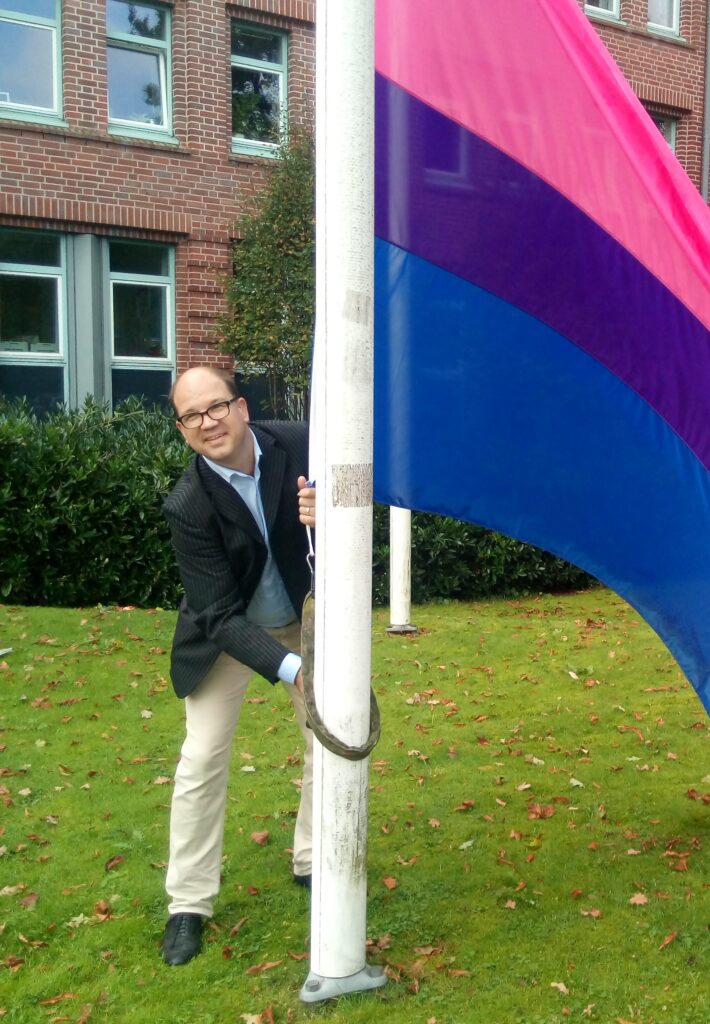
In September, there will be a separate Pride for bi+sexual people in Hamburg for the first time. Co-inventor Frank Thies tells us in an interview why the demo is important - and why he often feels invisible as a bisexual.
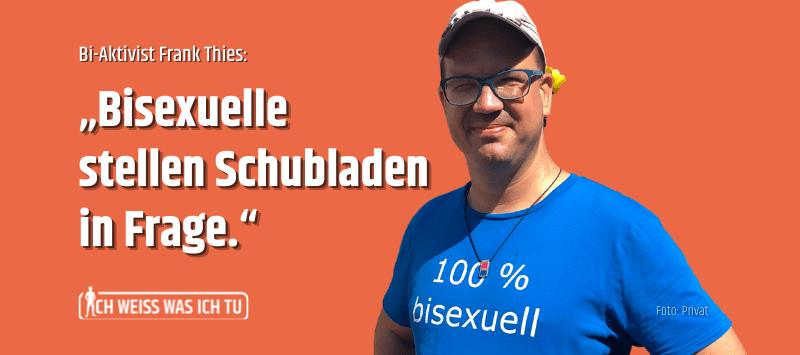
Frank, bisexuals like you should take centre stage at Bi+Pride. Why?
Because bisexuality is often invisible. When you see two men holding hands in the street, you think: "Oh, they're gay." When two women kiss, you think: "Ah, they're lesbians." When you see a man and a woman like that, you don't think anything at first. But maybe: "They're straight, of course!" But all six of the people we saw could be bisexual. You often don't realise that.
Why is that the case?
This is how our society works: we like to pigeonhole people. And if someone loves someone of the same sex, we pigeonhole them as "gay" or "lesbian". That's like straight - just a bit different. Then it fits again. But if someone changes the pigeonholes, it knocks this nice order around your ears, and you don't want that. Bisexuals question pigeonholes!
What do you demand from the Bi+Pride?
Many of our demands coincide with those of the CSDs. For example, we are demonstrating for a reform of the Transsexuals Act and for the lifting of the ban on blood donations for men who have sex with men. One specific demand is for more visibility and for bi- and pansexuality to be taught in schools. Other important points: Bisexuality should be better researched scientifically and projects for bisexuals should be promoted.
What do you want from your allies in the queer community?
It would be great if the "B" in LGBTIQ was always taken into consideration. It often falls by the wayside. For example, on the International Day against Homo-, Bi-, Trans*, Inter* and Asexual Hostility, which was initially called IDAHO, then IDAHOT, and later IDAHOBIT. But then suddenly a term like IDAHIT appears - and the B is dropped again. Many organisations react very constructively when you point this out to them. But this year I've also heard: "We're not going to change that now!"
Maybe homos think you're almost heteros who are less discriminated against...
Yes, I do often hear: "You're not really part of the community. When things get difficult, you'll flee back to the hetero island." There are always such and such. It's not a competition to see who is discriminated against the most, but bisexuals and pansexuals get it from two sides: Rejection from heterosexuals, but also from their own queer community. It is not without reason that statistics show that bisexuals have even more health problems. Many are afraid to come out of the closet.
You yourself are not only out privately, but also as a teacher at your school. How did that come about?
A few years ago, a Year 6 pupil asked me directly on a school trip: "Are you gay?" When I asked her where she got the information from, she replied: "Everyone says that behind your back." In that situation, I said no at first. That was true, but it was only half the truth. After consulting with a few people, I officially came out as bisexual to this class a few weeks later.
How did you put that into words?
"I've heard that people are whispering behind my back. That's not okay. I can fall in love with different genders - but it has nothing to do with you. That's the end of the matter for me."
How did your class deal with the information?
One pupil reacted very harshly. She shouted: "That's disgusting!" and wanted to leave the class. That was good, because it meant I could react directly and show everyone where the boundaries were. I told her that I didn't want to experience anything like that again. The good thing about this scandal was that I've had a better relationship with the pupil than ever before since the clear discussion.
What do you base that on?
Just one example: half a year after I came out, there were vicious insults against me in the grievance box. When I made this public, this pupil came to me with some friends to distance herself. They wanted to tell me of their own accord that they were on my side.
Do your colleagues at the school also stand by you?
I didn't realise it for a long time because I didn't come out to everyone at a conference. I don't know if the news spread like wildfire from my class at the time. As I was eventually married to my wife and had two children with her, I wasn't recognised as queer for a long time. But after I came out in a Contribution for The time when I came out as bisexual, various colleagues told me how great they thought it was that I had taken this step. The school management is also behind me and has promoted me to Diversity Officer.
The #teachout campaign wants to encourage teachers to come out too. You are also involved in this. Why are you doing this?
The more teachers are confidently out, the easier it will be for all those who are still very afraid of coming out. Everyone has to decide for themselves - that's quite clear. But teachers also have a role model function and an educational mission. That's why it's important that they are out. It has also been proven that people who are out - in a safe environment - are healthier and happier because they no longer have to hide.
How did #teachout come about?
It all started with the #actout campaign, in which many actors* came out of the closet. A primary school teacher reacted to this and took to Instagram with the hashtag #teachout came out as gay. Two teachers took up the word. When I read about it, I wrote to them asking whether we should make something bigger out of it. The lesbian teachers Gun and Annika and the asexual, non-binary, bisexual teacher Julia joined us. That's how the four of us became the founding team. The inventor of the hashtag agrees, but no longer wants to be in the front row. A group of over 20 people is now active.
How has the response been so far?
After #actout, the media response was naturally great. Well-known actors and actresses attract the media. NDR, ZDF and Time have reported on us. Of course, it would be great if this could continue in the coming school years. After all, we are only at the beginning.
Back to you: was it good that you came out?
Yes, definitely. A lot has happened at our school since then. We have set up a "Diversity" working group and organise "Respect Weeks". It's not just about LGBTIQ rights, but also against racism and hostility towards women and people with disabilities. On 17 May, I was at the Rainbowflash in front of Hamburg City Hall with students from the Diversity Working Group. The queer education projects soorum and Team Plietsch have offered workshops in several years. The demand is now greater than the supply. And I myself organise workshops and training courses on the topic of LGBTIQ for other teachers.
Impressive. Did you experience school as a queer-hostile place in the past?
Yes, of course. School is a place of crisis for LGBTIQ people because that's where many prejudices first emerge. Fortunately, people find themselves in the upper school and become more tolerant. But in the lower grades, children often bring prejudices into the classroom without thinking about them, for example those of their parents.
Don't the teachers oppose this? For example, in sex education lessons?
Yes, of course. But traditional sex education is mainly about hormones, reproduction and heteronormative lifestyles. And even that goes too far for some well-organised opponents of sex education. They are campaigning against sex education in schools and claim that it sexualises children. What rubbish! It's not about forcing children and young people to do something, on the contrary! It's about informing them, making them self-determined and strong so that they can also say no! Some watch unfiltered hardcore porn on their mobile phones from Year 6 onwards. And the school should keep quiet about this? I see it differently! We need to educate young people in an age-appropriate way. This also includes how they respect boundaries - their own, but also those of others! But there is already good, inclusive education, some of it interdisciplinary.
Finally, a personal question: do you have any sexual experience with men? Or is that just theory? What does your wife say?
My wife fully accepts me for who I am - from the very beginning, because I told her straight away. Trust and honesty are very important to me. Basically, I personally think that you're missing out if you only have experiences with one gender in your entire life. But everyone has to know that for themselves. I myself also like diversity when it comes to sex.
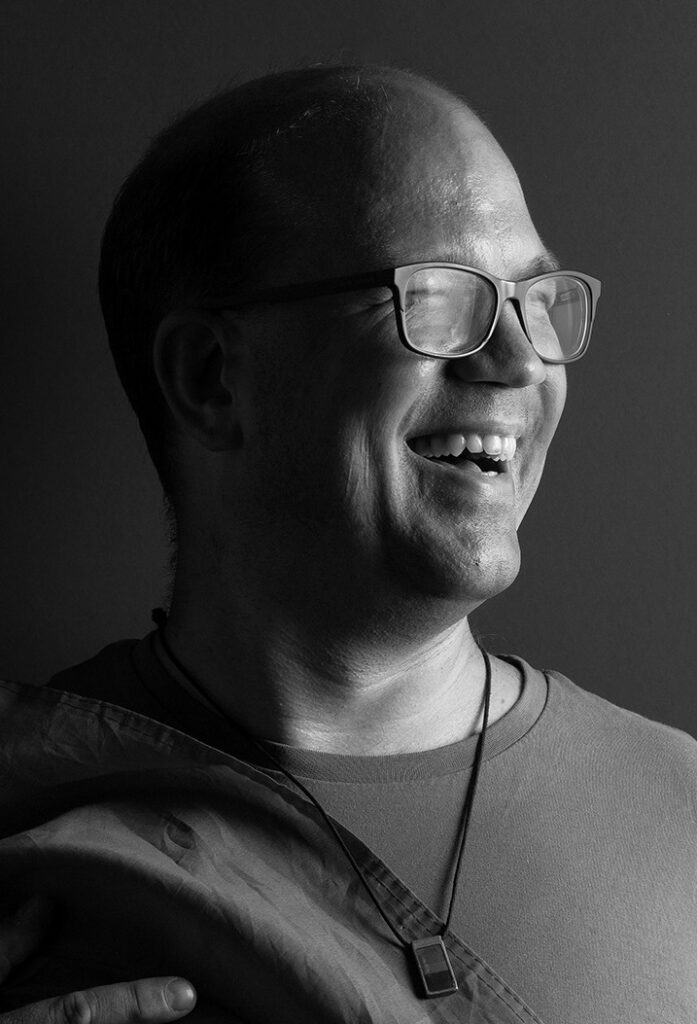
Frank Thies is a bi activist, co-initiator of the #teachout campaign and spokesperson for the first Bi+Pride, which will take place from 23-25 September 2021 - with workshops and a demonstration in Hamburg and bi flag-raising ceremonies throughout Germany. The 46-year-old teaches maths, physics and theatre at a district school in Hamburg. He lives with his wife and two children in the neighbourhood of the Hanseatic city. You can find out more about Frank on his Website.